Fantasy Basketball: Can Kemba Walker sustain his hot start?
Kemba Walker is playing the best ball of his NBA life, and Chris Towers wants to know if it's just a hot start or the beginning of something bigger.

By
Chris Towers
•
4 min read

Note: Sign up for FanDuel and receive a free entry into a one-day Fantasy Basketball league for real money. Finish anywhere in the top half to win cash. Enter now.
The idea of Kemba Walker has always been better than the reality. Walker is an undersized point guard, but he should theoretically have the speed, quickness and ball-handling acumen to get off any shot he wants from any spot on the floor. Often through his first four seasons, he would hit a poor defender with that wicked crossover and leave them in a heap on the court, and it wasn't hard to see him as a young player worth getting excited about.
And then you step back and survey the overall results and there just wasn't much positive to take from his track record. Walker topped 40 percent shooting from the field just once in his first four seasons, and sported a 39.5 percent mark overall that made him more Brandon Jennings than Damian Lillard. Walker struggled to score efficiently from basically every spot on the floor with the exception of the free-throw line, and at 25, it felt like he might never be much more than he had been.
That script has been dramatically flipped in the first month-plus of the 2015-16 season, and we're far enough into the campaign that it is worth looking deeper into Walker's performance to see whether this is just a hot streak or the start of a new phase of his career.


Superficially, Walker doesn't look that different this season. He has increased his scoring average from 17.3 last season to 18.4, while his rebounding and assist numbers are largely unchanged year over year. However, he has become a much more efficient player than ever before, and it all starts at the two most important parts of the floor; at the rim and behind the 3-point line.
Walker shot just 48.7 percent in the restricted area last season, the 11th-worst mark in the league among players who attempted at least 100 such shots. That wasn't an outlier for Walker, who had never topped 55.0 percent at the rim in his first three seasons, and shot just 52.6 percent overall there. Walker's quickness allowed him to get to the rim, but the Hornets lack of spacing made it so that he was throwing his slight frame into a forest of arms everytime he tried to finish there.
The Hornets made the 3-point shot an emphasis this offseason and added long-range threats like Jeremy Lamb, Frank Kaminsky, Spencer Hawes and Nicolas Batum to the roster in an attempt to open the court up for Walker's forays to the rim as well as Al Jefferson's post-ups. To that end, Charlotte has jumped from 24th in 3-point rate (3PA/FGA) last season to 6th so far, and you can see the impact that has had on Charlotte's offense in general and Walker's ability to score near the rim specifically:
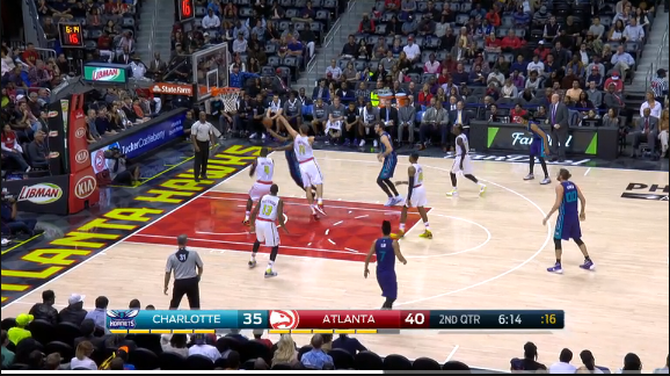
Even though Tiago Splitter is there to contest the shot, you can see how the Hornets' shooting can cause teams trouble. This lineup, featuring Kaminsky and Hawes as floor-spacing bigs, forces the Hawks to make some tough choices. Paul Millsap and Splitter are there, but because they had to travel from the perimeter to get there, they are each a step or two too slow to keep Walker from the rim.
We can attempt to quantify the impact of this spacing using NBA.com's SportsVU tracking data. Walker is shooting 57.5 percent within 10 feet of the rim this season, and only 26.3 percent of his attempts from that range have come with a defender within 2 feet of him; he shot 46.4 percent from that range last season and defenders were within 2 feet of him on 40.2 percent of the attempts. He is getting more clean looks near the rim, and that is unsurprisingly leading to more success.
Walker has also been helped tremendously by the addition of multiple competent ballhandlers, most notably Nicolas Batum. Walker was often left to try and bail out Hornets possessions last season, and 22.2 percent of his attempts came in the final seven seconds of the shot clock; only 16.6 percent are this season. A more effective, flowing offense has left Walker in fewer bad spots, which has had a predictable impact on his efficiency.
Walker's other big jump has come from beyond the arc, where the career 32.2 percent shooter from long range is nailing 3-pointers at a career-best 39.7 percent rate. Here we also see the impact of more spacing; Walker has taken just three 3-pointers all season with a defender within 2 feet of him.
However, in this instance, it's a bit harder to say he will sustain all of his apparent improvements. Walker shot just 33.7 percent on 3-pointers with a defender more than 4 feet away from him last season, a number that has spiked to 41.1 percent in the early going. He also shot just 33.1 percent on catch-and-shoot 3-pointers last season, a number he has improved to 42.5 percent and counting so far. It seems unlikely that Walker has developed into a dead-eye 3-point shooter after years of struggling with that shot, so some regression is certainly to be expected.
Still, getting more clean looks can only help, and Walker is getting those with the Hornets' philosophical and roster changes. Even if his 3-point shooting slows down a bit, Walker might be able to settle in as an average long-range shooter, and with the other improvements he has made, this seems like a great situation for him to post the best season of his career.
There is a lot to like about what the Hornets are doing this season, and Walker has been among the biggest beneficiaries; that should continue.