2017 MLB Draft: Fans of two-way players, Astros among biggest winners from Day 1
Among the biggest winners on day one of the draft was Major League Baseball itself

By
Mike Axisa
•
7 min read

Monday night, the 2017 First-Year Player Draft started with the first 75 picks during a live MLB Network broadcast. The MLB draft will continue with rounds 3-10 on Tuesday and conclude with rounds 11-40 on Wednesday. Here is our first-round pick tracker along with analysis.
Unlike the NFL or NBA drafts, the MLB draft is not about instant gratification. Your favorite team won't draft a player this week and plug him into their big-league roster next month. Teams are getting better at developing prospects and getting them to MLB in a hurry, but the vast majority of them need years in the minors.
So, because of that, it is kind of silly to declare draft winners immediately after the first round. That won't stop us though. Here are the four biggest winners from day one of the 2017 MLB draft.
Major League Baseball
Baseball is a global game nowadays. Players come from all over the world. Just this year the league had its first players from South Africa (Gift Ngoepe) and Lithuania (Dovydas Neverauskas) make their MLB debuts. It's great for the game.
And yet, despite the game's globalization, the number of African-American players is dwindling. Only 7.7 percent of all players on Opening Day rosters this season were African-American. That's down from 8.3 percent last year and way down from the peak of 18.2 percent back in 1981.
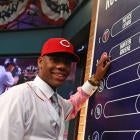
That's why, on Monday, it was not insignificant the first two players chosen in the 2017 draft, high school shortstop/outfielder Royce Lewis (Twins) and high school shortstop/right-hander Hunter Greene (Reds), are African-American. Prep outfielder Jordon Adell, another African-American player, was selected 10th overall (Angels).
MLB is trying desperately to cultivate young fans, and the league has spent tens of millions of dollars to try to grow the game in black communities. Greene is a product of MLB's Urban Youth Academy in California, for example. Here's Jeff Passan of Yahoo! Sports:
Over the last 20 years, MLB concentrated its growth on economics and revenue, on driving a $1.2 billion-a-year business into a $10 billion-a-year behemoth. Rich men got even richer. The unintended consequence was that a population so important to MLB's place in history as a socially vital operation was left wildly underserved. The fact that less than 8 percent of major league players today are black, down from the high of around 20 percent three decades ago, reflects this dereliction of duty.
And, yes, that's what it is. Even if football is the modern champion, MLB takes seriously its designation as the national pastime. A certain responsibility comes with that. The percentages do not need to be proportionate to those of society, but they demand to be more representative, particularly when incredible athletes like Lewis and Greene remind what baseball is capable of producing.
MLB has no shortage of black star players. There's Mookie Betts and Andrew McCutchen, CC Sabathia and Chris Archer, David Price and Adam Jones. The list goes on and on. Hopefully one day we can add Lewis and Greene (and Adell) to that list to give young African-American kids who maybe aren't sure whether they want to play baseball, or football, or basketball someone to look up to.
MLB's diversity problem is real. With any luck, Lewis and Greene going first and second overall in the 2017 draft is an indication things are starting to change for the better.
 Houston Astros
The Astros went into the draft with two extra picks and millions in extra bonus pool space courtesy of the Cardinals, who had to send their second (56th overall) and third (75th overall) selections to Houston as part of the penalties for the hacking scandal. St. Louis was the only team to not make a pick Monday night. Their first pick is in the third round.
So, right off the bat, the 'Stros had extra picks on Monday. And because that wasn't enough, a projected top 10 pick fell into their laps with the 15th overall selection, their first-round pick. UNC righty J.B. Bukauskas was considered a top 10 lock most of the spring and as recently as, well, Monday morning. He fell to the 15th pick for no apparent reason.
The MLB.com crew ranked Bukauskas as the seventh best prospect in the draft class. Here's a snippet of their scouting report:
At his best, Bukauskas can blow away hitters with a pair of double-plus pitches in a mid-90s fastball with sink and a mid-80s slider with tilt. His slider isn't as consistent as his heater, but it's still a plus offering more often than not. Bukauskas made good progress working on his changeup while with Team USA, and it shows signs of becoming at least an average pitch with armside run.
The first place Astros, who have the best record in baseball and one of the most promising young cores in the game, just landed a top 10 talent with the 15th pick. And they had two extra day one picks from the Cardinals. Don't get me wrong, the hacking scandal was bad and the 'Stros suffered serious harm in the process. In the end though, this draft gives them a chance to come out ahead. Way ahead.
 Pittsburgh Pirates
Along with the Astros, the Pirates were one of two teams to have four selections on Day 1 of the draft. In addition to their first- and second-round picks Pittsburgh also held an extra second-round pick (42nd overall) for failing to sign last year's second rounder, and a Competitive Balance Round B pick. MLB gives those to small-market clubs to foster, well, competitive balance.
With those four picks, the Pirates landed three of the top 50-ish prospects in the draft class according to the various scouting publications. Here's the list:
| Round | Pick | Name | MLB.com | Baseball America | ESPN |
|---|---|---|---|---|---|
1 | 12 | RHP Shane Baz (Texas HS) | 12 | 11 | 11 |
2 | 42 | RHP Steven Jennings (Tennessee HS) | 47 | 49 | 22 |
2 | 50 | OF Calvin Mitchell (California HS) | 79 | 74 | 63 |
Comp. B | 72 | OF Conner Uselton (Oklahoma HS) | 46 | 89 | 20 |
MLB.com's rankings indicate the Pirates selected three of the top 47 players in the draft class. Baseball America's rankings are a bit more bearish and say Pittsburgh drafted only two of the top 50 players. ESPN though? Wow, their rankings give the Pirates three of the top 22 available players.
Draft rankings are subjective, obviously, and ultimate who ranks where is meaningless. The bottom line is the Pirates had four picks on Day 1 and used each of them on a high school player with considerable upside. In many cases when a team has extra picks, you'll see them balance it out with a "safer" college player or two. Not the Pirates. They were quite bold on Monday and went hard after high-upside talent. Good for them.
Fans of Two-Way Players
There is a new fad around baseball these season. Teams are trying to turn players into true two-way players, who can both hit and pitch. The Padres are trying it with Christian Bethancourt, who is currently in the minors refining his game after making the Opening Day roster. The Dodgers are trying to do the same thing with Brett Eibner, and the Tigers have Anthony Gose on the mound too.
A pair of two-way players were selected in the top four picks of the draft on Monday. Greene, a shortstop/right-hander who went second overall to the Reds, and Brendan McKay, a first baseman/left-hander who went fourth overall to the Rays. Tampa Bay has already confirmed McKay will be given a chance to both hit and pitch in the minors.
#Rays GM Erik Neander says the club will explore developing McKay as a two-way player. pic.twitter.com/gvW0QIalln
— Tampa Bay Rays (@RaysBaseball) June 13, 2017
The Reds are expected to give Greene an opportunity to do both in the minors as well. Both he and McKay were considered first round talents on both sides of the ball, so we're not taking about a player with a first round arm and a sixth round bat, or something like that. These two can legitimately do both.
Now, the key difference between Greene and McKay and others like Bethancourt and Eibner will be their development. Bethancourt and Eibner were position players all throughout the minors who are now being asked to learn how to pitch. That's tough to do. Greene and McKay will be developed as two-way players. They won't spend, say, the next five years as a position player before being asked to get back up on a mound.
Will the two-way thing work? Who knows. It is a fun idea though. Baseball hasn't had a successful two-way player in a very long time. Brooks Kieschnick did both for a little while in the early-2000s, otherwise you have to go back to players like Willie Smith and Bobby Darwin in the 1960s. There's a reason for that. Being good at one thing -- hitting or pitching -- is difficult. Imagine trying to do both?
With bullpens growing seemingly every year -- we're what, two years away from an eight-man bullpen being standard? -- being able to develop a player who can contribute on both sides of the ball would be a huge advantage. Greene and McKay have a chance to be pioneers in baseball's two-way evolution.