Cubs' Kyle Schwarber: From World Series apparition to epic World Series drama
Schwarber's back in a big way and now the Cubs -- and Indians -- have to figure out what to do with him

By
Jonah Keri
•
6 min read

CLEVELAND -- What do you do with Kyle Schwarber? That's the question that has surrounded the slugger who resembles a fire hydrant for years. It's now one that the Indians and Cubs might both need to answer, if they hope to win this 112th edition of the World Series.
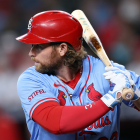
For the Indians, that question means figuring out how to get the guy out. After sitting for more than six months with a torn ACL, Schwarber appeared out of nowhere like a damn Gryffindor, zapping himself from a lightning-quick rehab stint in the Arizona Fall League into the fifth spot in the Cubs order for the team's first World Series appearance in 71 years.
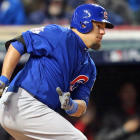
In Game 1, Schwarber looked in peak form, crushing a double off the right-field wall for Chicago's hardest-hit ball of the night, and even drawing a walk off Cleveland's indomitable relief ace Andrew Miller, a rare highlight in a 6-0 Cubs loss. In Game 2, Schwarber fared even better, banging out a pair of RBI singles and reaching base three times en route to a convincing 5-1 victory that tied the series.
For the Cubs, the decision boils down to how to use him. The team's right-field situation is a mess. Manager Joe Maddon has turned $184 million man Jason Heyward into a pinch-runner and late-inning defensive replacement, because Heyward's hitting about as well as Bartolo Colon with five Bartolo Colons on his back. The skipper doesn't seem to trust anyone else to man that position, either. Game 1 starter Chris Coghlan returned to the bench after an 0 for 2. Maddon thought so little of Jorge Soler and rookie Albert Almora Jr. that he chose to stick with 39-year-old No. 3 catcher David Ross against Miller with the bases loaded and the game on the line in Game 1, rather than tap either of his spare outfielders for pinch-hit duty.

Problem is, Schwarber hasn't been medically cleared to play the field. So with the series shifting back to Wrigley and homer-prone right-hander Josh Tomlin taking the hill, a masher who has already shown he can wallop pitches so hard and so far in October that they become part of the ballpark's furniture might be forced to gather splinters from the bench.
Whatever Schwarber's vantage point, he'll get to watch the rest of the Cubs starting rotation try to match Jake Arrieta's Game 2 results. The 2015 Cy Young winner fired 5⅓ innings of no-hit ball at the Indians, more than enough to back the nine times on base, four runs scored, and four runs batted in by the 3-4-5 combination of Anthony Rizzo, Ben Zobrist and Schwarber.
It's been a trying year at times for Arrieta, who saw his ERA balloon by nearly a run-and-a-half this season, thanks to a combination of tough luck and inconsistent fastball command. He has tinkered with his pitch mix, cutting way back on the high-effort slider/cutter hybrid he threw last year in favor of more sinkers -- many of which resulted in costly walks this year. And while you can't complain too much about a series-tying win in which he surrendered a single run on two hits in 5 2/3 innings, Arrieta got away with some mistakes in this game. That included a Jose Ramirez rocket to the warning track in center that ended the first, a stinging Coco Crisp lineout in the second that found Javier Baez's glove, and a Roberto Perez warning-track flyout in the fifth on a pitch that was meant to skirt the outside corner, only to end up middle-in, and eminently crushable.
Most pitchers benefit from both skill and luck when they succeed, of course. And Arrieta's performance spearheaded a much-needed victory that flipped home-field advantage to the Cubs. But if the weather's milder and the Indians' bats are a little sharper, Kyle Hendricks might need to be a bit more precise than Arrieta was Wednesday night, if he hopes to keep the good times rolling in Game 3.
Still, the biggest piece of Game 3 drama will center on the Cubs' ability to score a Hail Mary doctor's note that would clear Schwarber to play left field, shifting Zobrist to right and bolstering the lineup. For Schwarber, it's merely the latest in a long line of questions that others keep asking, even as he continues to mash.
In his junior season at Indiana University, Schwarber batted a ludicrous .358/.464/.659, adopting the take-and-rake approach that powered the career of his favorite player, Reds star Joey Votto. And that was all he could do, looking iffy as a college catcher and even worse in left field, with similarly bad marks for base running. At a time when offense was at a premium in the big leagues, the top college hitter in the 2014 draft was so shaky without a bat in his hand, many teams didn't know what to do with him.
When the Cubs bucked the experts' draft boards by taking him fourth overall anyway, the questions grew louder. Called up a year and six days after signing his first professional contract, Schwarber became an instant folk hero with Cubs fans. In his first major-league start -- against the Indians for a rare interleague series at Progressive Field, no less -- he banged out four hits, pacing a 17-0 demolition of the Tribe. In his second start, he racked up two more hits, including his first big-league home run. And still, no one knew what to do with him: Schwarber made 41 appearances in left, 21 behind the plate, and four in right, and looked bad at each position, playing poorly enough to cost his team a pro-rated 15 runs over a full season.
When Schwarber collided with Dexter Fowler in the second inning of his second game of this season, the prognosis was swift and cruel: torn ACL, see you next year. As the Cubs began steamrolling the rest of the league with their 6-foot, 240-pound man-without-a-position, it became easier to focus on Schwarber's negatives. Sure, the guy could hit. But on an athletic and versatile team that would go on to lead the league in every conceivable advanced defensive metric, what role could Matt Stairs' non-union American equivalent realistically hold down?
As tasty trade assets began popping up in June and July, a few rival teams started asking themselves the same question, wondering if they could pry Schwarber and his accompanying five years of team control free in a deal for a rent-a-vet. When the deadline dust settled, the Cubs got the relief ace they coveted, without having to part with their power-hitting prodigy.
Now, with the eyes of the baseball world fixed on the Cubs, he's right back to working deep counts, and crushing pitchers' mistakes. The third question posed to Arrieta on the postgame podium was about Schwarber's impact on his teammates.
"You can't say enough about him," Arrieta raved about Schwarber. "He's in the training room and the weight room for four, five hours a day. He's in a constant sweat. He's working extremely hard. To even be able to put himself in this position to be on the World Series roster, and to contribute the way he has is remarkable. I've never seen anything like it."
Someday, the Schwarber question might come up again. Maybe the Cubs will tire of his flaws, find a trade partner willing to pay for his bat, thank him for his service, and ship him out of town. That might happen just a few months after one of these two storied franchises ends its long World Series drought ... or maybe a few years.
If that day ever comes, the Schwarbs will probably send a bunch more fastballs into the stratosphere with his new team, even as he makes doubters wonder about the things he can't do. He might also end up being the biggest reason why 24 ex-teammates get to walk around for the rest of their lives wearing Cubs World Series rings.
Nick Pollack of PitcherList.com contributed research for this article.