The NL's struggling stars: Buy, sell or hold on their chances for a turnaround
Let's stake out claims on which struggling NL veterans are likely to turn it around.

By
Dayn Perry
•
6 min read

We're roughly one-fourth of the way through the Major League Baseball season, and certain performances are starting to stabilize. Yes, it's too early to heap praise or condemnation upon individual performances, but we can take note of some surprising struggles around the league. There are slumps and slow-starters, sure, but we're closer to June than April. So it's getting to the point in the season where people might start to wonder about established veterans who have numbers that don't look right.
My colleague Matt Snyder has already taken a look at some AL veterans who are scuttling thus far, and now I'll drop in some National League names. I'll buy, sell or hold their chances to turn it around. That is, if I'm buying, I believe they'll turn it around. A sell means I believe they won't. A hold is a wait-and-see.
Keep in mind we've subjectively picked these names based upon the criteria that these are very common names among casual baseball fans. Also, injured players don't count. Onward ...
Zack Greinke, Diamondbacks
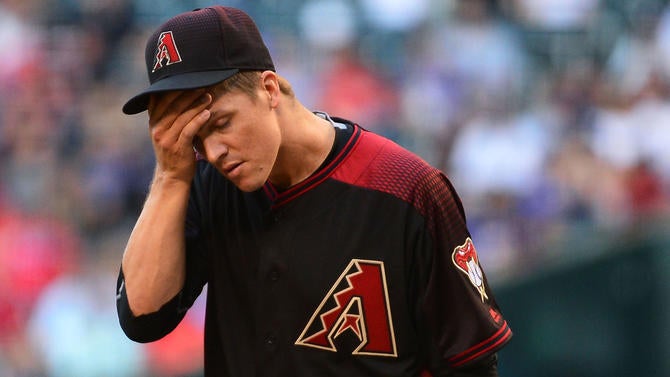
Last season, Greinke worked 222 2/3 innings and pitched to an MLB-best 1.66 ERA. On the strength of that season, the D-backs inked him to a $206.5 million deal. Thus far in 2016, however, the results have been disappointing: a 5.08 ERA after nine starts. The good news for Greinke insofar as the future is concerned is that the three primary indicators of bad luck for pitchers are all awry for him thus far. First, he's running a BABIP (batting average on balls in play) of .345, compared to a career mark of .299. For almost all established pitchers, that figure's going to settle in at .290-.300 range, given a large enough sample. As well, Greinke thus far has stranded just 67.9 percent of base-runners. That figure's likely to rise up to the standard 72 percent at some point (or to his career mark of 74.7 percent), assuming nothing's out of whack with his mechanics from the stretch. Also Greinke's home runs as a percentage of fly balls is also elevated relative to recent norms. That's also likely to correct at some point. In other words, expect better results moving forward.
Buy, sell or hold?: BUY
Matt Harvey, Mets
Harvey's running a 5.77 ERA thus far, and his command indicators are down sharply. In a related matter, Mets manager Terry Collins has wondered aloud whether Harvey will remain in the rotation. Harvey thus far in 2016 is also suffering from decreased velocity, and the team admits he hasn't felt the same since dealing with a blood clot in spring training. On another level, Harvey in his first season back from Tommy John surgery worked 216 innings counting the Mets' deep playoff run in 2015. I don't blame the Mets for that (when you have a shot at the belt and the title, you go for it), but it's possible that post-surgery workload is exacting a toll. Obviously, I still like the 27-year-old right-hander long-term, but I'm concerned about his value for 2016.
Buy, sell or hold?: SELL
Jason Heyward, Cubs
Heyward's still providing his customarily excellent defense and adding value on the bases, but he's been lost at the plate thus far. Through 36 games, Heyward is saddled with an OPS+ of 66 and has only one home run. To his credit, Heyward's long been a slow-starter (career OPS of .705 in April and .745 in May versus an overall mark of .776), and it's entirely possible that the pressures of a new contract and a team desperate for a title are causing him to clinch up. There's more swing-and-miss in his game thus far in 2016, but he's also putting the ball in the air a bit more often (if not squaring it up). The guess here is that eventually the altered approach takes and Heyward begins producing in line with career norms.
Buy, sell or hold?:BUY
Justin Turner, Dodgers
Prior to joining the Dodgers in time for the 2014 season, Turner changed his swing in order to get more power. That he did, as he's batted .314/.384/492 over the last two full seasons. This year, though, he's slipped to .233/.320/.316 with only one homer. Turner's strikeout and walk percentages aren't out of step, but he's been a bit more passive at the plate when it comes to how often he's swinging. As well, he's not pulling the ball as often, and pull power has been pretty important to Turner since his rebirth as a hitter. The good news is that much of Turner's struggles are being driven by a depressed BABIP and a deeply depressed percentage of home runs per fly balls. Absent underlying injury or premature deep decline, those are likely to pick up.
Buy, sell or hold?: BUY
Francisco Liriano, Pirates
Since undergoing a renaissance under Pirates pitching coach Ray Searage, Liriano has been a near-ace for the Buccos. From 2013-15, Liriano registered an ERA+ of 112 for Pittsburgh with 543 strikeouts in 510 innings. This season, though, Liriano has an ERA+ of 86, and in a related matter he leads the NL (in a bad way) with 25 walks in 46 ⅔ innings, in addition to allowing nine homers over that span. His velocity is fine, as is the movement on his pitches, but Liriano is having much more trouble getting hitters to chase stuff out of the zone. He's also allowing a higher contact rate on balls in the strike zone, and his percentage of hard-hit balls is at a career high. So we could be talking about something mechanical, which can be remedied. Still, the inability to locate is troubling.
Buy, sell or hold?: HOLD
Joey Votto, Reds
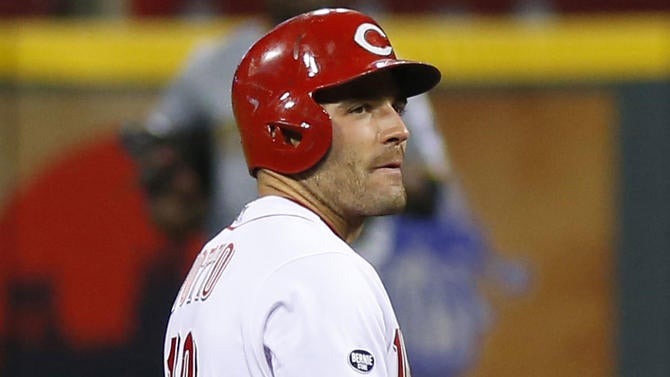
Votto's getting pitched inside more this year, and as a result he's pulling the ball more. That's not his game. As a result, he's batting just .215/.353/.378 in 167 plate appearances this season. Obviously, that's a dismal stretch, especially coming off his MVP-caliber performance last year. This season, he's pulling the ball more than 40 percent of the time for the first time in his career, and on pulled balls he's batting .158 and slugging .237 versus marks of .338 and .562 on pulled balls for his career. Those numbers seem bound to improve. As well, Votto's one of the headiest hitters in baseball, so he knows he need to adjust to the adjustments. Better days ahead, it says here.
Buy, sell or hold?: HOLD
Adam Wainwright, Cardinals
Wainwright's ERA of 5.92 is troubling enough, but he's also putting up the worst strikeout numbers of his career. At age 34, he may be entering into his decline phase. On the upside, he's coming off his strongest start of the season (6 ⅔ scoreless against the Rockies, with five strikeouts against one walk). His depressed rate of stranding runners should improve, but concerning is his steep decline in groundball percentage. That said, let's circle back to that last start for moment. Wainwright dropped his arm slot and got better results on pretty much all his pitches. That's a good thing. However, it's not always easy for small adjustments like that to stick, and it's hard to get past his age and history of arm troubles. The most recent results give some optimism, but some larger realities temper things.
Buy, sell or hold?: HOLD
Ryan Zimmerman, Nationals
Zimmerman's in his thirties, has long been prone to injury, and has been in a fairly steady state of rate-based decline for the last half-decade or so. The baseline was high enough to allow Zimmerman to remain valuable in prior season, but not so in 2016. Thus far, he's batting .235/.312/.390, which isn't adequate production for a first baseman. There's also a number of signs that Zimmerman's bat is in a state of decline: his hard-hit rate is down sharply, as his exit velocity. He's also making less contact on pitches in the zone and out of the zone. Pitchers are noticing, too, as they're confronting Zimmerman with a higher percentage of fastballs and a higher percentage of pitches in the strike zone.
Buy, sell or hold?: SELL
*Research from excellent resources Fangraphs, Brooks Baseball and Baseball Savant