Three reasons why the Mets are struggling to score and what they must do to fix it
The Mets have failed to score more than two runs in seven of their last 15 games

By
Mike Axisa
•
7 min read

Wednesday afternoon at Citi Field, the Mets and White Sox played a marathon 13-inning game that ended with a 2-1 White Sox victory (box score). The go-ahead run was scored by reliever Matt Albers, of all people. He laced an opposite-field double into the gap to start the 13th inning. Check it out:
That is Albers' first hit since 2007, when he was a rookie starting pitcher with the Astros, who were in the NL at the time. Albers moved to third base on a wild pitch and scored what proved to be the winning run on Jose Abreu's sacrifice fly. He also threw two innings to earn the win and closed the door in the bottom of the 13th.
The Mets were held to one run for the third time in their past five games Wednesday afternoon despite drawing 13 walks. It was only the second time since at least 1913 that a team drew 13 walks and scored no more than one run. The Brooklyn Dodgers drew 13 walks and lost 2-1 to the Reds in May 1953. Here's the box score.
New York's offensive struggles have been ongoing for a few weeks now. The team has been held to 43 runs total in its past 15 games -- the Mets have been held to two runs or fewer eight times in those 15 games -- to lower their season average to 3.75 runs per game. That ranks 25th among the 30 teams. Only the rebuilding Braves, Phillies, Padres and Twins have been worse offensive clubs in 2016.
The Mets had similar run-scoring problems last season, as you might remember. They scored 310 runs in the first half of the season, the fewest in all of baseball. Then, thanks to some trades and call-ups and players returning from the DL, the Mets scored 373 runs in the second half, third most in baseball. It was quite a turnaround.
Is such a drastic turnaround in the cards this season? Possibly! Here are three reasons the Mets are struggling to score runs and what they can do about it.
1. Duda, Wright and d'Arnaud are hurt
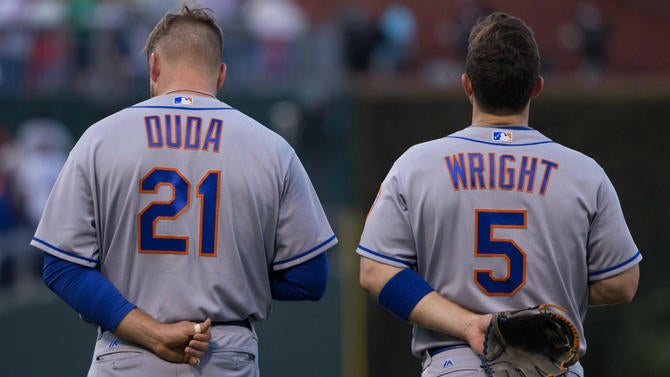
You could easily argue the Mets are without three of their best four hitters right now. Lucas Duda is out long-term with a stress fracture in his back, and while the team picked up James Loney to replace him, that's a big downgrade offensively. Loney is a "he won't kill you but you'd rather not start him everyday" player at this point of his career.
Travis d'Arnaud has been limited to 13 games due to a shoulder issue and is currently rehabbing. He's not particularly close to returning. Young Kevin Plawecki has taken over as the primary starting catcher -- Rene Rivera has getting some more playing time recently because he has impressed with his defense -- and hit only .198/.300/.271 in d'Arnaud's absence.
The Mets have had to navigate David Wright's spinal stenosis all season, which means regular off-days and treatment. Now he's sidelined with a herniated disc in his neck. Wright received a cortisone shot not too long ago to alleviate the pain, and right now the team is in wait-and-see mode. The Mets hope Wright will be back in the lineup soon and avoid the DL.
A year ago Duda led the Mets with 27 home runs and d'Arnaud put up a 129 OPS+ as a catcher. Wright is no longer the hitter he once was, but he has hit .226/.350/.438 (115 OPS+) this season, which is better than what Wilmer Flores, Ty Kelly and Eric Campbell can provide. Remove those three bats from the lineup and it's no secret why the Mets are having a hard time putting runs on the board.
2. Their leadoff man isn't on base enough
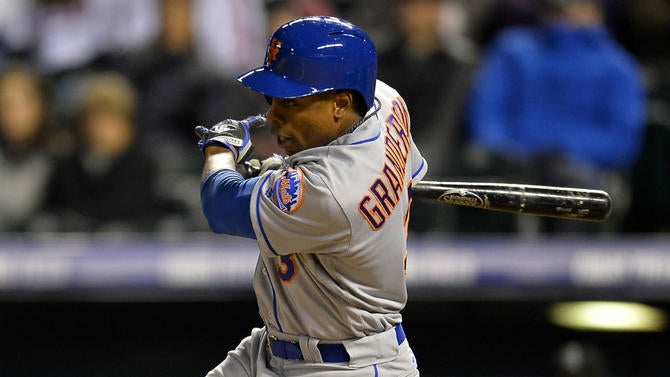
A year ago, Curtis Granderson was one of the most productive leadoff men in the league. No only did he reach base in 36.4 percent of his plate appearances, he was right behind Duda for the team lead with 26 home runs. Having a leadoff man who can do damage like that is a huge weapon. It definitely sets the tone for the rest of the offense.
Granderson went 0 for 5 with a walk Wednesday to drop his overall season batting line to .208/.301/.422 in 219 plate appearances. The power numbers are there -- Granderson has hit nine home runs and is on pace for 28 -- and in fact the walk numbers are there too. He has walked in 10 percent of his plate appearances, which is above the league average even if it's down from last year's 13.3 percent walk rate.
The overall lack of batting average is dragging down Granderson's on-base percentage and short-circuiting the offense. There is some element of bad luck here -- his batting average on balls in play is a mere .237, far below his career .299 mark -- but the fact he has his highest ground-ball rate (40.7 percent) since his partial rookie season in 2005 isn't helping matters.
Even though he fills the leadoff spot, Granderson is a power hitter at heart, and it's tough to hit for power when you don't get the ball in the air. He's pounding the ball into the ground and that is hurting his batting average and on-base ability. Without Granderson's getting on base consistently, the middle of the order doesn't have as much of an opportunity do damage.
3. Conforto is struggling for the first time

Yoenis Cespedes got all of the attention last season, and rightfully so. He was incredible. But he wasn't the only reason the Mets got their offense turned around last year. Top prospect Michael Conforto was called up in late July and hit .270/.335/.506 (131 OPS+) with nine home runs in 56 games. He was a huge boost to the offense.
Conforto started this season very much the same way. He hit .365/.442/.676 (206 OPS+) with four home runs in April and assumed the No. 3 spot in the lineup. It did not carry over to May. Conforto hit .169/.242/.349 (60 OPS+) in May with four home runs. His June did not get off to a good start Wednesday:
First at-bat: Strikeout
Second at-bat: Strikeout
Third at-bat: Strikeout
Fourth at-bat: Strikeout
Fifth at-bat: Ground out to first
Sixth at-bat: Grounded into 5-6-3 double play
That's 0 for 6 with four strikeouts and a double play. Ouch. Conforto's season batting line is down to .252/.328/.485, which certainly isn't awful, but it is largely a product of his April. He has been a drain on the offense the past four weeks or so.
Baseball is very hard and Conforto is struggling for the first time in years. This guy raked all through college and the minors, and in his first few months as a big leaguer as well. The past month as not gone well and it was inevitable that at some point Conforto would struggle. The league adjusted to him and now it's time to adjust back. That's baseball.
I have no reason to think Conforto will not be able to make those adjustments. He's one of the most impressive young hitters in the game in my opinion. That doesn't change the fact that his lack of production over the past month is contributing to the team's offensive woes. Getting Conforto back on track is priority N0. 1 for hitting coach Kevin Long.
So what can the Mets do about their offense?
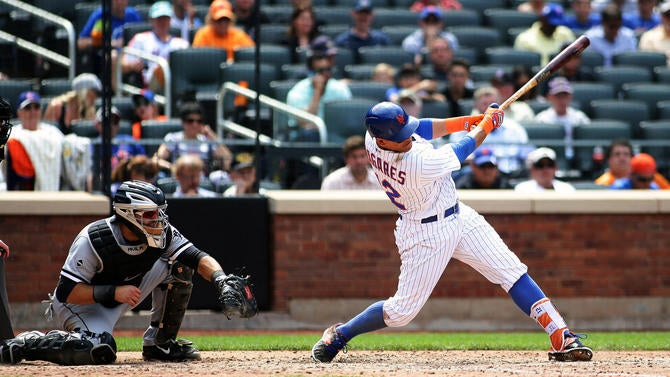
It's very easy to say the Mets made a mistake by letting Daniel Murphy walk. He's having an incredible season with the rival Nationals, hitting .397/.428/.634 (178 OPS+) with 15 doubles and nine homers in 51 games. Every team would love to have that player in their lineup right now.
Second base has not been a problem for the Mets though. Neil Walker is a rock solid ballplayer who went 2 for 4 with two walks Wednesday to raise his season batting line to .283/.345/.522. No, he's not hitting like Murphy, but pretty much no one is. Walker is not part of the problem for the Mets. Griping over Murphy is not going to fix anything anyway.
Here is the best way the Mets can improve their offense: wait. I know no one wants to hear that, but it's the smartest thing to do at this point of the season. Granderson and Conforto won't struggle all year, and it's possible Wright and d'Arnaud will be back in the near future. This same team scored 107 runs in April, remember. That was the seventh most in the league.
Now, if we get to late June and the Mets are still having problems scoring runs, then it's probably time to re-evaluate things. Is Granderson still not hitting? Then drop him in the lineup. Is Wright not healthy? Start looking for a third base option on the trade market. So on and so forth. Even though it's now June 1, it's still a little early to start making drastic changes.
Even after Wednesday's loss, the Mets are 29-23 on the season and 2 1/2 games back in the NL East. They're right in the thick of the hunt and they certainly have the pitching to remain competitive. Remember when I said the Mets have only scored 43 runs in their past 15 games? They've gone 8-7 in those 15 games because the pitching is so good. That rotation buys the Mets time.
GM Sandy Alderson is a veteran executive, and he has been through offensive slumps like this many times in the past. He acted when it got to be too much last year -- once ownership agreed to allow him to take on payroll at the deadline, of course -- and he'll do the same this year. For now, the Mets are merely in an offensive slump for a number of reasons. It's a little too early to start making big changes.