Penguins win Stanley Cup with dominant defensive effort in Game 6
The Penguins defense played its best game of the season to clinch the Stanley Cup on Sunday

By
Adam Gretz
•
5 min read

Pittsburgh Penguins fans had to wait a few days for their championship party.
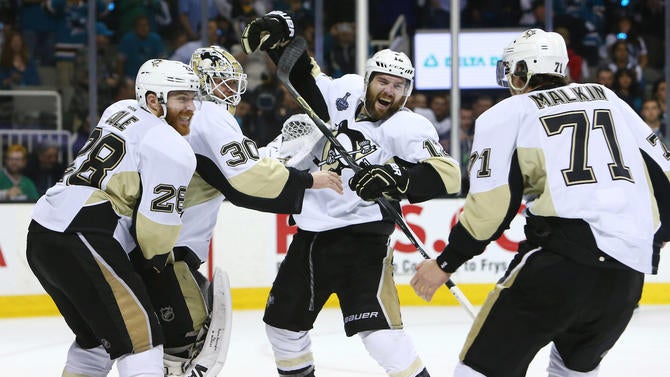
Thanks to their 3-1 victory against the San Jose Sharks in Game 6 on Sunday night, the Pittsburgh Penguins won the fourth Stanley Cup in franchise history, doing it exactly seven years to the day after their previous one.
And like each of their previous three Stanley Cup triumphs, they clinched this one on the road.
Here are six takeaways from their big win on Sunday night.
1. Game 6 was about the Penguins defense. All season, the Penguins defense was a question mark because it isn't exactly full of household names other than Kris Letang. It is not a particularly big group, it is not a physical group and it is not full of players who are known for being crease-clearing, shut-down players. But thanks to their ability to skate, move the puck and get it out of danger, they find a way to make it work. On Sunday night, they played what might have been their best game of the season, limiting the Sharks to 19 shots on goal.
The most stunning number, though, is two.
That is the number of shots the San Jose Sharks, with their season on the line, and with the Stanley Cup on the line for the Penguins, managed to get on net in the third period.
Two. That is a stunning defensive performance, and it came at a point where you would expect the Sharks to pick up the pace and put everything they had on the ice.
For the first 18 minutes, it was only one shot until they got one through with the extra attacker after goalie Martin Jones was pulled.
The Penguins kept the pressure going offensively, managed to get in every shooting lane the Sharks thought they had and blocked shot after shot, and pretty much took control of the game.
2. Kris Letang scored the biggest goal of his life. Letang is one of the best defensemen in the NHL and was magnificent for the Penguins all season and especially in the playoffs. In the clinching Game 6 on Sunday he scored what would go on to be the Cup winning goal when he finished a spectacular shift in the offensive zone that saw him pretty much take over the game.
79 seconds.
— #StanleyCup Final (@NHL) June 13, 2016
That's how long it took the @penguins to nab the lead back. #StanleyCuphttps://t.co/u6TeREy3Sd
3. Martin Jones did everything he could for the Sharks. Jones was by far the Sharks' best player in this series and is the biggest reason the series went six games.
He very nearly singlehandedly pushed it to a seventh game.
The Penguins didn't reach the 35-shot mark on Sunday after averaging that number through the first five games, but a lot of the shots they did get Sunday were fantastic chances that Jones shut down.
This save on Phil Kessel late in the third period to keep it a one-goal game was probably his best of the night.
Battling...#SJSharks#GameOfJones#StanleyCuppic.twitter.com/W2s0KtrChs
— #TurnUpTheTank (@SanJoseSharks) June 13, 2016
4. Chris Kunitz had an up-and-down night. The Penguins' great defensive play on Sunday wasn't limited to their blue liners. In the first period, Chris Kunitz disrupted a breakaway attempt on Joel Ward when he came in from behind and knocked the puck away from Ward with an amazing diving effort.
Chris Kunitz with the backcheck of the series, denying Joel Ward of a breakaway. pic.twitter.com/1QVxPQfCuw
— Cristiano Simonetta (@CMS_74_) June 13, 2016
As far as backchecks go, that is as good as it gets.
But then in the second period, he had a chance to perhaps put the game away when he and Evgeni Malkin went in on a two-on-one rush. Malkin set up Kunitz with a perfect pass to give him a wide-open net to shoot at. The problem is Kunitz never even looked at the net and instead tried to give it back to Malkin.
It did not go as planned.
When I say Kunitz never looked at the net, that is not hyperbole. He literally never looked at the net.
He passed this. 😱😱😱 pic.twitter.com/bn9zV6LXxu
— NHL on NBC (@NHLonNBCSports) June 13, 2016
That left the window open for the Sharks, but thanks to the Penguins defense they were never able to climb through it.
5. Brian Dumoulin doesn't score a lot of goals, but he scored a big one Sunday. In the end, it was the Penguins power play, and not the Sharks, that ended up making a difference in this series, and it came from a pretty unlikely source.
Brian Dumoulin did not score a goal during the regular season and had one in the playoffs until Sunday. But after Dainius Zubrus was penalized in the first period, he found himself on the ice at the start of the power play because all of the regular members of the Penguins' top power play unit were playing on the previous shift and needed a rest.
Dumoulin took advantage of the opportunity.
The first goal of a HUGE Game 6 belongs to the @Penguins#StanleyCuphttps://t.co/Xum9TvOMny
— #StanleyCup Final (@NHL) June 13, 2016
6. Another rookie goalie took Jim Rutherford to a Stanley Cup. Penguins general manager Jim Rutherford has now taken two different teams to a Stanley Cup title: The 2015-16 Penguins and the 2005-06 Carolina Hurricanes. Both times a rookie goalie took him there.
In 2006 it was Cam Ward, after appearing in 28 regular-season games for the Hurricanes, who got hot in the playoffs and posted a .928 save percentage on the way to the Stanley Cup.
This season, it was 22-year-old Matt Murray.
Murray started the season as the starter for the Penguins' AHL team in Wilkes-Barre/Scranton and eventually worked his way up to being the backup at the NHL level. But as the Penguins' regular starter Marc-Andre Fleury was sidelined with his second concussion of the season, Murray had to take over as the Penguins' starter early in the first round.
He ended up winning 15 of the Penguins' 16 postseason victories (tying a rookie record set by Ward, Patrick Roy and Ron Hextall).
In the end, the Penguins used three different goalies this postseason. Jeff Zatkoff started the first two games in the first round against the New York Rangers, while Murray started every other game other than Game 5 of the Eastern Conference finals when Fleury made his lone start of the playoffs.
In a season where the Penguins had to overcome a slow start, a coaching change, some injuries, and completely overhauled their roster in the middle of the season, it seems like a fitting way to go through the playoffs.