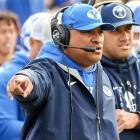
Matt Rhule's views on fixing sexual assault culture make him the perfect fit for Baylor
Rhule's stance on sexual violence is much-needed for a program that's been submerged in controversy

•
5 min read

When Matt Rhule left Temple to become the coach at Baylor, the overwhelming question was whether he would be a good fit. He went to Penn State and doesn't have ties to Texas and its competitive recruiting grounds. The farthest West he'd ever gone as a coach was UCLA when he was an assistant defensive line coach for one season in 2001. In other words, he's an east coast guy.
But to look at it from that perspective is to focus on the wrong things. Those are strictly football observations, and the massive assault scandal in which Baylor finds itself is not strictly a football one. Rape culture is a giant umbrella that goes beyond statistics and a world-wide problem that extends beyond the field.
This is Baylor's world now. It's unavoidable. Rhule, entering his first season, is not afraid to acknowledge that these problems exist. For that reason, he's actually a perfect, and much-needed, fit for a program accused of an numerous acts of violence, missteps and deflections under the university's former administration and coach Art Briles.
Just having a meaningful conversation about sexual assault and general views towards women is where Rhule is starting, as he told ESPN...
"I think one thing I'll say -- and I feel very passionately about this -- is so often football coaches say, 'Of course, I'm against rape. I have two young girls.' To me, it's not just the fact that I have girls in my life is why I don't believe in rape. When you communicate like that with football players or any young people, they begin, in my mind, to differentiate between women they know and love and women who they don't know, and then they don't place any value on them."
Rhule continued ...
"No. 1, we have to educate them about affirmative consent," Rhule said. "With a lot of kids, that's not intuitive to them at first. It's, 'Hey, she didn't say no.' No, we believe in affirmative consent. Did she say yes at every point along the way? Did she verbally say it to you? Did she lovingly say it to you? I think it's really about educating them about consent and about alcohol and drugs and their ability to affect consent."
Rhule's words are good optics in light of everything that's happened, but they're not hollow. He's already dismissed two staff members for inappropriate actions: assistant director of football operations Demarkco Butler, for allegedly sending inappropriate text messages to a teenager, and assistant strength coach Brandon Washington, who was arrested in a prostitution sting. Washington was an assistant under Rhule at Temple.
Defensive back Travon Blanchard also remains suspended after a protective order was issued against him for multiple incidents of alleged violence against a woman he was in a relationship with.
One of the most maddening things about Baylor in the wake of its scandal, which has yielded seven Title IX lawsuits, has been the responses by administrators and coaches. Women's basketball coach Kim Mulkey caught significant, albeit warranted, grief for saying "If somebody [is] around you and they say, 'I will never send my daughter to Baylor,' you knock them right in the face. Because these kids are on this campus. I work here. My daughter went to school here...And it's the damn best school in America."
Mulkey attempted to clarify her remarks by noting "Just tired of hearing it. I'm tired of people talking about it on a national scale."
Encouraging people to knock someone else in the face, literally or otherwise, was obviously tone-deaf, especially considering the allegations the school is facing. Mulkey later apologized for those comments. The broader issue was that Mulkey was "tired of hearing" how a few bad apples slanted the general perception of Baylor, which is an overly simplistic and deflective view of how these problems arise in the first place.
And when former Baylor president Ken Starr tried to explain how and why alleged sexual assaults occurred, it came off as a shallow understanding of the issue. "We're an alcohol-free campus," Starr said in June of 2016. "It's not happening on campus, to the best of my knowledge. They are off-campus parties. Those are venues where those bad things have happened." Never mind that the Chronicle of Higher Education quickly debunked that narrative.
None of this is even counting Briles. So for anyone wondering "What else is Rhule going to say?" Well, those are two example of how difficult it's been for others to so much as acknowledge a problem without an accompanying qualifier.
That's only a small part of the solution, of course. Rhule has to sustain this type of attitude and follow-through for years -- he's on a lengthy deal -- before a change can be considered a success. And there's still so much that Baylor still has to do to make this right. The university's board of regents recently announced the structural completion of the 105 recommendations made by investigator Pepper Hamilton -- but there are still unknowns about how bad things really were.
There's more to all of this than what Baylor has implemented or who has been fired. You don't begin to change without taking an honest look about what happened and where our collective views stand on physical assault and rape. And it's a hard conversation to have in general because it's uncomfortable. So the talking points -- at least relative to Baylor -- are often shifted into football terms because it's easier and more quantifiable. It's even harder to talk about for Baylor, a Baptist institution with a strict moral code.
In a large way, Rhule is taking significant initiative to re-shape how sexual assault is discussed at a place where it needs to be re-shaped. To be sure, it's a change that's bigger than his efforts. However, Rhule is at least willing to have the difficult conversation. That, as much as anything, is what Baylor needs right now. Now, the university has to follow suit.