Standards open College Football Hall of Fame to heroes, rogues
Sometimes it is tough to believe who is already in the College Football Hall of Fame and -- more notably -- who is not.

By
Dennis Dodd
•
5 min read
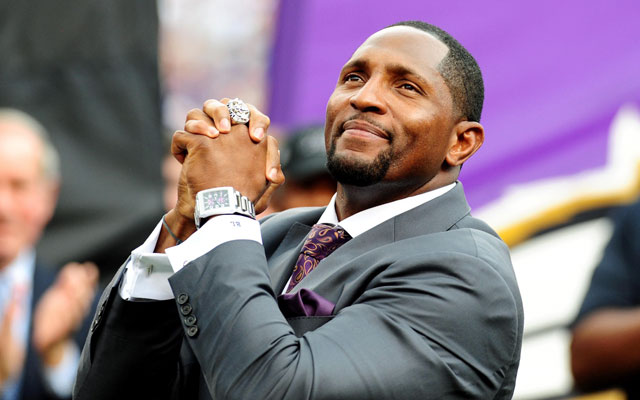
Joe Montana can never be in the College Football Hall of Fame. Neither can Drew Brees. Ray Lewis absolutely can.
Your thoughts?
Here we go again with the hall’s 2016 ballot released this week. Even before Jim Tressel was elected as a hall of fame coach at the same time he was being blackballed by the NCAA, the ballot has never failed to entertain.
The hall is administered by the respected National Football Foundation. But like many halls, it contains its share of heroes and rogues. This hall’s rules dictate that only first-team All-Americans recognized by the NCAA are eligible.
That’s why Montana can never make it. In Notre Dame’s national championship year (1977), Guy Benjamin (Stanford), Doug Williams (Grambling) and Matt Cavanaugh (Pittsburgh) were the consensus All-Americans. In 1978, Montana’s senior year, Penn State’s Chuck Fusina, Michigan’s Rick Leach and Washington State’s Jack Thompson were the picks.
Brees threw for at least 3,600 yards at Purdue from 1998-2000. But he was beaten out in various years for All-American honors by Joe Hamilton, Cade McNown and Josh Heupel.
Their All-American status is also why the likes of Lewis and Kenneth Davis are on the ballot despite, shall we say, issues. Miami’s Lewis -- one of the greatest linebackers of all time -- is in his third year on the ballot. He also once pleaded guilty to obstruction of justice in a 2000 double murder.
If he gets elected, Lewis will be enshrined in the same city as those murders -- Atlanta.
TCU’s Davis was the central figure in a wide-ranging scandal at the school in the mid-1980s. This was in the bad, old days of anything goes in the Southwest Conference. Davis not only was alleged to have taken money from boosters, he admitted it.
Thirty years later, he is on the ballot for the first time.
If you’re looking to the hall as a moral compass, well, don’t. LSU’s Billy Cannon was admitted to the hall in 1983. The honor was rescinded later when he was convicted of counterfeiting. There was a redemptive re-admittance in 2008.
O.J. Simpson remains in the hall despite the fact that he's currently serving more than 30 years for robbery and kidnapping.
Like all halls, there are also politics. Some Nebraska fans believe Tommie Frazier waited way too long to get in.
Less than 1,000 of the five million college football players ever to play the game are in the hall. The process starts with schools nominating players. Those nominees then must make it through one of eight District Screening Committees.
Sometimes exclusion needs an explanation. SMU’s Eric Dickerson played in the same turbulent SWC days as Davis. He finished third in the 1982 Heisman balloting. Of the top five vote getters that year, Dickerson is the only one not in the hall.
He has been on the ballot since 2004.
It still boggles the mind Youngstown State’s president (Tressel) made it this year despite still serving a five-year show cause sentence for misleading the NCAA.
It took an admitted steroid abuser -- grateful for his induction -- to put it all in perspective. Oklahoma’s Brian Bosworth waited through 20 years of eligibility and 10 nominations to finally get in the same class as Tressel in January.
"That's really what the College Football Hall of Fame is looking for," Bosworth said, tears in his eyes. "They want quality character. They want human beings with passion. And they want those truthful human beings ..."
With that said, 76 players were nominated this year. Here are 10 who absolutely should be in:
Morten Anderson, K, Michigan State: Three-time all-Big Ten kicker followed up with a great pro career. Anderson still holds the Big Ten record with a 63-yard field goal.
Derrick Brooks, LB, Florida State: The former NFL Man of the Year also sat on the FSU board of trustees. Brooks was a two-time All-American and national defensive player of the year (FWAA) and the defensive backbone of FSU’s first national championship. Brooks is why halls of fame are built. What more do you need?
Eric Dickerson, RB, SMU: His exclusion to this point is both odd and uncomfortable. How is the NFL’s single-season and SMU’s career rushing leader left out? Dickerson ripped his old program last year, but SMU has remained loyal, nominating him 11 straight years. Is he not in because Dickerson once said he was paid by SMU? Seems rather petty considering some of the folks that are in (see above).
Rocket Ismail, WR/KR, Notre Dame: It wouldn’t be a hall without an Irish player or two. Ismail is one of the all-timers given his electric returning abilities. The 1990 Heisman runner-up was a two-time All-American. We're still wondering why Bill McCartney kicked to The Rocket.
Matt Leinart, QB, USC: In his first year of eligibility, Leinart should be a slam dunk. Before AJ McCarron, he was the last quarterback to win back-to-back national championships. He also earned the 2004 Heisman Trophy and was second all-time in Pac-10/12 pass efficiency.
Dat Nguyen, LB, Texas A&M: A tackling machine who had to be seen live to be appreciated. The only Aggie to lead the team in tackles four straight years. Won both the Bednarik (best defender) and Lombardi (best lineman or linebacker) Awards in 1998. Also the defensive player of the year in the Big 12 that season.
Rashaan Salaam, RB, Colorado: Just about every Heisman winner from 1935-1993 is in the hall. Salaam, the 1994 winner, is not. There’s a reason. This is only the second year Salaam has been nominated by the school. His time will come soon.
Brian Urlacher, LB, New Mexico:Even if you dismiss his all-everything career with the Bears (which you can’t), Urlacher was a collegiate force. In 1999, he led the nation in tackles, was a consensus All-American and was named the player of the year in the Mountain West. He's another first-timer on the ballot.
Mike Utley, OL, Washington State: Gave his body for the game. That should be enough. If Utley doesn’t make it in his first year on the ballot, tear down the hall.
Rod Woodson, DB, Purdue: One of the game’s great secondary players. The Big Ten Network said he was one of the four greatest players in Purdue history along with Bob Griese, Drew Brees and Leroy Keyes. Seventeen years in the NFL.