Fantasy Baseball: Who gains and loses from MLB pandemic proposal to play 2020 season at spring training sites?
Here are players who could be most impacted if the 2020 MLB season begins in spring training sites.

By
Scott White
•
4 min read
We still don't know where or when, much less if, the 2020 season will begin. We just know it'll be unlike any we've ever seen.
There have been a number of proposals focusing on the "where," and it seems like those specifically have captured the imagination of Fantasy Baseballers, leading them to speculate whose value might change in different scenarios.
The scenarios that seem the most plausible would have teams open the season at spring training sites. One would have all teams playing at Cactus League venues in Arizona. One would have teams play at their own Cactus and Grapefruit League venues in Arizona or Florida. One would also incorporate Texas somehow.
The one worthy of analysis right now, I think, is the second of those proposals — the one that would have teams play at their own spring training sites in both Arizona and Florida — for the simple reason that we would know exactly which venue each team would call home. It introduces a crucial element of certainty to an exercise that's mostly guesswork.
Understand, though, it still isn't much to go on. Analysis of these venues is scarce, lacking much of the data we're accustomed to seeing in MLB parks. A little more has been done for the Grapefruit League sites since most of them double as venues for high Class A affiliates (i.e., the Florida State League), but not all of them do.
And frankly, the impact of Grapefruit League venues is easier to deduce just by looking at each one's dimensions. It's the drier-air, higher-elevation environment of the Cactus League that's more difficult to sort out. It's fair to assume hitters all gain and pitchers all suffer in such an environment, but for which teams would it be most pronounced and exactly how pronounced would it be?
Let's look at the more straightforward one first, the Grapefruit League.
(Note: Most proposals have all teams adopting the DH for 2020, and Chris Towers has already highlighted some NL players who would benefit from such a scenario. This article specifically focuses on what impact the venues themselves would have.)
Florida (AKA the Grapefruit League)
Affected Teams:
Braves, Orioles, Red Sox, Tigers, Astros, Marlins, Twins, Mets, Yankees, Phillies, Pirates, Cardinals, Rays, Blue Jays, Nationals
Relative to the way these team's MLB venues play ...
Stock up for pitchers:
- Phillies
- Tigers
- Astros
Stock up for hitters:
- Pirates
- Rays
- Marlins
- Mets
Again, that's relative to the way these teams' MLB venues play and not necessarily relative to the league as a whole.
Interestingly, the Braves, Red Sox and Yankees all designed their spring training venues to have the exact same dimensions as their MLB parks. It doesn't mean they'll play the exact same way — environmental factors will also have a say — but it does allow for a closer approximation.
Of course, not all players are equally impacted by their environment. Ground-ball pitchers, for example, wouldn't be as susceptible to a hitter's park. Here, though, are some of the players who might be impacted the most.
Five players who gain the most:
The Pirates' surroundings would change the most of any Grapefruit League team, and it's possible their one star hitter, Josh Bell, would enjoy the benefits as well. But PNC Park is worse for right-handed bats, as evidenced by Kevin Newman's .269 batting average and .696 OPS there vs. .350 and .910 on the road.
|
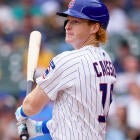
Cavan Biggio is already used to a hitter-friendly environment in Toronto, but TD Ballpark in Dunedin, Fla., is especially inviting for left-handed hitters thanks to a 363-foot fence in right-center (it's 380 feet in left-center). Biggio not only bats left-handed but also has some of the most extreme fly-ball tendencies of any hitter.
|
What little data is available shows Roger Dean Stadium in Jupiter, Fla., to be pitcher-friendly, but not nearly to the extent of Marlins Park. Most notably, its 375-foot fence in right-center is much like the 373-foot fence in right-center at Camden Yards, which is where Jonathan Villar, a switch-hitter, hit 16 of his 24 home runs last year. Maybe the power decline wouldn't be as big in this scenario.
|
Amed Rosario has had a dreadful time hitting at Citi Field during his career, batting .228 with a .621 OPS there vs. .307 with a .792 OPS everywhere else, so any change of scenery would help. And it just so happens that Clover Park in Port St. Lucie, Fla. is among the more hitter-friendly in the Grapefruit League.
|
Joker Marchant Stadium's dimensions aren't too unlike Comerica Park, but the fences take a more direct path to 420 feet in center field, making the gaps less forgiving for hitters. Being a pitcher who's especially susceptible to the long ball, Matthew Boyd's best chance of survival is in a big park like that one.
|







Five players who lose the most:
Rhys Hoskins' home-run production relies more on him putting the ball in the air a ton than hitting it especially hard. It makes him well suited for a smallish venue like Citizens Bank Park, where he has a .908 OPS compared to .806 everywhere else in his career. The fence in left-center is 15 feet further away at Spectrum Field, though, where the Phillies play their spring games.
|
Caleb Smith's 33 home runs were tops in the NL, yet only 10 of them came at home. It shows you the sort of problems his extreme fly-ball tendencies could create in a more neutral environment than Marlins Park, which Roger Dean Stadium certainly is.
|
Minute Maid Park is one of the more abnormal venues in all the sport. FITTEAM Ballpark, where the Astros play their spring games, has a more conventional layout, meaning no more box seats bringing the left field fence so close. It'll take cheap homers away from someone like Yuli Gurriel, who hit 19 of his 31 homers last year at home.
|
If he hadn't been playing at the second-most home run friendly ballpark last year, Victor Robles probably wouldn't have hit even 17 home runs, judging from his weak quality of contact. He hit .266 with an .807 OPS at home vs. .244 and .688 on the road last year, and his spring training home, the same as the Astros, would be a little bigger.
|
Granted, J.T. Realmuto managed to be a top flight Fantasy catcher even during his stint at Marlins Park, but enthusiasm for him has peaked in part because of last year's move to Citizens Bank Park, where he hit 16 of his 25 home runs. A deeper left-center field would hurt him just as it would Hoskins.
|







So how much would these players' values actually change? Not enough to shake up my rankings, I don't suspect. Realmuto's best-case scenario looks worse, yes, but I'd still take his most-likely scenario over most any other catcher's. And that's with him being the fifth-most impacted player, in my estimation.
Overall, I was underwhelmed by the impact that moving to the Grapefruit League would have on these teams. No, the bigger changes would come in the Cactus League ...
Arizona (AKA the Cactus League)
Affected Teams:
Diamondbacks, Cubs, White Sox, Reds, Indians, Rockies, Royals, Angels, Dodgers, Brewers, Athletics, Padres, Giants, Mariners, Rangers
Relative to the way these team's MLB venues play ...
Stock up for pitchers:
- Rockies
Stock up for hitters:
- Every other team
It's not an exaggeration. While I don't have as much data to go on, all available evidence, from spring training output to pre-humidor Chase Field to everything we already know about the way the ball travels in different atmospheric conditions, points to the Cactus League being an extremely hitter-friendly environment. The ball travels differently in the dry desert air, and even though the elevation isn't even quite one-third what Coors Field is, it's still enough to affect the way pitches move, as Dodgers pitchers Ross Stripling recently noted on the Fantasy Baseball Today podcast.
Fittingly, the venues in the Cactus League are all on the larger side, just as Coors Field is. It won't prevent them from being hitter's havens, just as Coors Field is, but it does prevent the home run rates from getting totally out of control. I worry most about the Cactus League teams whose venues are actually smaller than their MLB counterparts, which include the Royals and Padres. The Brewers and Cubs, meanwhile, have venues about the same as their MLB counterparts, which might be just as egregious.
Presumably, none of the Cactus League venues rises to the level of Coors Field in terms of elevating hitting and suppressing pitching, which is why the Rockies pitching staff may well benefit from this change. But by the same token, their hitters might actually lose some value.
They're the exception, though. It's hard to see how any other pitcher would benefit or how any other hitter would suffer from playing in the Cactus League. Still, the ones who'll be impacted most — on both the pitcher end and the hitter end — are the ones who put the ball in the air.
Since the impact would be greater here than in the Cactus League, I'll highlight a few more players.

10 players who gain the most:
The argument that he can't hack it outside of Baltimore falls apart if he's playing in an even more hitter-friendly environment that would reward his fly-ball tendencies rather than punish them.
|
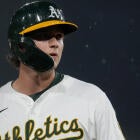
The Athletics have a number of hitters -- Matt Chapman and Khris Davis being a couple -- who would especially benefit from this environment, but none more than Matt Olson, whose home venue has long been his worst enemy. He hit .236 with a .777 OPS there last year compared to .300 with 1.023 on the road.
|
German Marquez is the one Rockies pitcher who would most clearly be a stud if he was pitching his home games anywhere else. He had 3.67 ERA and 0.94 WHIP in 15 road starts last year.
|
Oracle Park is of course the most pitcher-friendly in all of baseball and especially detrimental to left-handed hitters like Mike Yastrzemski. He had a .300 batting average and .929 OPS on the road last year. It's also worth noting that Brandon Belt would finally be unbuckled, though perhaps at an age where it might not matter so much.
|
The Royals might experience the biggest change of any team, going from playing in one of the most pitcher-friendly venues in the majors to one of the most hitter-friendly in an already hitter-friendly environment. Hunter Dozier is poised to enjoy it the most after hitting 18 of his 26 home runs on the road last year.
|
Mike Moustakas has always been one of the game's most extreme fly-ball hitters, which is why he's not much good for batting average even though he strikes out so little. If the home run output improves in this environment, though, so would the batting average. Willie Calhoun profiles similarly, for what it's worth.
|
Will Smith sells out so hard for power, with fly-ball and pull tendencies that put even Moustakas' to shame, that his profile depends on him delivering a big home run total. It would be more likely in the Cactus League.
|
We discovered last year that Detroit was just a terrible environment for Nick Castellanos' swing and were already looking forward to the polar opposite environment of Cincinnati. The Cactus League would be even more beneficial to him.
|
Kris Bryant puts the ball in the air plenty but doesn't hit it as hard as you'd expect for a player of his stature. He wouldn't have to hit it as hard to enjoy a big home run total in this environment, though. It's worth pointing out that Jose Ramirez profiles similarly, but his stock doesn't have as much room to improve.
|
Part of the reason prospect Evan White's arrival has met with a lukewarm response is because his already questionable power profile was being introduced to a power-suppressing venue, but that obviously wouldn't be the case anymore. Kyle Seager and Daniel Vogelbach might similarly benefit.
|












For the hitters here, this only speaks to their relative advantage over other Cactus League hitters. All Cactus League hitters would have an advantage over Grapefruit League hitters.
And the opposite is true for pitchers.
10 players who lose the most:
David Dahl's high-strikeout, low-fly ball profile relies on the BABIP-inflating effects of Coors Field to make him viable in Fantasy Baseball. To whatever extent the Cactus League inflates BABIP, it wouldn't be what he's used to, and it would be enjoyed by hitters on all teams, creating further separation.
|
I was already concerned about a fly-ball pitcher like Madison Bumgarner moving out of a venue where he had a 2.48 ERA and 0.97 WHIP the past two years compared to 5.16 and 1.43 everywhere else. In a Cactus League scenario, every venue he's in could be like his worst nightmare.
|
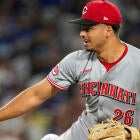
You thought Trevor Bauer's 6.39 ERA in 10 starts after getting traded to the Reds' hitter-friendly park last year was bad? If he can't figure out how to put the ball on the ground more like he did in 2018, his time in the Cactus League could be a disaster.
|
Lucas Giolito is among the more fly ball-prone of the high-end starting pitchers, which helps explain why he had a 4.06 ERA at the White Sox's homer-friendly park last year. Hard to imagine him having a sub-4.00 ERA in a league where every park is even more homer-friendly.
|
The story goes that Andrew Heaney, with his strikeout-to-walk ratio, could blow up in Fantasy Baseball if he could just get the home runs under control. He had a chance pitching at Angel Stadium. In the Cactus League, not so much.
|
Another pitcher who has struggled with the long ball. Pitching in the Cactus League would be even more hazardous to Dylan Bundy than pitching in Baltimore was and would undermine the change-of-scenery argument that accompanied his move to Anaheim.
|
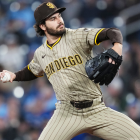
One of the few knocks on Chris Paddack is that his fly-ball tendencies are fairly high for a successful pitcher in today's environment, but with him pitching half his games at a pitcher's haven like Petco Park, where he gave up only seven home runs, it wasn't a huge concern. He gave up more than twice as many homers (16) on the road, though, which hints of his undoing in a more hitter-friendly environment.
|
Trevor Story probably won't see the bottom fall out, but his first-round status depends on him being of some use in batting average, which depends on him having an inflated BABIP at Coors Field. He hit .260 with a .767 OPS on the road last year.
|
The entire Athletics rotation was built for a pitcher-friendly venue, and while Mike Fiers would be the pitcher least suited for something else, he doesn't have as much to lose in Fantasy as Sean Manaea does. Some of the changes that helped Manaea break out last year also made him more vulnerable to fly balls, and back in February and March, he was feeling the effects of the long ball.
|
Charlie Blackmon has been one of the most reliable sources of batting average while playing half his games at Coors Field, but he hasn't been evan a .260 hitter on the road the past two years. He would likely find some middle ground in Arizona, but he'd deserve to go at least a couple rounds later in drafts.
|







And that, my friends, is just the tip of the iceberg.