2022 World Series: How the Phillies can hold off Astros ace Framber Valdez in do-or-die Game 6
The Phillies must find a way to hit Valdez to keep their season alive

•
5 min read
The World Series is off on Friday, the final travel day of the year. The stakes from here are straightforward: the Philadelphia Phillies cannot lose again to the Houston Astros if they want to claim their first championship since 2008. The Phillies, who started this best-of-seven clash by taking a 2-1 advantage, lost two of their three home games to go down 3-2 headed into Houston Saturday. Those losses came in agonizing fashion: an historic no-hitter in Game 4, then a one-run defeat in Game 5. The Phillies, certainly no stranger to arduous journeys, will now have to win back-to-back games in Houston to cap off their surprise run.
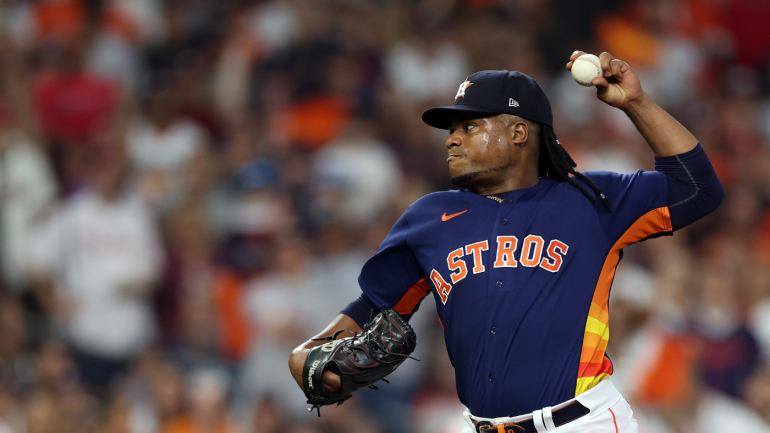
Before the Phillies can worry themselves about a potential Game 7, they'll need to win Game 6. That entails, among other things, finding a way to do damage against Astros left-hander Framber Valdez. For those who may have forgotten, Valdez pitched well in his Game 2 start, surrendering one run on four hits in 6 1/3 innings of work.
With the acknowledgement that anything can happen in a single game, we decided to dig into the numbers to see if there was any reason to think the Phillies would fare better against Valdez a second time around. Here are three things we learned.
Framber Valdez, 97mph 🔥
— Rob Friedman (@PitchingNinja) October 21, 2022
6th K pic.twitter.com/TyZZVHMpv2
1. Hoskins might be the best weapon vs. Valdez
If you read our article before the series began ranking the potential individual matchups, then you know that we like to dabble in granular data from time to time. We concede that it's not a perfect or infallible approach -- again, anything can happen in a single-game setting -- but we find it to be more in line with what front offices look like ahead of games than the traditional methodology of citing overall numbers.
With that in mind, we decided to examine the Phillies' lineup on the basis of how well they hit pitches similar to Valdez's sinker during the regular season. (Valdez threw that sinker close to 50 percent of the time, making it his primary pitch.) When we write "similar," we mean pitches within a few inches either way of his horizontal (14.6 inches) and induced vertical breaks (7.2 inches). For the sake of not getting too nitty gritty, we ignored some other important factors, like release point and velocity (though both are, in theory, baked into the aforementioned movement metrics).
Anyway, you don't care about that; what you care about are the results. Based on our search parameters, the Phillies' best-performing batter against Valdez's caliber of sinker was Kyle Schwarber. But you didn't see Schwarber's name in the subheading because, for all his merits as a hitter, he's always been worse against lefty pitchers.
So, instead, we're highlighting Rhys Hoskins as the Phillies' best bet versus Valdez. During the regular season, he posted a .414 wOBA (a catch-all offensive metric hosted at FanGraphs) against sinkers similar to Valdez. Hoskins' body of work includes eight hits in 30 at-bats, with four of those going for extra bases (two home runs).
What's more is that Hoskins proved he could elevate similar pitches. Whereas the Phillies' average team launch angle against this kind of sinker was just 2 degrees, Hoskins' was 10 degrees. The aforementioned Schwarber was the only member of the Phillies, regardless of the sample size, to have a higher launch angle. You can't take advantage of the Crawford Boxes if you're hitting the ball into the dirt. In that respect, Hoskins does indeed seem like one of the keys to the Phillies getting over on Valdez.
In addition to Schwarber and Hoskins, the only other member of the roster to clear a .350 wOBA against this variety of sinker was Jean Segura. J.T. Realmuto and Brandon Marsh were both above .330. Everyone else, including the subject of our next subheading, was at or below the .310 team average.
Framber Valdez, Nasty 95mph Two Seamer. 🤧 pic.twitter.com/OKMHxDwaOd
— Rob Friedman (@PitchingNinja) August 25, 2022
2. Harper might be non-factor
We're going to continue to state this caveat so that it sinks in: anything can happen in a single game. There's no magic formula or approach to finding a good matchup when, at most, you're talking about two or three plate appearances. Got it? All right.
With that established, we'll note that Valdez appears to be a particularly rough matchup for Bryce Harper. In fact, no Phillies who put at least five of these sinkers into play had a worse wOBA on this kind of pitch than Harper's putrid .175 mark.
To Harper's credit, he often struck the ball hard. His average exit velocity was 91.6 mph, and nearly 60 percent of his batted balls went 95 mph or faster. The problem was the launch angle. His average was -1.3 degrees, better than only Jean Segura (-2.8) and Matt Vierling (-10.9) among Phillies hitters with more than five Valdezian sinkers in play. How prone to hitting the ball into the dirt was Harper? He had more batted balls with a launch angle below -15 degrees (five) than above 10 (four).
Hitting hard grounders isn't inherently a bad thing, but that's where the angle comes into play. Harper isn't usually hitting this kind of sinker at an angle that would result in a groundball single that shoots through the infield; he's hitting it so directly into the ground that he's creating easy fielding chances (and outs) for the opposition.
Maybe Harper can make some adjustments against Valdez. Otherwise, he might have to wait until later in the game for his moment of glory.
Framber Valdez, 97mph ⛽️ pic.twitter.com/d6FeSdjUY1
— Rob Friedman (@PitchingNinja) May 20, 2022
3. No (offensive) reason for lineup change
You might be wondering if there's any reason to be found in this data to make a lineup change or two. Perhaps insert Vierling in place of Marsh, or Sosa in place of Stott, the way they did in Game 2. We'll make it short and sweet: none that we found.
Now, the Phillies have a well-staffed analytics department and they're certain to offer Thomson and crew more in-depth analysis than we can here. It's possible they have their reasons for going back to those changes, if they do indeed run out their Game 2 lineup again. It's also possible that they do so for defensive purposes.
Zack Wheeler will again get the nod, as he did in Game 2. The Phillies just might decide that their best hope against beating Valdez isn't by bludgeoning his sinker, but by keeping the Astros' bats in check, too.