Who are the Los Angeles Lakers? Are they the disorganized mess that traded for Russell Westbrook, or the aggressive win-now contender that emerged after the trade deadline in early February? Are they decrepit former champions clinging to 2020 glory as their stars age out of the NBA's inner circle, or are they a slumbering juggernaut that just hasn't had its two best players on the floor together enough over the past two seasons? Were the Lakers a real threat last year? Are they one this year? And why do they seem so fixated on being one a few years from now?
There aren't easy answers to these questions. We can't cleanly define who the Lakers are because it doesn't seem as though they know who are they yet either. In fairness, they haven't made any sort of commitments yet. Only three Lakers have guaranteed contracts for next season. A few players are likely to be back, but ultimately the Lakers will declare what sort of team they really want to be in the coming days and weeks. Here are the three biggest questions they'll have to answer as they do that.
1. Who is behind Door No. 2?
At every possible turn, the Lakers have made it clear that they want to run it back. "I think keeping that continuity is going to be very important," Lakers general manager Rob Pelinka said during his joint exit interview with coach Darvin Ham. "We feel like we've got a group of special players in the locker room, they enjoy playing with each other, Darvin loves coaching them … so I would say it's a high priority to keep our core players together."
Doing so would be a first in the LeBron James era. He is about to enter his sixth season with the Lakers. They haven't retained more than seven players from the previous season's roster in any of them. There are question marks surrounding several of the players they'd hope to bring back, but most are relatively keepable:
- Malik Beasley ($16.5 million) and Mo Bamba ($10.3 million) both have non-guaranteed contracts. The Lakers will need to decide what to do with them by Wednesday, June 28.
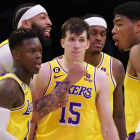
- Rui Hachimura and Austin Reaves will both be restricted free agents. The Lakers can match any offer they receive. Additionally, Reaves will be limited by the Gilbert Arenas provision, which is explained in more depth here. The short version: his salary is limited next season, but on a four-year deal, opposing teams could backload his contract so that he earns as much as the max in the third and fourth season. His salary for next season, however, will likely be the non-taxpayer mid-level amount, which is projected at $12.2 million right now.
- D'Angelo Russell will be a Full Bird free agent. The Lakers can pay anything up to the max in order to retain him.
- Dennis Schroder and Lonnie Walker IV will be Non-Bird free agents. The Lakers can offer them only 20% raises on their prior salaries to keep them without using either cap space or a cap exception. They will be the hardest Laker free agents to keep considering that limitation.
This lays out two relatively straightforward "run it back" paths. The first is the most conservative. Keep Beasley and Bamba, re-sign Reaves, Hachimura and Russell, and then either try to convince Schroder or Walker to stay at less than market-value, or find cheaper replacements. Not very exciting, but, hey, if the Lakers want to keep last year's team in place, this is the way they can do so. This roster likely stretches deep into the luxury tax, but there is no cap mechanism preventing the Lakers from bringing most of these players back.
The slightly more aggressive variant of this approach involves waiving Beasley and Bamba. Doing so, depending on how much Hachimura and Russell demand, could open up the non-taxpayer mid-level and bi-annual exceptions to use on external free agents. This approach would allow the Lakers to keep the most important parts of last year's team in place while adding on the fringes. If they have the non-taxpayer mid-level exception at their disposal, expect them to target wings (Harrison Barnes? Josh Hart? Max Strus? Bruce Brown?) and ball-handlers (Gabe Vincent? Jordan Clarkson? Seth Curry?) as their major offseason expenditure. The downside risk here is that using the non-taxpayer mid-level exception hard caps you at the first apron. Right now, the projected figure there is $171 million. The Lakers can work with that, but they found that hard cap extremely cumbersome in 2021, when they triggered it by signing Montrezl Harrell.
This approach would more or less allow the Lakers to bring back the roster that reached the Western Conference finals. Of course, it would also mean bringing back the roster got swept there by the Nuggets. It's fair to believe, with James getting another year older, that last year's roster simply isn't in the same league as Denver, and that beating them will mean adding a significant player from the outside. And that's what the Lakers can find by looking behind Door No. 2.
Based on current cap projections, the Lakers can get to around $29 million in cap space simply by waiving Bamba and Beasley and renouncing the rights to their own free agents. If they wanted to get really aggressive and move on from Jarred Vanderbilt, that figure jumps to around $32.5 million, but let's use that first number as our barometer. In this scenario, the Lakers would still be able to retain the tiny cap hold of Austin Reaves and re-sign him or match any offer sheet.
Are the Lakers a better team with Russell and depth (the Beasley/Bamba combination, or perhaps those two cap exceptions), or one big splash like, say, Kyrie Irving? How about Khris Middleton or Fred VanVleet? Could they make that big splash while retaining Rui Hachimura? Possibly, though it would require a bit of sacrifice on his part: take a one-year deal at the cap room mid-level exception ($7.6 million) and then re-sign for fair market value in a year. These types of agreements are relatively common. Bobby Portis stayed in Milwaukee under a somewhat similar arrangement.
If the Lakers wanted to pay Hachimura a bit more and still go for a big-name veteran, they could simply pay him with cap space and use the rest on an external target. How does Hachimura at $12 million, Brook Lopez at $18 million and a new point guard at the $7.6 million cap room mid-level exception sound? The Lakers probably can't create enough room with this plan to bring Kyle Kuzma back, and his overlap with Hachimura probably prevents a reunion anyway, but that's another name that would probably interest them.
If you really want to get in the weeds, there are sign-and-trade scenarios available for any of these big names if the Lakers are willing to put their 2029 first-round pick on the table and deal with that dreaded hard cap, but the fundamental question at play is the same regardless: do the Lakers want to bring back last year's team, or do they want to try to improve upon it?
2. In for a penny, out for the pound?
This question relates to the first, and comes down to what this front office prioritizes. The Lakers got credit for remaking their roster at the trade deadline, but they didn't exactly go all-in to do it. They traded a single first-round pick, their 2027 selection, and protected it in such a way that it will not roll into future years if it does not convey. The players they added were all relatively young. They (correctly) made Austin Reaves untouchable in trade talks, but also held on to longer-term projects like Max Christie, and the 2023 draft came and went without a major trade. Now the Lakers have another young guard to develop in Jalen Hood-Schifino.
Having developmental projects is rarely a bad thing, but ask the Warriors what happens when you get too attached to the idea of multiple timelines. The Lakers have James and Anthony Davis right now. They have a championship window that might not reopen for quite some time, and as much promise as Reaves, Hachimura and Hood-Schifino might have, the Lakers have to know that they aren't leading the purple and gold to a title after LeBron is gone. Last year's team was at least one player short. Could trading the 2029 first-rounder at the deadline for one last piece have changed that? That's unknowable.
But between now and the 2024 deadline, the Lakers will have more opportunities to add immediate talent at the expense of their future. Their best hope at another ring likely means sacrificing the future. The front office has not yet shown much willingness to do that. It's probably the most important question facing the Lakers right now. They probably have the chips to build a championship team, but they have to decide if they have the stomach to use them.
3. Breaking the bank for the oft-broken big?
In August, Davis will become eligible for an extension on the five-year contract he signed back in 2020. If he doesn't get one, he, like James, can become a free agent next offseason. Their departures would end their era in Lakers history. Extensions could keep it going a bit longer, or, if James walks and Davis stays, at least give them room to pivot.
Davis will surely ask for the max. How comfortable will the Lakers be giving to him? The reporting has been mixed thus far. Brian Windhorst suggested that it was an offseason priority for the team. Dave McMenamin hinted that there could be a bit of trepidation. Such trepidation is warranted.
Davis played 76 games in the 2020-21 and 2021-22 seasons combined. That's the downside risk of a Davis extension. But how appealing is even the best-case scenario? Davis looked like an MVP at points last season and was largely tremendous in the playoffs. He still only played 56 games, and while his defense was unimpeachable in the playoffs, his offense was still fairly inconsistent. He's 30 and his jump shot has regressed to the point where he is largely only an effective player near the rim on offense at this stage of his career. How is he going to look in five years?
These negotiations are going to be delicate, considering the influence Klutch Sports wields within the Lakers. In a perfect world, the Lakers would probably give Davis an extension for only a few seasons. Rich Paul has never been known for his flexibility. The reality is that if the Lakers don't extend Davis this offseason, they're probably going to have to accept the reality that he could seek a new home next summer, especially if James leaves. With that in mind, a Davis extension is probably slightly likelier than not, but the long-term risks are tremendous.