2020 NFL Draft QB Stock Watch: Justin Herbert shakes off sluggish start to deliver best game of season
Justin Herbert is going to be one of the most polarizing players in the 2020 NFL Draft class

By
Ryan Wilson
•
11 min read
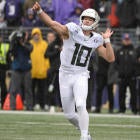
With Joe Burrow, Tua Tagovailoa and Jalen Hurts off this week, all eyes were on Oregon's Justin Herbert. We've been down on Herbert in recent weeks, and even went so far as to say he was outplayed by Jacob Eason when the Ducks and Huskies met late last month. But after a sluggish start against USC on Saturday, Herbert had his best game of the season.
Meanwhile, Eason struggled against Utah, and Jordan Love's season-long struggles continued, this time against BYU. And Jake Fromm returned to action to help Georgia outlast Florida.
Alright, let's get to it.
Justin Herbert, Oregon
Coming into Saturday's game against USC, graduate transfer Juwan Johnson had six receptions on the season. By the time Oregon had finished off the Trojans, 56-24, Johnson had added seven more catches -- including three touchdowns -- for 106 yards. We point this out because for as good as Oregon's offensive line has been this season, Justin Herbert has had little help from his pass catchers, especially after losing tight end Jacob Breeland last month.
If Johnson can emerge as a reliable go-to target, perhaps that assuages some of the concerns about Herbert's consistency. It's a concern we've mentioned almost weekly in this space, and after watching Herbert muddle his way through a frustrating first quarter against USC, we tweeted this:
Justin Herbert's been wholly underwhelming for most of this season. He's not a top-15 pick and he shouldn't be a 1st-rounder at this rate. If you're this inconsistent behind one of the best O-lines in college, how are you going to magically improve on an NFL team that went 4-12. https://t.co/9zwOcriGgf
— ryan wilson (@ryanwilsonCBS) November 3, 2019
As you might imagine, the results were mixed. Some folks agreed that Herbert hasn't lived up to his otherworldly physical gifts, while others pointed out that Herbert's numbers are substantially improved over a season ago. And that's true; as a junior, he completed just 59 percent of his throws while he's currently at 69 percent. He's also on pace for more touchdowns and fewer interceptions -- in fact, Herbert tossed only his second interception of the season against USC and that was Oregon's ninth game (he had eight picks a year ago).
There's also the matter of the Ducks' offense, which can best be described as ill-fitting of Herbert's talents. Put another way: After seeing the jump in Joe Burrow's game, imagine Herbert in LSU's offense. But these are the projections NFL teams will have to make. There's no mistaking Herbert's physical attributes -- he can make throws that take your breath away -- but to gloss over (or worse, ignore) the mistakes he makes, often on a weekly basis, will lead to him being overdrafted. And with that lofty draft status comes unrealistic expectations by a weary fanbase beset by losing and a front office and coaching staff pressured to win now, even if that means pushing onto the field a quarterback not yet ready to face NFL defenses.
Here's what we wrote last week, after Oregon beat Washington State, thanks in large part to a late drive by Herbert to set up the game-winning field goal:
The majority of Herbert's throws are some variety of screens, and to his credit, he is typically accurate in those situations. But once you get 15-plus yards down the field, the consistency wanes and he's not in the same conversation with Joe Burrow or Tua Tagovailoa. Granted, he also doesn't have the same receivers, and that's part of what NFL evaluators will have to figure out.
And remember, Herbert was 21 of 30 for 222 yards with no turnovers in that game. The stat line was impressive, but you have to look beyond those stats to get an idea of what a quarterback does well and what he needs to work on.
On Saturday night against USC, Herbert got off to a rocky start. He had a chance for a big gain -- possibly even a touchdown -- but underthrew Jaylon Redd down the seam. Instead, the pass was broken up:
Herbert's deep ball needs major work. No reason to miss this from a clean pocket. Underthrows it, and costs himself a touchdown. pic.twitter.com/F99iw8oULo
— Ian Wharton (@NFLFilmStudy) November 3, 2019
In a vacuum, this isn't an end-of-the-world throw, but we've seen this from Herbert a lot this season. He wasn't pressured, he had a clear read and he just didn't make the play. On the next drive, Herbert has a pass rusher coming up the middle and he misfires on a curl route, again to Redd. Instead of hitting Redd where he stood, Herbert leads him and throws the ball right to a USC defender.
INTERCEPTION @USC_FB! 😱@Isaiah_Pola_Mao gets the Trojans the ball, with the drive resulting in a FG. ➡️ 1️⃣0️⃣-0️⃣ ✌️
— Pac-12 Network (@Pac12Network) November 3, 2019
📺FOX pic.twitter.com/gXAnn6f9ty
It was a terrible decision, easily his worst of the game. Herbert misfired again on the third drive, short-hopping Johnson on an out route -- with no pressure and Johnson running open. But he followed that up with a 17-yard gain on a similar route; the ball was on time and accurate, which is what you want to see from Herbert on every dropback where he's not facing pressure.
Something clicked after the slow start that saw Herbert go just 3 of 7. Maybe it was the Oregon defense intercepting Kedon Slovis for the first of three times (he also lost a fumble), or maybe Herbert just needed to get comfortable, but the senior quarterback finished 18 of 19 with three touchdowns.
Late in the second quarter, Herbert whips his head around after a play-action fake and hits a wide-open Redd near the sidelines. Again, on time, accurate and composed:
Some of his nicest plays come from rollouts or play-action drops from under center. pic.twitter.com/TvH5ftOMBN
— Ian Wharton (@NFLFilmStudy) November 3, 2019
It gets better. After Herbert took a nasty hit to his knee and had to leave the game for two plays, he returns to throws this RPO laser to Johnson that capped an 80-yard, seven-play drive.
Justin Herbert can't be stopped!
— FOX College Football (@CFBONFOX) November 3, 2019
The @oregonfootball QB throws a TD in his first play after leaving the field with an apparent knee injury. pic.twitter.com/yHhZrPb9iT
Johnson gets the defensive back on his hip and Herbert hits him in stride with a perfect pass. THIS is what gets scouts and general managers so hot and bothered.
On the ensuing drive, midway through the third quarter, Herbert and Johnson hook up again for an even more impressive touchdown, a perfectly thrown back-shoulder fade:
Juwan is BACK AT IT AGAIN! 👏@Ju_heard_ makes an incredible catch and puts @oregonfootball up 2️⃣5️⃣ in the third quarter.
— Pac-12 Network (@Pac12Network) November 3, 2019
📺FOX pic.twitter.com/NFmLJ3mNKv
Yes, Herbert and the Oregon offense benefited from a pick-six, a kickoff return for touchdown just before halftime and four USC turnovers, but Herbert deserves credit for bouncing back after a rough start. A lot of those 26 attempts were quick screens and short passes, but after the first quarter, he was accurate on almost every downfield throw, and that's encouraging. In fact, if you had never seen Herbert play before and just witnessed the final 45 minutes against USC you'd be convinced that he's the No. 1 overall pick.
Which brings us back to the overarching theme of Herbert's last two seasons: consistency. Now the question is if he can replicate Saturday night's performance two weeks from now when the Ducks play again, and the week after that, and the week after that. Because consistency, more than anything else, will ultimately determine how successful he is at the next level.
Jacob Eason, Washington
If Justin Herbert got off to a terrible start and then caught fire against USC, Jacob Eason's afternoon was just the opposite. He got off to a red-hot start and then slowly crumbled.
Eason's first throw of the game was a field-side dart on an out route that checked every box -- on time, right on the receiver, an NFL throw despite the lack of tight coverage. Facing third-and-17 on that same drive, Eason finds Marquis Spiker between three defenders for an 18-yard gain.
These are the types of throws that excite you about Washington QB Jacob Eason. He has the confidence that he can fit a football through a key hole.
— Jordan Reid (@JReidNFL) November 2, 2019
Reminds me a lot of Matthew Stafford. pic.twitter.com/5wEConsRPD
It was a recurring theme early: Eason has time to throw and he picks apart a Utah defense that hadn't allowed an opponent to score in the first half since the Sept. 28 game against Washington St. Eason is so decisive when the looks are clean -- the ball is out quickly and he can spin it, hitting his receiver in the hands, and more importantly, putting them in position for MAX YAC. (We don't know if people say this already or not but we're claiming it as our own until proven otherwise; MAX YAC = maximizes yards after catch because of well-placed throws that best allow the receiver to run once the ball is in his hands.)
Washington's first drive ends with Eason faking a quick screen and then hitting Jordan Chin in the end zone after the defender falls down:
WASHINGTON STRIKES FIRST! Jacob Eason hits a wide open Jordan Chin for the 11 yard TD! #Huskies pic.twitter.com/jvHU3jOXIu
— I'M SEEING GHOSTS (@FTBeard11) November 2, 2019
On the next drive, Eason fumbles while scrambling for a first down and Utah recovers. But he follows that up with several beautiful throws to tight end Hunter Bryant, including this 34-yard touchdown strike to give the Huskies a 14-3 second quarter lead (again, notice the lack of pressure on Eason):
.@skinnyqb10 is on 🔥🔥🔥 to start this game!
— Pac-12 Network (@Pac12Network) November 2, 2019
📺 FOX pic.twitter.com/EPp0HoXBEi
The Utes defense starts to get into the backfield, forcing Eason to get rid of the ball before he wants to. Early in the second half, he showed off his arm strength, throwing late in the middle of the field, but with enough zip to get it to tight end Cade Otton to move the sticks. But on the next play, again under pressure, Eason stands tall in the pocket with eyes downfield, but hurries his throw to avoid pressure in his face. The result: He airmails a wide-open Hunter Bryant who would've walked in for a touchdown. The drive ends when Eason stares down Otton on a wheel route and he doesn't see the safety over the top. It's his first truly bad interception of the season:
"Mine" - @JulianBlackmon
— Pac-12 Network (@Pac12Network) November 2, 2019
📺 FOX pic.twitter.com/AM7BLd1HIX
Turns out, Eason tossed his second truly bad interception three drives later, and this time it was returned to the house:
Jacob Eason had a minuscule 0.55% interceptable pass rate entering this game. This is the second awful pick he's thrown against Utah. pic.twitter.com/dHjPpdOC60
— Ian Wharton (@NFLFilmStudy) November 2, 2019
If nothing else, this reconfirms that Eason is wildly talented but he also hasn't played a lot of football in the last 24 months. He outplayed Herbert two weeks ago but he was thoroughly flummoxed for the final 40 minutes against Utah. It didn't help that his receivers struggled to hold onto the ball but Eason did himself few favors with poor decisions. It's probably in his best interest to return to Washington for another season but a strong finish to the 2019 campaign might have him leaning on declaring for the draft, especially if it looks like Herbert's decision to come back to Eugene could cause him to fall out of the top 10.
Jordan Love, Utah State
This feels like a lost season for Love. He came into 2019 with sky-high expectations after completing 64 percent of his throws for 3,567 yards, 32 touchdowns and six interceptions as a sophomore. His junior season has been mostly forgettable; he's completing just 58 percent of his looks with nine touchdowns and 12 interceptions through eight games -- including three picks against BYU on Saturday night.
A big issue is the lack of playmakers around him. A year ago, Ron'Quavion Tarver and Jalen Greene combined for 110 receptions and 14 touchdowns, and Dax Raymond was one of the best tight ends in the conference who many folks (us included) thought would get drafted. Darwin Thompson, who was drafted by the Chiefs, rushed for more than 1,000 yards and added another 351 receiving yards. All those weapons are gone. And that has had a noticeable effect on Utah State's offense and, more specifically, Love's productivity.
We've been saying it all season: Love's arm talent is undeniable, but his decision-making has been suspect, and that was again the case against BYU. You have throws like this to Siaosi Mariner that are NFL-caliber:
Good deep ball that gave Mariner a chance to win the jump ball. DB may have had a chance at it if the receiver didn't create contact. pic.twitter.com/ogUfxrdRGh
— Ian Wharton (@NFLFilmStudy) November 3, 2019
Or this, later in the game:
This is a terrific throw after a double clutch. Beats the defender there. pic.twitter.com/IpGq0vYUYI
— Ian Wharton (@NFLFilmStudy) November 3, 2019
But then there are interceptions like this that are hard to explain away:
Jordan Love was playing well until this interception, thrown directly to a defender. Even if it got past 34, there was another defender about to undercut it. pic.twitter.com/B3ECgvQb7c
— Ian Wharton (@NFLFilmStudy) November 3, 2019
Even if Love didn't see the first underneath defender, there's another underneath defender behind him. And he did it again on his second interception, somehow not seeing the underneath defender:
Love once again can't spot the underneath backer and throws it to him. This season has avalanched on him. This is the 9th (!!!) interception this year due to a bad read. pic.twitter.com/jN4fK7xOrs
— Ian Wharton (@NFLFilmStudy) November 3, 2019
We'll end on this, which feels like a perfect microcosm of Love's season. Despite his athleticism, Love will work his way around the pocket with his eyes downfield. Facing a second-and-7 with 90 seconds to go in the first half, Love rolls right, comes back to his left and throws a seed to the sidelines for a nine-yard gain … except Mariner couldn't make the catch:
Encapsulating drive from him. Missed two screens, then hit a nice intermediate third down pass, and extends this play for what should've been a catch on the move. Dropped. pic.twitter.com/Aa9pTEv8uh
— Ian Wharton (@NFLFilmStudy) November 3, 2019
Does Love return to Utah State for his senior season? Or does he enter the draft, probably see his draft stock slip to Day 2, and hope NFL coaching and NFL players can return his game to 2018 levels (and beyond)?
Jake Fromm
Georgia was off last week but Fromm was an efficient 20 of 30 for 279 yards with two touchdowns and no interceptions in the Bulldogs win over the Gators on Saturday afternoon. His steady-as-she-goes performance did nothing to change our opinion of him. He's s smart, savvy quarterback whose lack of arm strength and struggles throwing the ball accurately down the field -- especially to the sideline -- will affect his draft stock.
On Fromm's second throw of the game he underthrew wideout Demetris Robertson, who has\d a step on the defender. Fromm was lucky the ball wasn't intercepted. But he came back to Robertson a few plays later and converted a third-and-17 on a really good throw.
This was a theme for most of the day; Fromm would miss a receiver and then follow it up with a well-timed and accurate throw that moved the sticks. For example, this can't happen:
Fromm's ability to create out of the pocket is poor. It really limits his upside pic.twitter.com/GO7U18EgJC
— Ian Wharton (@NFLFilmStudy) November 2, 2019
Then later in the game, Fromm play-actions, gets his head around and finds Lawrence Cager streaking down the sideline for an easy score.
Play-action and the clear-out route springs Cager wide open for a 52-yard touchdown. Great play design. pic.twitter.com/yh68TTXPS2
— Ian Wharton (@NFLFilmStudy) November 2, 2019
And then, with just under three minutes to go and the Bulldogs having to convert on third-and-7 to put the game away, Fromm does this:
Good third down throw to move the chains in a critical moment. Could've been a bit better since 17 had to turn to grab it, but Fromm did his job. pic.twitter.com/CGKbWlG1iK
— Ian Wharton (@NFLFilmStudy) November 2, 2019
That's a big-boy play at a critical juncture and that says a lot about Fromm's mindset. But the reality is that, despite his above-the-neck attributes, he's a Day 2 pick because of his physical limitations. But again, a lot can change over the final month of the season, as well as the nearly four months of draft season.