

Pinned
Link copied



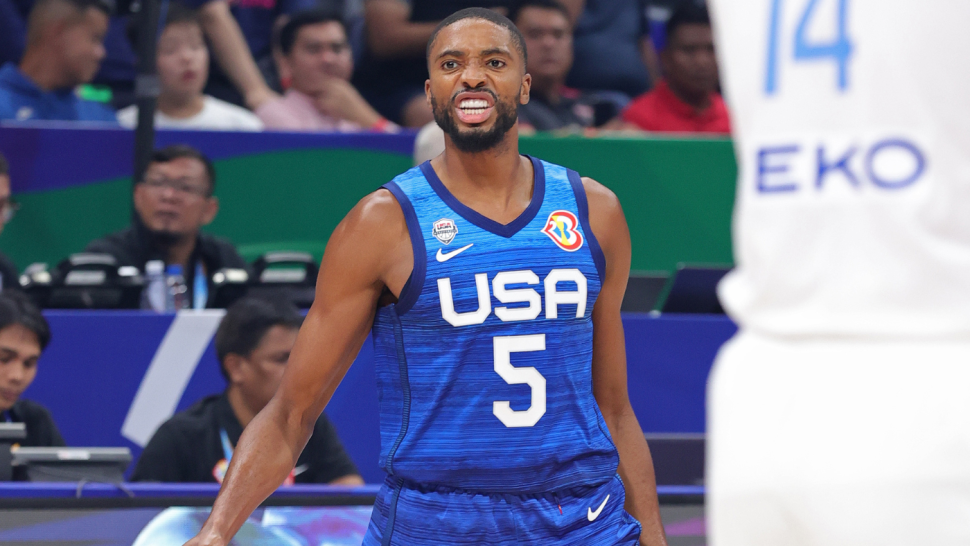
Another game, another emphatic victory for Team USA to open the 2023 FIBA World Cup. After decimating New Zealand on Saturday in their opener, the Americans continued their dominant start to the tournament with an even more convincing 109-81 victory over Greece on Monday. In the process, they clinched Group C and have advanced to the second group phase of the tournament.
Unlike Saturday's win over New Zealand in which Paolo Banchero scored 25 points, no single player dominated this one for the Americans. Austin Reaves led the way with 15 points, but all 12 players on the roster scored at least four. The win was ultimately the result of strong team play and a great shooting day from both 3-point range (9-of-22) and, more importantly, the foul line (30-of-34).Throw in a 40-25 domination on the glass and Team USA controlled just about every aspect of this game.
Greece was severely undermanned for this one, with just one NBA player, Thanasis Antetokounmpo, on its roster. His more famous brother, Giannis Antetokounmpo, may have played in this tournament if not for knee surgery. Instead, he sat out, and Greece posed no major threat to Team USA.
The Americans will now close group play on Wednesday against Jordan. Greece, meanwhile, will play New Zealand on Wednesday, and after they snuck out an overtime win over Jordan on Monday, that game will determine second place in Group C. As the top two teams advance to the second group phase, that game will be meaningful as the rest of the tournament shakes out.
The top two teams in Group C will join the top two teams from Group D (Lithuania and Montenegro) in the second group phase, with the top two teams out of those four advancing to the knockout stage. If Team USA keeps playing like this, the group should have no trouble making it that far. Here are the biggest takeaways from Team USA's victory
Team USA led by only four points when the starters exited the game in the first quarter. The lead was well into double digits when they returned. This has been a persistent theme for Team USA in both the exhibition season and the tournament itself. The starters are still struggling to figure things out. The bench, however, has dominated from the start.
Reaves alone led Team USA in points (15), assists (6) and tied for the lead in steals with Jaren Jackson Jr. (2). The leader in rebounds was also a reserve, as Josh Hart pulled in 11 of them. Five American players had double-digit plus-minus marks, and they were the first five Americans off the bench: Reaves (plus-19), Tyrese Haliburton (plus-19), Cam Johnson (plus-19), Banchero (plus-14) and Hart (plus-13).
There are plenty of possible explanations for this, and the obvious one is that high-level NBA players are typically going to have an enormous talent advantage over foreign reserves, but by the eye test, the obvious answer is that this group just fits together remarkably well. Haliburton and Reaves are great playmakers. Everyone in that group can shoot. Banchero has exceeded expectations on defense as a switching, small-ball five. With the starters struggling, Team USA's path to gold likely goes through the bench. It hasn't disappointed thus far.
Speaking of those struggling starters, no one has had a harder time adjusting to the FIBA game than Brandon Ingram. He expressed his frustration to The Athletic on Sunday, saying "The team is winning right now, so I can't be selfish thinking about myself. But it's a little frustrating right now for me, and I'm just trying to figure out ways I can be effective."
Well, those frustrations persisted on Monday. Ingram scored five points on four shots in 17 minutes and was largely an afterthought in Team USA's victory. Team USA likely hoped that he could play the old Carmelo Anthony role as a catch-and-shoot threat that offered a bit on defense and as a rebounder. It hasn't played out that way. Ingram's best skill is individual shot-creation, but with Jalen Brunson and Anthony Edwards thriving as the first-unit ball-handlers, he just hasn't had a place on this team. Kerr could bench him, but doing so would disrupt that excellent bench lineup. There's no easy answer here. If there were, Ingram and Kerr would've found it by now.
Kerr did have one particularly interesting adjustment in Monday's game. Greek center Georgios Papagiannis, a former Sacramento King, dominated Team USA in the first half because of its drop-coverage. The middle of the floor was totally open for Greece, and Papagiannis, a shooter and crafty post worker, took advantage with jumpers and hooks. When that drew Jackson out of the paint, the Greek pick-and-roll thrived.
So Kerr flipped the matchups. He allowed Edwards, just 6-foot-4, to defend Papagiannis, who is 7-foot-3. Why? So he could put Jackson, the reigning NBA Defensive Player of the Year, on the comparatively non-threatening Antetokounmpo, The Milwaukee forward is not a strong shooter, so Jackson could sag off of him and take away the rim. This disarmed Papagiannis and with him, most of the Greek offense.
It was a bit of a throwback change for Kerr, who pioneered the concept of size mismatches to exploit non-shooters in his early days as coach of the Golden State Warriors, when he famously used center Andrew Bogut to defend shooting guard Tony Allen. His strategy against Greece was the reverse of that move, but to the same effect. Kerr is among the NBA's more creative coaches, and it showed on Monday.
Josh Hart isn't exactly known for his playmaking, but that full-court pass was the perfect exclamation mark on this Team USA victory. He closes this game with a team-best 11 rebounds to go along with four assists. On a team full of scorers, Hart is thriving doing the little things.
Bobby Portis has gotten the better of Bucks teammate Thanasis Antetokounmpo in this fourth quarter, but finally, Antetokounmpo throws down a big dunk to regain a bit of respect in his own locker room. Of course, the best Buck of them all, Giannis Antetokounmpo, is out for this game due to knee surgery.
The two bench players who seem to be out of the typical rotation are Bobby Portis and Walker Kessler. Portis has eight points in eight minutes. Kessler has a block and has made a major difference as a rim-protector in his brief stint. That's how deep this team is. Every player can contribute in some way, shape or form.
It was Paolo Banchero with a game-high 25 points against New Zealand, and thus far tonight, it is yet another reserve, Austin Reaves, leading the way with 15. Reaves also leads Team USA in assists (four), while another reserve, Josh Hart, leads the team with 10 rebounds. Team USA's bench once again steals the show.
All day, Team USA drivers have been met with help at the rim when they've beaten their man. But this team is so loaded that Greece has to draw the line somewhere. Down by more than 20 in the fourth quarter, Austin Reaves just beat his man and got a free walk to the rim. The help wasn't there, and Greece is clearly frustrated by the talent disparity.
The last important note of this game, which Team USA has well in control, is the 22.5-point line. Team USA entered the game as a heavy favorite, and after three quarters, they lead 79-56 to just barely cover the spread.
With Bobby Portis checking in for the first time, Team USA has used 11 of its 12 players tonight. It seems as though Portis and Walker Kessler are the odd men out of this rotation with Steve Kerr preferring to play small with Paolo Banchero as his backup center.
Team USA leads Greece by 22 points, 70-48, and not coincidentally, they've made all 22 of their free-throw attempts. They'd be in control with even a few misses, but when favorites get upset, struggles at the line are often a big reason why. Thus far, this American team has taken care of business on the easy shots.
Brandon Ingram just got called for basket interference, and Steve Kerr challenges. It doesn't take long for review to confirm that the officials had it right the first time, so two points for Greece.
Anthony Edwards opens the second half with a 3-pointer, and then he finishes a layup against the less athletic Greek defense. More importantly, Steve Kerr is allowing him to defend Georgios Papagiannis, who has given Team USA so much trouble today, with the idea that they can switch pick-and-rolls and not worry about the Greek shooters.
Greece managed to regain a bit of momentum when the starters came back in, but ultimately, Team USA created some separation going into the locker room and now lead 50-37 after two quarters. The difference has been their 18-of-18 shooting performance at the line.
Team USA remains in control, but all of that momentum the bench built during its dominant run now seems gone as the starters return and immediately struggle. As soon as they come back in, Greece goes back to exploiting their drop-coverage, and Team USA's offense goes back to being stagnant.
Playing small-ball in a FIBA setting is a big gamble. Rim-protection is at a premium with these relaxed goaltending rules, and international opponents tend to emphasize post-play more than the NBA does. Team USA maximizes spacing by playing Paolo Banchero at center, but the theoretical cost of doing so is strength, rim-protection and rebounding. Fortunately, Josh Hart has done such a good job on the glass (five rebounds thus far) and switching onto bigger players that Team USA has been able to not only survive, but thrive playing small.
Team USA's reserves came in with a four-point lead. Now? It's a 12-point game following that Paolo Banchero dunk. This bench unit has outplayed the starters throughout the summer, and right now, it's responsible for the bulk of the team's success against Greece.
A whistle just cost Paolo Banchero one of the nicest blocks of the tournament. Greece seemingly generated a free lane to the rim off of a ghost screen, but Banchero makes the incredible rotation to swat the ball away. It may not have counted, but Banchero has shown a lot defensively in these small-ball lineups thus far in the tournament. He's been one of the big winners of the Team USA experience.