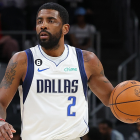
Kyrie Irving has spent the offseason trying to drum up a market for himself. He reportedly tried to rope LeBron James into a partnership earlier this offseason. The Houston Rockets have been linked to him at various points. Bleacher Report's Chris Haynes even reported Thursday that he would meet with the Phoenix Suns.
All of this would suggest that Irving has a robust market in free agency... before context is considered. Irving's proposed partnership with James in Dallas wouldn't even be possible until next offseason without the Los Angeles Lakers agreeing to trade their superstar. How likely does that sound? All reports indicate that the Rockets consider Fred VanVleet, not Irving, to be their top guard target this offseason. The Suns can offer little more than the veteran's minimum for his services. Irving's goal in all of this would seemingly be to create a compelling enough bidding war to convince the Mavericks, who have his Bird Rights and therefore the ability to outbid any other team, to give him his full max contract. On that front, he has thus far failed to generate meaningful leverage.
But as league sources are telling CBS Sports' Bill Reiter, he's still doing everything in his power to create that market outside of Dallas. In addition to the Mavericks, Irving will reportedly meet with the Lakers, Rockets, Suns, Clippers and Heat when free agency begins. Some of those meetings will reportedly take place in Los Angeles. Others will be virtual. Few of them, however, offer Irving a genuine chance at the money or leverage he is seemingly seeking.
Of those five non-Mavericks teams, only two can create significant cap space. The Rockets lead the NBA with over $60 million in space. The Lakers can get to around $29 million right now, and if they needed to start shedding dollars, could jump up to almost $36 million by offloading every financial obligation they have except for James, Anthony Davis and Austin Reaves. If Irving is going to generate leverage, these are the easiest ways for him to do it. However, neither appears especially likely to pursue Irving at anywhere close to his max.
Remember, James Harden failed to use the Rockets to leverage Philadelphia into a long-term contract extension. Harden is a Rockets legend, but he and the 76ers are looking for trades because Houston was seemingly uninterested in Harden at a price he was looking for. Instead, the Rockets seem set on VanVleet, with rumors suggesting he will receive a two-year, $80+ million max contract.
Could the Rockets sign VanVleet and Harden? Potentially... but it's unlikely. If Houston indeed signed VanVleet at his $40.8 million max for next season, they'd have less than $23 million in remaining space. That's enough for a decent player, but Irving likely sees himself as far more than that. They could potentially create another $17 million or so in space by dumping Kevin Porter Jr. into someone else's cap space. His partially-guaranteed contract can be waived with no consequence after next season, and he likely wouldn't make sense on a team with Irving, VanVleet, Jalen Green and Amen Thompson anyway. Of course, Irving himself wouldn't make much sense on a team with VanVleet, Jalen Green and Amen Thompson either, so the odds of Houston surrendering draft capital to pay Irving appears slim. Houston has too many guards as it is. Pursuing Irving in this manner would prevent them from devoting any cap space to defense.
How about those long-rumored Lakers? Well, they could do it. An Irving deal between $29-35 million in the first season is probably his honest market value, and the Lakers are such an appealing destination that he might actually leave a bit of money on the table to get there. He was reportedly interested in them for the mid-level exception last offseason, after all. There were sign-and-trade possibilities that could have gotten the Lakers to an even higher number, but with Malik Beasley and Mo Bamba gone, those are likely not feasible at the moment.
But pursuing Irving would defy virtually everything the Lakers have said this offseason. At every turn, Rob Pelinka has indicated that he plans to bring back the bulk of last year's roster. Austin Reaves has such a tiny cap hold that keeping him would still be possible, but signing Irving all but sacrifices D'Angelo Russell, and assuming Rui Hachimura isn't comfortable taking a wink-wink one-year deal at the room mid-level exception with the understanding that he'd get a raise next summer, he'd likely be gone as well. James would seemingly love a reunion with Irving, but making it happen would essentially mean sacrificing the team the Lakers have already built. Pelinka, to this point, has given no indication that he is willing to do that.
Okay, so the Lakers and Rockets are probably out. What about those three other teams? Well, the Suns, Clippers and Heat are all currently luxury tax teams. This is notable because a) it means they aren't creating the cap space to sign Irving outright for anything resembling his expected asking price and b) landing Irving via sign-and-trade would be extremely difficult because the CBA dictates that acquiring any player via sign-and-trade hard caps your team at the first apron. That is a line that these teams would have a very difficult time dealing with.
Phoenix is the least realistic here. The projected first apron is $172 million. Kevin Durant, Bradley Beal and Devin Booker will combine to earn $130.4 million next season. Let's say, hypothetically, that the Suns were willing and able to trade Deandre Ayton and all of their non-minimum salaries and land Irving. We don't yet have exact figures on the veteran's minimum, but if we use the old projection of $2.02 million apiece, signing 10 of them would take the Suns up to $150.6 million. That leaves around $21 million for Irving under the first apron, and the Suns would be limited to 14 players all season. Does that sound plausible?
The Heat, at this moment, are already over the projected first apron with around $177 million in salary committed to 10 players. This does not include free agents Gabe Vincent or Max Strus, who would almost certainly leave in this scenario (and, frankly, in reality). However, the Heat have four fairly large contracts that could possibly be included in a deal: Tyler Herro, Duncan Robinson, Kyle Lowry and Victor Oladipo. With those four, the Heat could potentially shed the money they would need to fit Irving at a significant number. However, we have to remember that they need to fill out their roster, and the hard cap cannot be exceeded for any reason. Five veteran minimums would take them to around $15 million above the first apron as it is. Either Dallas would need to be willing to absorb a significant amount of extraneous salary, or a third team would need to be compensated with draft picks to do so.
The Heat have three tradable first-round picks, so creating value in a deal likely wouldn't be a problem. However, the cap mechanics of staying under that hard cap line would simply be too complicated for Miami to credibly pursue this path. There's a reason they've been linked to Damian Lillard all offseason. Aside from his obvious value on the court, he is already under contract. That gives Miami more wiggle room to absorb his deal, as it would not come with a hard cap.
The Clippers seemingly have the same idea with James Harden. At this moment, they have around $183 million in salaries devoted to 13 players, so they are well beyond the projected hard cap line that trading for Irving would trigger. Sending out some of those salaries for Harden wouldn't be a problem because, like Lillard, he is under contract and wouldn't trigger a hard cap. Irving, of course, would. Thursday's decision to waive Eric Gordon (which saved a preposterous $110 million with luxury taxes included) took this possibility from "completely and utterly impossible" to just "practically impossible," but that's not exactly a major improvement. The Clippers have been linked so heavily to Harden because Harden is simply easier for them to acquire.
Could Irving take someone's mid-level exception? Potentially. If the Lakers do decide to run it back, they are expected to remain above the cap and wield the full, $12.4 million non-taxpayer mid-level exception. The Rockets, as a cap space team, will have access to the $7.6 million cap room mid-level exception. Finally, the Heat, Clippers and Suns could all potentially have access to the $5 million taxpayer mid-level exception... but even that is no longer a guarantee. Using that exception forces teams to commit to staying below the new CBA's second apron, which is projected to come in at $182.5 million. Whether or not that is feasible comes down to what other moves those teams have planned. Also... Irving probably isn't taking $5 million and sacrificing his Bird Rights.
So what's going on here? Why is Irving going to all of this trouble to meet with teams that probably aren't going to pay him? In all likelihood, it comes back to Dallas. Irving requested a trade from the Nets in February in part because contract talks between him and Brooklyn broke down. Perhaps he is experiencing similar difficulties with Dallas.
The Mavericks have the ability to pay Irving up to $272 million over five years. It's possible and perhaps likely that the Mavericks are hesitant to give a player as frequently unavailable as Irving a five-year commitment. It's also possible and perhaps likely that the Mavericks do not want to give Irving his full max salary, and would instead like to pay him slightly less in the interest of maintaining access to their own non-taxpayer mid-level exception. This would make sense, as Irving couldn't even lead the Mavericks to the play-in round last season. They desperately need to improve on defense, and that will mean retaining every possible team-building resource at their disposal.
If push really came to shove, though, the Mavericks would probably eschew the mid-level exception if they absolutely needed to in order to retain Irving. They simply have no way of replacing his talent if he leaves. They owe first-round picks to the Knicks and Nets. Luka Doncic is probably the only non-rookie-scale player on their roster that has positive trade value. They simply have no path to competitive viability that does not include Irving.
But right now, the Mavericks know that no other team is likely to come close to offering Irving what they can. With that in mind, they likely see no reason to give Irving everything he's asking for. In short, they'd probably like to compromise. Whatever compromise they're offering Irving doesn't seem satisfactory to him. So he's spent months trying to find a competing offer. He has thus far failed. This set of free agency meetings is a last ditch effort to convince the Mavericks someone else might pay him.
The likeliest outcome here is that the two sides eventually come back to the table and find a sensible middle ground. However, few players are as capable of irrationality and unpredictability as Irving. Perhaps that's something he's betting on. Most players would never take an enormous pay cut just to stick it to their previous employer. If Irving can convince the Mavericks he would, that might be his best chance at convincing them to just pay them whatever he's after.