Leaderboarding: Best MLB players from Japan
Veteran righty Hiroki Kuroda is returning to Japan for the 2015 season. Where does he rank among the best Japanese-born players in MLB history?

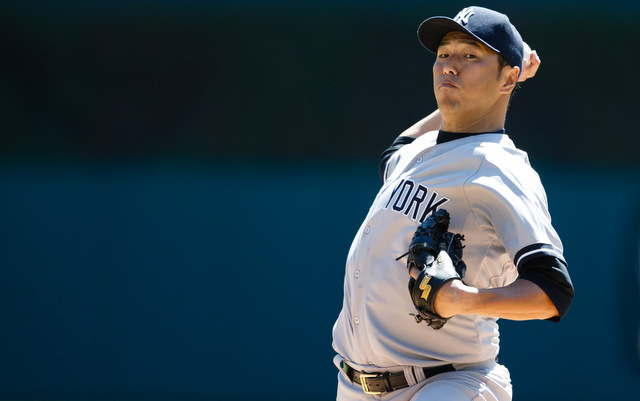
On Friday, our own Jon Heyman confirmed that veteran right-hander Hiroki Kuroda will leave MLB and return to Japan to pitch for the Hiroshima Toyo Carp in 2015, his former team. He spent the first 11 seasons of his career wth Hiroshima before coming over to MLB to pitch for the Dodgers (2008-11) and Yankees (2012-14).
During his seven seasons in MLB, Kuroda managed a 3.45 ERA in 211 starts (and one relief appearance), which is slightly better than the 3.69 ERA he posted with the Carp. Kuroda is the rare example of a player who came over from Japan and improved his performance. His 79-79 record with the Dodgers and Yankees really doesn't do justice to his seven years in MLB.
At this point, a strong case can be made that Kuroda has been the most successful Japanese-born pitcher in MLB history. He's clearly on the short list. Others like Yu Darvish and Masahiro Tanaka still need to put in a few more years before matching Kuroda's career value.
So, with that in mind, let's take a look at the 25 best players to come over from Japan using the Baseball-Reference version of WAR (pitchers, position players).
| Career WAR: MLB players from Japan | ||||||
| Player | WAR | PA or IP | OPS+ or ERA+ | |||
| OF Ichiro Suzuki | 58.8 | 9,663 PA | 110 OPS+ | |||
| RHSP Hideo Nomo | 21.8 | 1,976 1/3 IP | 97 ERA+ | |||
| RHSP Hiroki Kuroda | 21.7 | 1,319 IP | 115 ERA+ | |||
| OF Hideki Matsui | 21.3 | 5,066 PA | 118 OPS+ | |||
| RHSP Yu Darvish | 12.8 | 545 1/3 IP | 127 ERA+ | |||
| RHSP Tomo Ohka | 11.9 | 1,070 IP | 105 ERA+ | |||
| RHRP Koji Uehara | 11.6 | 350 1/3 IP | 174 ERA+ | |||
| RHRP Shigetoshi Hasegawa | 11.6 | 720 1/3 IP | 125 ERA+ | |||
| RHSP Hisashi Iwakuma | 11.5 | 524 IP | 120 ERA+ | |||
| RHRP Takashi Saito | 10.5 | 338 IP | 185 ERA+ | |||
| RHSP Daisuke Matsuzaka | 9.3 | 790 1/3 IP | 99 ERA+ | |||
| OF Norichika Aoki | 7.5 | 1,811 PA | 103 OPS+ | |||
| RHSP Masato Yoshii | 7.4 | 757 1/3 IP | 101 ERA+ | |||
| LHRP Hideki Okajima | 6.9 | 250 1/3 IP | 149 ERA+ | |||
| RHRP Akinori Otsuka | 6.6 | 232 IP | 171 ERA+ | |||
| 2B Tadahito Iguchi | 6.3 | 2,079 PA | 93 OPS+ | |||
| IF Kazuo Matsui | 5.3 | 2,555 PA | 83 OPS+ | |||
| C Kenji Johjima | 5.3 | 1,722 PA | 91 OPS+ | |||
| IF Akinori Iwamura | 4.5 | 1,755 PA | 92 OPS+ | |||
| OF Kosuke Fukudome | 4.3 | 2,276 PA | 99 OPS+ | |||
| OF Tsuyoshi Shinjo | 3.9 | 960 PA | 77 OPS+ | |||
| RHRP Kasuhiro Sasaki | 3.7 | 223 1/3 PA | 138 ERA+ | |||
| RHSP Hideki Irabu | 3.4 | 514 IP | 89 ERA+ | |||
| RHSP Masahiro Tanaka | 3.3 | 136 1/3 IP | 140 ERA+ | |||
| RHRP Junichi Tazawa | 3.2 | 203 2/3 IP | 127 ERA+ | |||
Yeah, no surprise Ichiro's at the top. He's going into the Hall of Fame in both countries and is simply one of the best and most dynamic all-around players we'll ever see.
If you want to sort the rest of these players into tiers -- with Ichiro being in his own little Tier 1 world -- Tier 2 would be Nomo, Kuroda and Matsui, the grizzled veterans whose MLB careers are over. Tier 3 is the miscellaneous arms. Middling starters like Ohka and Dice-K and good relievers like Uehara and Saito. Tier 4 consists of position players who didn't quite live up to expectations, like Kaz Matsui, Johjima and Fukudome. Then Tier 5 is pretty much everyone else.
There are some exceptions, of course. Darvish is well on his way to joining Tier 2 and we can say the same for a healthy Tanaka, though his health is far from guaranteed at this point. Tazawa seems more likely to wind up in Tier 3 than Tier 5 when it's all said and done as well.
I don't think it's a coincidence most of the best Japanese players in MLB history are pitchers (16 of the 25 are pitchers). Pitching is generally easier to scout, even with the differences that exist between MLB and NPB baseballs, mounds and schedules. A 95 mph fastball is a 95 mph fastball. A nasty slider is a nasty slider. You know it when you see it.
Hitting is tougher to evaluate because there is no textbook swing. What works for one player won't necessarily work for someone else. That's why more hitters come out of nowhere to be elite players than pitchers. Judging whether an NPB player with a hitch in his swing can hit MLB caliber pitching is not easy. Guys like Ichiro and Hideki Matsui, who made the transition from NPB to MLB seamlessly, are the exception, not the rule.