Last week on the Fantasy Baseball Today podcast, we took a look ahead at the 2018 season, mock drafting the first two rounds as things stand now. Despite being less than a week removed from his return from a wrist injury -- no small thing for a power hitter -- Braves slugger Freddie Freeman went 12th overall, a pick Heath Cummings made. In the preseason, Heath and I were both skeptical of Freeman's second-half breakout in 2016, often citing his 27th overall ADP in drafts as a reason why he might disappoint, so we've certainly come a long way on Freeman.
How could we not? Freeman has picked up right where he left off since coming back from the DL, hitting .310/.356/.595 with five multi-hit games in 10 tries; this has actually dropped his season-long line to just .333/.438/.712. Over the last 365 days dating back to last season, Freeman is hitting .336/.443/.683, with 35 homers, 102 runs, and 92 RBI in just 113 games. Those are astounding numbers.
Freeman has built himself into an elite hitter, proving that last season's second half was no fluke. On May 17, I wrote about Freeman's development into one of the best hitters in baseball and a legitimate first-round-caliber Fantasy option. He, of course, went on the DL the next day with a wrist injury, and this piece sat in my drafts untouched for the next two months, forgotten.
I rediscovered it today, and figure it's still pretty timely. Freeman has cemented his place as one of the best hitters in baseball, and everything I wrote in the middle of May still very much applies. If you're still doubting Freeman, allow me to convert you:
The best predictor of future performance is past performance.
This is a generally accepted truism in sports, and you'll succeed more often than you fail if you follow it across the board. When a player has a long track record saying he is one very specific kind of player, it typically takes a lot more than a few hot months to change the perception of that player.
However, at some point, new information has to outweigh what we thought we knew before. This time a year ago, there were still Daniel Murphy skeptics out there, not buying into the big second-half and postseason run he put together to finish out 2015. Those people, of course, missed out on a player who nearly led the NL in batting average, while leading the senior circuit in slugging percentage and OPS en route to an elite Fantasy season.
What those people missed were very real changes Murphy had made to his game, as the veteran became a much more pull-heavy and flyball-heavy hitter, a trend that began in 2015 and has continued ever since. A few hot months at the end of a season can be an outlier, but if a player closes out a season strong and then picks up right where he left off after the offseason, it's time to start re-evaluating what your baseline expectations are for him.
That's where we are at with Freddie Freeman. I was skeptical of his apparent breakout last season, after the 27-year-old hit as many homers after the All-Star break last season as he has in any single season since 2013. Freeman has long been a very good hitter, with strong walk rates, consistently high BABIPs, and tons of extra-base hits (weighted more toward doubles). However, before the second half of last season, he has never really belonged among the truly elite players at his position, thanks to a lack of homers.
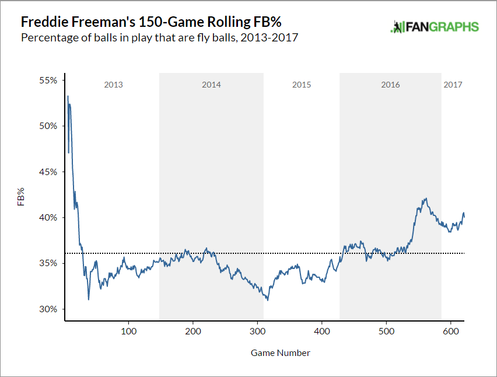
That has changed, and there's really no doubting it anymore. He went deep yet again Tuesday (May 16), bringing his total for the young season to 14 in just 36 games. Over the last calendar year, Freeman now has 42 homers, while hitting .316/.417/.632. He has 95 extra-base hits total in that span, and like Daniel Murphy, there is at least one pretty explanation for the changes we're seeing (courtesy of FanGraphs.com):
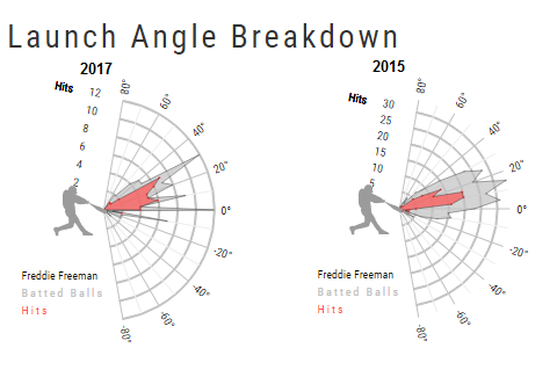
Raw power has never been an issue for Freeman, who has a career 38.5 percent hard-hit rate. He has kept his hard-hit rate over 40 percent in each of the last two seasons, but has also pushed his flyball rate up to 40.5 and 39.8 percent (respectively) as well. You can see the increase in his average launch angle here as well (courtesy of BaseballSavant.com):
Freeman isn't actually a dramatically improved hitter compared to years past. He has always hit the ball hard, and his 19.1 percent strikeout rate to date is pretty much in line with where he has been before. He is putting his skills to use in better ways, finding ways to maximize his already impressive skill set, and the results speak for themselves.
Freeman was a must-start first baseman in the days when he was hitting 18-23 homers every year, because you could rely on him for a .280 batting average floor and plenty of runs and RBI. Adding 15-20 homers on top of that -- along with the jumps in run production tied to that -- is how you go from "must-start" to putting yourself on the shortlist of the best hitters in baseball.
Increasing your launch angle isn't a panacea for all batters -- Billy Hamilton doesn't need to be putting the ball in the air any more than he is -- but Freeman is the perfect example of a player who has benefited from this kind of change. He's as big and strong as nearly anyone in baseball, and he is simply leveraging those tools in an ideal way.
The question before the season was, "Could Freeman sustain his breakout?" Now? There's no question about that. The only question moving forward is, "How early in the first round should I take Freddie Freeman?"