Remembering Yogi Berra: Eight things to know about his life
Berra bridged the DiMaggio and Mantle eras, making his own name by being one of the best catchers of all time, along with one of its great 'unwittingly witty' spokespeople.
Hall of Fame catcher Yogi Berra, one of the most popular Yankees ballplayers of any era, has died at age 90. The Yogi Berra Museum and Learning Center in Little Falls, N.J., near Berra's residences for many of the past several years, reported the news Tuesday night.
Also legendary in popular culture for his myriad "Yogi-isms" -- "unwittingly witty" sayings, the New York Times calls them -- Berra parlayed a funny and likable personality into a lifetime of goodwill.
Here are eight things to know about Berra (he wore uniform No. 8), who played for the Yankees for parts of 19 seasons, from 1946-1963, and was elected to the Hall of Fame in 1972:
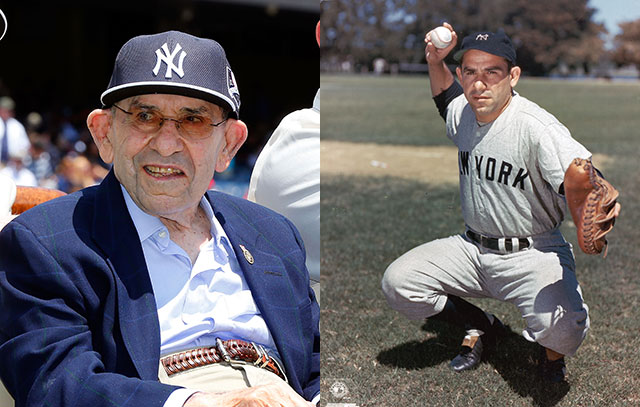
1. Berra's playing career bridged the likes of Joe DiMaggio and Bill Dickey in the beginning, and Mickey Mantle and Roger Maris by the end.
He was an All-Star for 15 consecutive seasons. Among catchers, Berra is fourth all-time in home runs (358) and runs scored (1,175), and is first in RBI 1,430. He's eighth in slugging percentage, and is notable for having struck out 414 times in 8,364 career plate appearances. By comparison, in 7,797 plate appearances, Lance Parrish struck out 1,527 times.
It's worth noting that Berra made his major-league debut Sept. 22 -- also the date of his death.
2. Berra played in 14 World Series with the Yankees.
He won 10 rings, including one in his first full season (1947) and five straight from 1949 to 1953. Berra caught Don Larsen's perfect game in the 1956 Series, famously jumping into his arms after the final out of Game 5, and batted .360 with three homers, 10 RBI, and an on-base plus slugging percentage of 1.248. He probably would have been named MVP of the Series, if not for Larsen's singularly impeccable achievement.
3. Berra managed the Yankees and Mets to the World Series.
Berra had an awkward split from the Yankees, who named him manager in 1964, when the team won 98 games and made it to Game 7 of the World Series. But after they lost the title to the Cardinals, Berra was fired. From his New York Times obit, here's an account of one of the incidents that led general manager Ralph Houk to do the unthinkable and fire Yogi:
On the team bus to O'Hare Airport, the reserve infielder Phil Linz began playing "Mary Had a Little Lamb" on the harmonica. Berra, in a foul mood over the losing streak, told him to knock it off, but Linz did not. (In another version of the story, Linz asked Mickey Mantle what Berra had said, and Mantle responded, "He said, 'Play it louder.' ") Suddenly the harmonica went flying, having been either knocked out of Linz's hands by Berra or thrown at Berra by Linz. (Players on the bus had different recollections.)
A year later, Berra joined the crosstown Mets as a player, for four unremarkable games. He became a coach (coaching first base in 1969 when the Mets won the World Series), and was named manager after Gil Hodges died in 1972. The Mets returned to the World Series the next season, but Berra was fired "abruptly" in the middle of the 1975 season when the team fell out of contention in the old NL East.
4. Berra made peace with the Yankees (even though they fired him again later).
Berra coached with the Yankees from 1976-83 (when they won three pennants and two World Series), and he managed them to 87 wins in 1984. But they started 6-10 a year later and Berra was fired by impulsive owner George Steinbrenner. Berra never managed again, but he coached with the club during spring training frequently until his death.
5. Berra sued Hanna-Barbera for defamation of character after the creation of Yogi Bear in 1958.
One of the more quotable athletes ever, some of Berra's famous phrases included:
• "You can observe a lot just by watching."
• "When you come to a fork in the road, take it."
• "Nobody goes there anymore," he said of a popular restaurant. "It's too crowded."
Already known in popular culture as a figure who might say anything, Berra was paid an ultimate tribute by the creation of Yogi Bear. It wasn't necessarily taken as a compliment by Berra, though, because he reportedly sued because he never gave his permission. Berra eventually withdrew his suit, but the company always maintained that Berra and the Bear had coincidentally similar names.
"We never thought of Yogi Berra when we named Yogi Bear," a straight-faced executive was quoted as saying. But as Walter M. Brasch put it in his book Cartoon Monickers, "Whether coincidence or not, it is difficult to find anyone else in the industry who believes it."
How did Lawrence Peter "Yogi" Berra get his nickname in the first place? The Hall of Fame bio of Berra says:
One afternoon, after attending a movie that had a short piece on India, a friend Jack McGuire Jr. noticed a resemblance between him and the “yogi”, or person who practiced yoga, on the screen. McGuire said “I’m going to call you Yogi” and from that moment on, the name stuck.
It also has been said that McGuire's realization had something to do with how Berra crossed his legs when sitting.
6. Berra's wife of 65 years, Carmen Berra, died March 7, 2014.
They married in 1949, shortly after Berra established himself in the majors. She apparently appreciated Berra's sense of humor, as told to New York Daily News reporter Bill Madden:
Carmen Berra related how her husband once sent her an anniversary card signed, “Yogi Berra.” She said she was glad he signed it that way because it eliminated any confusion about all the other Yogis she knew.
In later years, she played a key role in operating the Yogi Berra Museum on the campus of Montclair State University in New Jersey.
"She died peacefully -- she went the way she would have wanted to," son Larry Berra told the Daily News. "We're grateful that she and dad were able to spend some good time together (Thursday). I'm not just saying this because she was my mom, but she was one of the great women of all time."
7. One of the Berra's sons, Dale Berra, played in the majors.
The 20th pick overall by the Pirates in 1975, he played in Pittsburgh for parts of eight seasons as a defense-first shortstop, and was traded to the Yankees before the '85 season. Berra played a handful of games for his dad before the team replaced him with Billy Martin.
8. Berra was a World War II veteran
His professional career started in the minor leagues in 1943 at 18, but he joined the Navy after playing in 118 games for the Norfolk Tars of the Class "B" Piedmont League.
The New York Times wrote of his service:
He took part in the invasion of Normandy and, two months later, in Operation Dragoon, an Allied assault on Marseilles in which he was bloodied by a bullet and earned a Purple Heart.
CBS News has more on Berra's life and death
Editor's note: An earlier version of this post incorrectly said Berra's Yankees won the World Series from 1947-1953. They did not win the Series in 1948 (sorry, Cleveland Indians!) H/t: @MattLaWell on Twitter.