Note: Don't whiff on this special FanDuel offer. Win your first contest or get your money back (up to $10) to keep playing. Try FanDuel now!
If you didn't like the dominance of pitching over hitting in recent years, 2016 has to be your kind of year. Power hitting is back with a vengeance. Across the majors, Isolated Power has increased from last season's .150 to .162, and the ratio of home runs to plate appearances has risen from 2.7 to 3.0 percent.
Lately, we have seen some eyebrow-raising hitting performances from players like Michael Saunders, Danny Espinosa, C.J. Cron and Marcus Semien, but it's not as if these players were completely devoid of power before this season. In the past month or so, there have been some truly astounding displays of power from sources where you would have never suspected it.
Over the last 30 days, Lonnie Chisenhall, Brad Miller and Cody Asche have all posted an Iso above .200, even though none has a career mark as a high as .160. Rookies Tyler Naquin and Tim Anderson hit for minimal power in the minors, but Naquin has compiled a .314 Iso over the past 30 days, while Anderson clocks in at .204. Not only are these players intriguing because their power displays are so unexpected, but each is either in his peak or pre-peak years. Unlike with, say, Rajai Davis, one can imagine that these hitters are young enough to add to their skill set in a surprising way.
Just because it's possible to imagine it doesn't mean we should expect it. Let's look beyond the results to see if it's worth putting our hopes in continued extra-base production from these five unexpected power sources.
Note: Stats are current for games played through Tuesday, July 5.


The above stats actually undersell Naquin's recent power binge, because he had a three-game homer streak just prior to the beginning of his most recent 30-day period. If you add in those three games, Naquin has a .415 Iso over his last 26 games. In his first 28 games as a major leaguer, Naquin had an .090 Iso that was much more in line with his work as a prospect, so the contrast is striking.
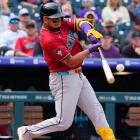
As you might expect, it's taken a notable shift in approach for Naquin to achieve these gains in power. He is hitting more flies, pulling the ball more often and increasing his hard-hit rate. One thing that hasn't changed for Naquin is that he's not doing much against four-seam fastballs, slugging .333 according to BrooksBaseball.net. However, he's been destroying changeups (1.364 SLG) and sliders (1.615 SLG). Naquin's mastery against sliders is an especially marked change from earlier in the season, and it will be interesting to see if it continues -- or if pitchers start to avoid throwing them.
As hot as Naquin has been over the past month-plus, it's hard to trust him as a power source when he is still not producing against four-seamers. With Michael Brantley possibly back soon, it will be a crowded outfield in Cleveland, so even a brief slump could be hazardous to Naquin's playing time.


Chisenhall has also been an integral part of the Indians' resurgence, and if he continues to hit, he could make it even more difficult for Naquin to stay in the lineup. Then again, he could regress and be the odd man out himself. Chisenhall was hitting with precious little power prior to the last month, and only one of his four June home runs travelled more than 385 feet. It probably didn't hurt that his last two came against Joel De La Cruz and Tyrell Jenkins, and a third was a 347-foot cheapie off flyball-prone Justin Verlander.
Given that Chisenhall has enhanced his power stats under favorable circumstances and hasn't undergone any significant change in approach, I'd expect his chances for a correction to be even greater than Naquin's.


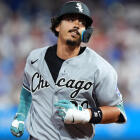
If you picked up Anderson when he was called up in early June, you were likely looking for steals. With just two attempts -- both successful - Anderson hasn't helped you there, but he has provided value nonetheless. The young shortstop who hit all of five home runs last season at Double-A Birmingham has already launched four homers in his first 24 major leagues games.
Then again, maybe we need to pay more attention to where Anderson has played his home games. His current home park, U.S. Cellular Field, is very hospitable to home runs, and he has hit three home runs there in only 14 games. When he played in a good hitter's park at Class A Winston-Salem, Anderson slammed five home runs in 29 games there. He hit for less power at Birmingham, which is tough on hitters, but also at Triple-A Charlotte, which is a homer haven. The track record is mixed, but maybe it's not outlandish to think Anderson could finish with double-digit homers. Now if only he would start stealing some bases ...


Through his first three seasons, Miller established himself as a potential 10-to-15 homer threat and nothing more. Already, Miller has hit a career-high 12 home runs and is on pace to challenge the 25-homer threshold. That pace has been accelerated by his work over the past month, though it's hard to point to any cause behind the change. Then again, Miller also had a nice power surge back in late April and early May, so it may just be that he is having a true power breakout at age 26.
It's truly impressive that Miller has hit nine of his 12 home runs on the season at pitcher-friendly Tropicana Field. Two of his other three long balls were hit at Angel Stadium, a similarly challenging place to hit homers. Power hitters are becoming more common among shortstops, but given how much power he has shown, Miller should be owned in more than 26 percent of the leagues on CBSSports.com.


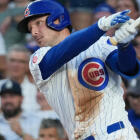
Asche has never had more than 12 home runs in a major league season, but unlike Naquin and Anderson, he looked as if he might develop into a power hitter when he was a prospect. The 21-homer pace that Asche is currently on is better than we likely expected but not earth-shattering. Asche's 63-doubles pace is not sustainable, but it just may hint at more home run power to come. His 39 percent hard contact rate (per FanGraphs) is well above the 31 percent rate that serves as Asche's career mark and the major league norm.