Franchise bests/worsts: Cleveland Indians
Let's take a look at the good and the bad from the sprawl of Cleveland Indians history.

Over the course of the next month, we'll venture through the history of each of the 30 Major League Baseball franchises, discussing some of the best and worst moments, players, teams, etc. It's more a fun snapshot for discussion purposes than a be-all, end-all declaration. We continue today with the Cleveland Indians.
The Indians, owners of two championships and five pennants, trace their origins back to 1901, when the fledgling American League swooped into the Cleveland market after the demise of the NL's Spiders. Now let's enjoy a walking tour of Indians history ...
Best team: 1948
On the basis of raw dominance, we should probably go with the 1954 squad (111-43) or the 1995 team (100-44). However, those colossi failed to win the World Series. So the honor falls to the 1948 team, which did win the World Series.
Paced by player-manager and AL MVP Lou Boudreau, second baseman Joe Gordon, third baseman Ken Keltner, rookie center fielder Larry Doby and a powerhouse rotation fronted by Bob Lemon, Bob Feller and Gene Bearden, the Indians barged to a 97-58 record and prevailed over the Red Sox in a one-game playoff to determine the pennant. The Yankees also won 94 games that year, so the Indians had some tough competition in the AL. As well, the '48 Indians, based on runs scored and runs allowed, should have finished 104-51. So in that sense they were even better than their already sparkling record.
In the World Series, the Indians prevailed over the Boston Braves in six games. Enthusiasm? A then-record 86,288 fans showed up at Cleveland Stadium for Game 5.
Side note: Signed in July of that year, the ageless Satchel Paige turned out to be a valuable swingman for the Tribe in '48.
Worst team: 1914
Coming off a strong 86-66 season in 1913, the 1914 team cratered in a big way, as it finished 51-102 (good for a frachise-worst .333 winning percentage). The team did feature a pair of quality hitters in Shoeless Joe Jackson and fated shortstop Ray Chapman (he would be struck and killed by a Carl Mays pitch in 1920). However, the pitching staff featured only one primary hurler who managed an ERA better than the league average. The '14 Cleveland team wound up 48.5 games behind the first-place Athletics, and they managed to go 19-55 in road games. Oh, and of their 708 runs allowed, 211 were unearned.
Best player: Nap Lajoie

(Image: From Deep Right Field)
How good was Lajoie? Well, they named the team after him. Yes, the "Indians" were actually the "Cleveland Naps" from 1903 through 1914. Lajoie spent 13 of his 21 big-league seasons in Cleveland, and along the way he batted .338/.380/.466 (150 OPS+) with 3,243 hits, 657 doubles and 380 stolen bases. He was also regarded as one of the best defensive second basemen of his era.
Oh, let it also be said that Mr. Lajoie had a rather healthy supply of competitive fire. From his SABR bio:
During his career, Lajoie also had some famous run-ins with umpires. In 1904 he was suspended for throwing chewing tobacco into umpire Frank Dwyer's eye. After one ejection, Lajoie, who stubbornly refused to leave the bench, had to be escorted from the park by police. And in 1903, Nap became so infuriated by an umpire's decision to use a blackened ball that he picked up the sphere and threw it over the grandstand, resulting in a forfeit.
Enthusiasm! Lajoie was voted into the Hall of Fame in 1937 alongside Ty Cobb and Cy Young.
Best trade: Tris Speaker
On April 9, 1916, the Indians acquired inner-circle great Tris Speaker from the Red Sox in exchange for right-hander Sad Sam Jones, infielder Fred Thomas and $55,000. Thomas would be of little consequence, while Jones would go on to have a lengthy and quality career. Speaker, though, would spend the next 11 seasons in Cleveland and bat a remarkable .354/.444/.520 over that span. Eventually, Speaker would become player-manager, and he would lead the Indians to win the 1920 World Series.
Worst trade: Norm Cash
Obviously, the 1960 swap of Rocky Colavito, since it inspired an imaginary curse and everything, will have its supporters for this "honor." However, I'm going with the Cash trade. In December 1955, the Indians acquired young Cash from the White Sox. However, four months later (and before he had ever appeared in a Cleveland uniform) the Indians would flip him to the Tigers for infielder Steve Demeter. Demeter? He would have a total of five major-league at-bats ahead of him. Cash? He would spend 15 seasons in Detroit and put up a 139 OPS+ with 373 home runs.
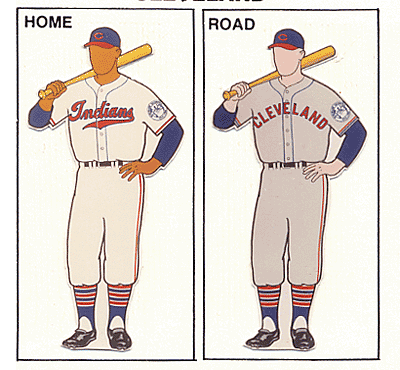
Best uniforms: 1946
Regard, the Cleveland Indians as they were meant to look ...
(Image: Dressed to the Nines)
The cursive "Indians" across the chest makes its first appearance in '46. And may I say that those are some fine striped stirrups.
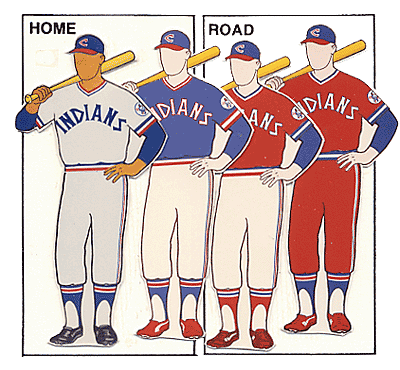
Worst uniforms: 1975
Things are just fine until we get to the road alternate on the far right ...
(Image: Dressed to the Nines)
Shield thine eyes from the monochromatic "Ziploc filled with blood" look.
Least modest uniforms: 1921

(Image: Dressed to the Nines)
Hey, as noted above they won the belt and the title in 1920, so consider them entitled to wear what you see above. Actually, a few teams donned this look in the glow of a championship, and it's a tradition I would love to see revived these days.
Best pitcher to strike out his age: Bob Feller
Rapid Robert was pretty good, you know. How good? Well, the career tallies speak for themselves, but let it be known that Feller as a 17-year-old rookie in 1936 struck out his age against Connie Mack's Athletics. That's a rare feat, to say the least ...

Some Feller indeed.
Best "motorcycle grade" fastball: Bob Feller
Ahem ...
Best "pioneering"
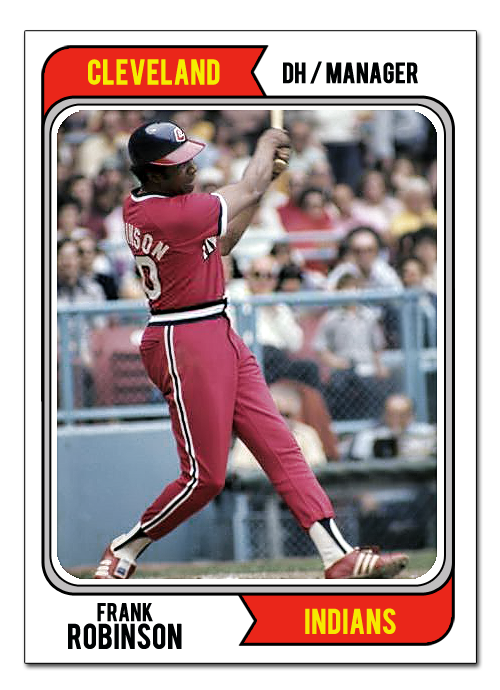
Let it be said that Indians made their marks in social history, at least insofar as baseball is concerned. In 1947, they made Larry Doby the first black player in American League history. The very next year, they signed the luminous Satchel Paige to his first major-league contract. Fast forward to 1974, and the Indians made the great Frank Robinson the first black manager in MLB history.
On the downside, Robinson had to wear these things ...
(Image: Dick Allen Hall of Fame)
Worst ending: 1908
In '08, the Naps/Indians finished second to the Tigers in the American League. Specifically, they finished one-half game behind the Tigers in the American League. What gives?
Cleveland surged from fourth to first place down the stretch thanks to a 10-game win streak. However, the Tigers mounted a 10-game win streak of their own, also down the stretch, to squeak into first place. The season ended with Detroit in front by a half a game because they had failed to make up a rained-out game from earlier that year. Needless to say, Cleveland objected, pointing out that if the Tigers made up and lost that game, then the two clubs would be tied atop the AL and would play a single contest to determine the pennant. For reasons sufficient to themselves, the AL powers determined this was not necessary and awarded the pennant to Detroit.
Eventually, rules were put in place to govern this sort of thing, but those came too late for the 1908 Naps.
Best assist by hometown flying insects
Take that, Yankees ...
iViva la midges!
Best home run, in which "best" means "mightiest"
Jim Thome, come on down ...
Woof.
Well done, Indians. It's a rich history indeed.
Up Next: On Sunday, we'll look at the best and worst moments for the Detroit Tigers.
>> Want more franchise bests/worsts? CHC | MIL | STL | CIN | PIT