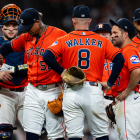

We've been venturing through the history of each of the 30 Major League Baseball franchises, discussing some of the best and worst moments, players, teams, etc. It's more of a fun snapshot for discussion purposes than a be-all, end-all declaration. We continue today with the Houston Astros.
The Houston Astros as we know them came into existence during the 1965 season. From 1962-64 they were known as the Houston Colt .45's. The franchise has yet to win a World Series but they do have an NL pennant (2005) to their credit. Of course, they now play in the AL. Here are the bests and worsts in .45's/Astros history.
Best team: 1998
Easy call here. The 1998 'Stros wen 102-60 -- the best record in franchise history by five wins -- with a +254 run differential. They won the NL Central by 12.5 games and went 37-16 in August and September to close out the season. Look at the middle of this lineup:
1B Jeff Bagwell: 158 OPS+
2B Craig Biggio: 139 OPS+
OF Moises Alou: 157 OPS+
OF Carl Everett: 121 OPS+
OF Derek Bell: 125 OPS+
No wonder they led the NL in runs scored by 29. And look at the top three starters:
RHP Shane Reynolds: 117 ERA+
RHP Jose Lima: 111 ERA+
LHP Mike Hampton: 123 ERA+
That doesn't include the staff ace, who came over in a trade at the deadline. We'll get to him in a little bit.
The 1998 Astros lost three of four to the Padres in the NLDS and were eliminated from the postseason, but that doesn't take anything away from their regular season accomplishments. This is the best team in franchise history.
Worst teams: 2011-13
The 2011 Astros went 56-106 with a -181 run differential and had what was then the worst record in franchise history. Then the 2012 Astros went 55-107 with a -211 run differential and had the worst record in franchise history. Then the 2013 Astros went 51-111 with a -238 run differential, which now stands as the worst record in franchise history. That's a weirdly impressive run of awfulness.
Best player: Bagwell
Yes, Biggio is the Hall of Famer and the franchise's all-time leader in games (2,850) and hits (3,060), but Bagwell is the franchise king in WAR (79.6, well ahead of Biggio's 65.1) and was simply the more dominant player on a rate basis. Bagwell hit .294/.408/.540 (149 OPS+) during his 15-year career with 449 home runs (123 more than any other Astro in history) and and 1,529 RBI (354 more than anyone else). Plus he won the 1991 NL Rookie of the Year and 1994 NL MVP. Biggio was really good! But Bagwell was better.
Best individual season: 1994 Bagwell
Bagwell won that 1994 NL MVP award by doing this in 110 games before the work stoppage:
.368/.451/.750 (213 OPS+) -- led MLB in OPS+ by one and the NL by 23 (!)
104 runs -- led NL by eight
147 hits
32 doubles
39 homers
116 RBI -- led MLB by four
65 BB
65 K
8.2 WAR -- led NL position players by 2.0 WAR
Total dominance. In terms of OPS+, that is the 24th best offensive season in baseball history. Or, to put it a better way, it is the eighth best offensive season in history by someone other than Babe Ruth, Ted Williams or Barry Bonds.
Best MLB debut: J.R. Richard
Richard, the second overall pick in the 1969 draft, made his big league debut on September 5, 1971 in style: he struck out 15 Giants in a complete game win. His final pitching line: 9 IP, 7 H, 3 R, 2 ER, 3 BB, 15 K as a 21-year-old. The 15 strikeouts is still the MLB record for a pitcher in his first career game.
Best moment: Mike Scott's no-hitter
On September 25, 1986, Mike Scott didn't just throw a no-hitter, he threw a no-hitter to clinch the second division title in franchise history. He struck out 13 in the 2-0 win over the Giants:
Worst moment: Larry Dierker's seizure
In one of the scariest moments in baseball history, Astros manager Larry Dierker suffered a massive grand mal seizure in the eighth inning of the team's game against the Padres on June 13, 1999. The game was suspended and Dierker was rushed to the hospital, where he had emergency brain surgery. Thankfully, Dierker recovered and returned to managing the club a month later. The sight of Dierker convulsing on the dugout floor was absolutely horrifying.
Worst moment, postseason: Lidge gets Pujolsed
The Astros led the 2005 NLCS three games to one and took a 4-2 lead into the ninth inning of Game 5 against the Cardinals. Manager Phil Garner gave the ball to all-world closer Brad Lidge -- Lidge in 2005: 2.29 ERA (185 ERA+) with 42 saves and 103 strikeouts in 70 2/3 innings -- for the final three outs, then this happened:
Listen to that crowd. I'd say that ball still hasn't landed if the video hadn't shown it actually, you know, landing. That a moonshot. The Astros still won the series and the pennant, but golly, that's as deflating as homers get.
Best walk-off homer: Chris Burke
Prior to Game 2 of last year's NLDS between the Giants and Nationals, the longest postseason game in baseball history was the 18-inning affair between the Astros and Braves in Game 4 of the 2005 NLDS. Chris Burke did the game-ending honors:
That homer ended Atlanta's season and sent Houston to the NLCS.
Best trade: Bagwell
On August 30, 1990, the out of contention Astros traded ace reliever (and impending free agent) Larry Andersen to the first place Red Sox, who were looking to boost their World Series chances. Andersen was outstanding for Boston -- 1.23 ERA with 25 strikeouts and three walks in 22 innings -- and did help the team to the AL East title. Unfortunately he cost the Sox a first base prospect named Jeff Bagwell, who made his MLB debut in 1991 with a 139 OPS+ en route to being named NL Rookie of the Year. Bagwell went on to become one of the best hitters of his generation.
Worst trade: Joe Morgan
It's hard to believe that, at the time, this trade was viewed as a win for the Astros. They shipped Morgan, who appeared to be declining after posting a 131 OPS+ from 1965-68 and a 113 OPS+ from 1969-71, to the Reds in November 1971 with four others (OF Ed Armbrister, RHP Jack Billingham, OF Cesar Geronimo, IF Denis Menke) for 2B Tommy Helms, 1B Lee May and UTIL Jimmy Stewart.
Helms and May took over as Houston's new right side of the infield, and while May had a good run with the 'Stros (122 OPS+), Helm didn't hit at all (86 OPS+). Morgan, meanwhile, was about to enter the prime of his Hall of Fame career. He hit .303/.431/.499 (163 OPS+) from 1972-76 while winning two NL MVPs and helping the Big Red Machine to the 1975 and 1976 World Series titles. Morgan is simply one of the best players in the history of the sport.
Giving up Morgan was bad enough, but we should also note Billingham had a 108 ERA+ with the Reds from 1972-73, including a 123 ERA+ in an NL high 293 1/3 innings in 1973. That earned him a fourth place finish in the NL Cy Young award voting. Oh, and Geronimo put up a 102 OPS+ with Cincinnati from 1972-76.
Best rental trade: 1998 Randy Johnson
On the morning of July 31, the 1998 Astros were 64-44 and 3.5 games up on the second place Cubs in the NL Central. Then they pushed all their chips into the middle of the table and acquired the Big Unit from the Mariners to help put them over the top. They gave up a lot to get him -- minor leaguers Freddy Garcia, Carlos Guillen and John Halama -- but he was worth it. Johnson dominated in Houston:
11 GS, 10-1, 1.28 ERA (322 ERA+), 84 1/3 IP, 116 K, 4.3 WAR
Johnson threw 84 1/3 of 99 possible innings in his 11 starts, or 85.2 percent. He also dominated in the postseason (two earned runs allowed in 14 innings with 17 strikeouts), but the Astros gave him zero run support and lost his two starts.
Garcia, Guillen and Halama all turned into big leaguers of various quality, but, if you ask the Astros if they'd do this trade again, they'd say yes in a heartbeat. Johnson was that good and improved their World Series chances considerably.
Worst game by an opposing hitter: Joe Torre
At Shea Stadium on July 21, 1975, Mets third baseman Joe Torre had perhaps the worst day at the plate in MLB history, going 0-for-4 and grounding into four double plays against the Astros. Torre is still the only player in history to ground into four twin-killings in one game. (Victor Martinez hit into four double plays in 2011, but one was a line drive double play.)
Worst inning: First inning on August 3, 1989
This ... this was ugly. To the play-by-play via Baseball-Reference.com:
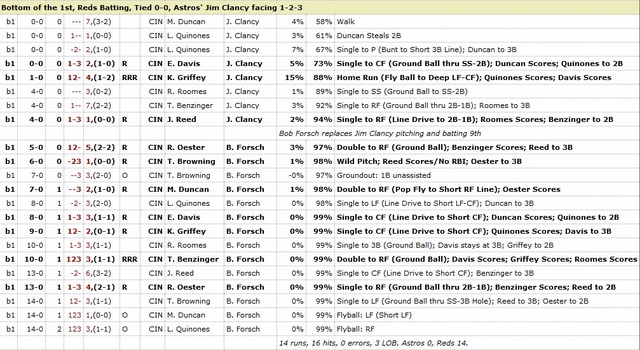
That's 14 runs on 16 hits in the first inning for the Reds. Egads.
Best state of the art accomplishment: The AstroDome
Roy Hofheinz, who was part of the group that helped bring an MLB franchise to Houston, had a vision of creating the world's first indoor sports stadium. He helped make that a reality with the AstroDome, which opened in 1965 as the first domed stadium in sports. The Astros called it home from 1965-99.
Best uniform: The shooting star
I know a lot of people love the "rainbow" uniforms the team wore from 1975-86, but I declare the shooting star uniforms of 1965-70 to be the best in team history:
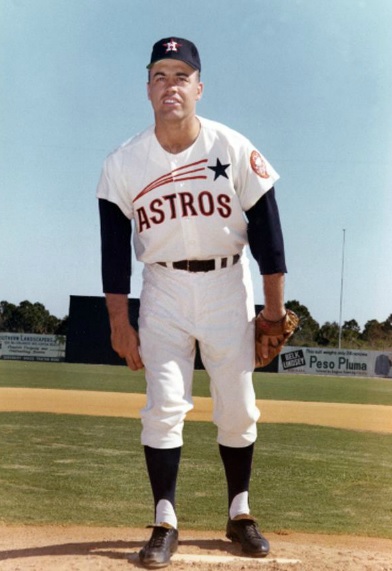
(Photo via the Astros)
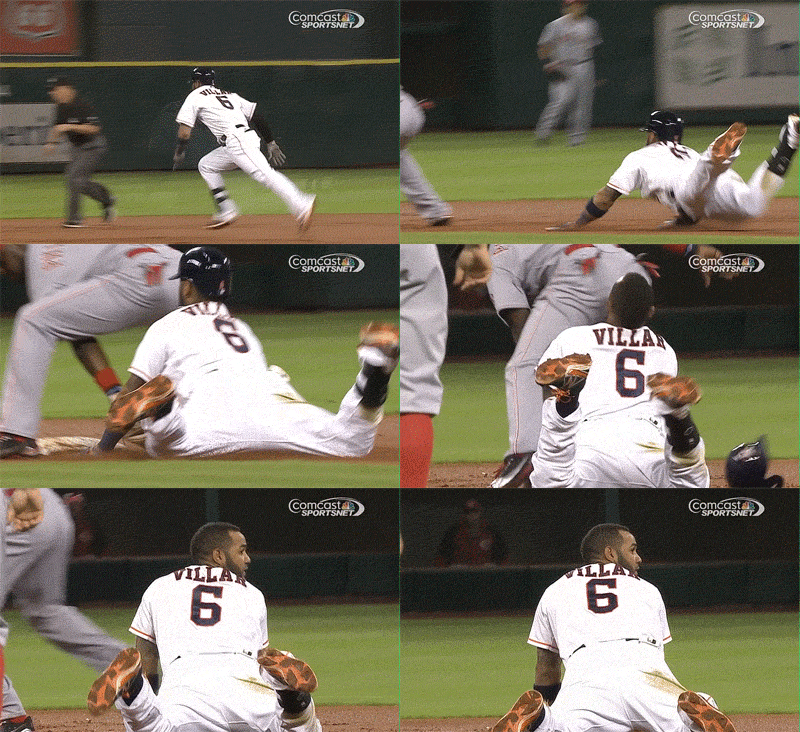
Worst slide: The butt slide
Might as well close with this. Take it away, Jonathan Villar:
Up next: Monday we will cover the Los Angeles Angels and their many other team names.
>> Want more franchise bests/worsts? CHC | MIL | STL | CIN | PIT |CLE | DET | MIN | CHW | KC | NYY | BOS | BAL | TOR | TB | MIA | WAS | NYM | PHI | ATL | COL | LAD | SF | ARI | SD | OAK | SEA