Franchise bests/worsts: Los Angeles Dodgers
The Dodgers have one of the richest histories of any franchise, so we've got plenty to sort through.


We've been venturing through the history of each of the 30 Major League Baseball franchises, discussing some of the best and worst moments, players, teams, etc. It's more of a fun snapshot for discussion purposes than a be-all, end-all declaration. We continue today with the Los Angeles Dodgers.
The Dodgers are one of baseball's most august franchises. They trace their roots back to the 1880s and have become a part of the cultural landscape on both coasts. There's a lot to touch on (and with a club like the Dodgers, it's impossible to hit it all), so let's begin ...
Best team: 1953
No, the '53 Brooklyn Dodgers didn't win the World Series (they fell in six games to the Yankees), but they did go 105-49 in the regular season, which is good for a franchise-record winning percentage of .682. In the National League pennant race, they prevailed over the second-place Braves by a healthy 13.0 games.
The Dodgers that year boasted a powerhouse offense, as they averaged 6.2 runs scored per game. Catcher Roy Campanella and center fielder Duke Snider (future Hall of Famers, each) combined for 83 home runs, and "Campy" won the second of this three MVP awards. Jackie Robinson, a primary left fielder and third baseman in his age-34 season, batted .329/.425/.502. Gil Hodges chipped in another 31 homers, and Carl Furillo slugged .580. The worst OPS+ of any lineup regular was Pee Wee Reese's 104. Consider this one of the best offenses of all-time.
Worst team: 1905
In part it was because owner Charley Ebbets and manager Ned Hanlon were chronically at odds, but whatever the causes the franchise reached its nadir during this period. They cratered in 1905, when the Superbas (as they were then known) went 48-104, got out-scored by more than 300 runs and finished 56.5 games behind the pennant-winning Giants. After the season, Hanlon was fired.
On the upside, it was during this down cycle (the club endured 11 straight losing seasons from 1904 through 1914) that they became known as the Dodgers (though they wouldn't be known as the Dodgers for good until 1932) and moved into Ebbets Field. Better days were ahead.
Best team, Los Angeles edition: 1963
Tough call here, but we'll go with the second L.A. Dodger team to hoist the trophy. The '63 model won 99 games and finished atop an NL grouping in which seven of 10 teams posted winning seasons. In the lineup, Maury Wills batted .302 and swiped 40 bags, and corner outfielders Tommy Davis and Frank Howard authored OPS+'s of 142 and 150, respectively. In the rotation, the luminous Sandy Koufax went 25-5 and put up an ERA of 1.88 over 311 innings (he was named MVP and Cy Young winner that year), and Don Drysdale ran an ERA+ of 114 over 315 1/3 innings. Relief ace Ron Perranoski boasted an ERA of 1.67 in a now-unthinkable 129 innings of work. In the World Series, the Dodgers swept the 104-win Yankees ...

(Image: BigTimeBats.com)
Worst team, Los Angeles edition: 1992
The '92 squad lost 99 games, which is the highest total since the aforementioned days of the Superbas in the early 20th century. The Dodgers that year managed to score just 548 runs, and Brett Butler stood out as the only worthwhile lineup regular. Primary third baseman Dave Hansen batted .214/.286/.299, and Jose Offerman put on a glove and played almost 1,300 innings at shortstop. The '92 team featured Eric Davis and Darryl Strawberry, but each was significantly limited by injury that season.
Best trade: Dazzy Vance
OK, this wasn't so much a trade as it was a case of having Vance foisted upon them. Regardless, the rise of Vance is a certifiable baseball miracle. In 1921, the Robins, as the Dodgers were then known, acquired Vance from the minor-league New Orleans Pelicans only because the Pelicans wouldn't give up catcher Hank DeBerry unless the Robins agreed to take Vance, too. Reluctantly, they finally agreed.
Vance had been a hard-throwing right-hander for the Pirates and Yankees, but he'd seemingly washed out of big-league baseball by the age of 27 and with only 33 MLB innings to his name. However, as the tale goes, an experimental elbow surgery restored his former promise, and at age 31 he began an impossible run with the Robins. From 1922-32, a span that went through his age-41 season, Vance went 187-129 for the Robins and pitched to an ERA+ of 130. During that tenure, he won an MVP award and claimed the NL strikeout title in seven straight seasons.
Vance, the former cast-off, was elected to the Hall of Fame in 1955.
Worst trade: Pedro Martinez
Young Pedro Martinez flashed plenty of promise in his season and change with the Dodgers (147 ERA+ and 127 strikeouts in 115 innings), but on Nov. 19, 1993, they flipped him to the Expos in exchange for second baseman Delino DeShields. Pedro, of course, would go on to author one of the great peaks in baseball history and be elected to the Hall of Fame on the first ballot. Fred Claire had a distinguished career as Dodgers GM, but he missed badly on this one.
What could've been ...

(Image: Omeng.info)
Best draft pick: Mike Piazza
With the 1,390th pick of the 1988 draft, the Dodgers select ... Tommy Lasorda's god-son (actually, Lasorda has said that while he is Piazza's godfather, Piazza isn't his god-son). One pick after Paul Bacosa! One pick before Jim Greenlee!
Sure, it looked like a harmless bit of late-round nepotism at the time, but Piazza of course turned out to be a 12-time All-Star and the greatest-hitting catcher of all-time. In a sensible universe, he'd already be in the Hall of Fame. As 62nd-round picks go, Piazza wasn't a bad one.
Worst draft pick: Bill Bene
The Dodgers picked fifth overall in 1988 -- the same year, of course, that they chose Piazza in the 62nd -- and they spent said high pick on right-hander Bill Bene out of Cal State-L.A. Bene never made the majors in large part because of his lack of control. Across parts of nine minor-league seasons, Bene pitched to a 5.45 ERA and walked 543 batters in 515 2/3 innings (!) ...

Drafted later in the first round of 1988 were talents like Jim Abbott, Robin Ventura, Tino Martinez, Charles Nagy, Alex Fernandez and Brian Jordan. Darren Oliver and Marquis Grissom would go in the third round.
Postscript: Bene would years later be sentenced to prison for, of all things, running a counterfeit karaoke operation.
Best Vin Scully photo: The rainbow
National treasure/greatest of all broadcasters Vin Scully on his very own bobblehead night in 2012 was greeted with a heavenly gesture of appreciation ...

(Image: Ben Platt/MLB.com)
Nothing could be more fitting.
Worst name: Bridegrooms
From 1888 through 1898, this franchise of note was known as the "Bridegrooms," then just the "Grooms" and then Bridegrooms once again. As the story goes, a bunch of Brooklyn players all got married around the same time, so the name rose from that. Bridegrooms! Cummerbunds and second thoughts!
Best rookie season by a pitcher: Fernando Valenzuela, 1981
What a year. In strike-shortened '81, Valenzuela, then just 20 years of age, went 13-7, pitched to a 2.48 ERA, led the NL in innings (192 1/3) and complete games and led the majors in strikeouts and shutouts. Of course, there's was much more to "Fernandomania" than just the impressive numbers ...
ABBA!
Best final season: Sandy Koufax
As final acts go, the great Koufax towers over all. In 1966, Koufax, still just age 30, made 41 starts and worked a majors-leading 323 innings. He completed 27 of those starts (!), went 27-9 and logged a majors-leading ERA of 1.73. He also struck out 317 batters and claimed his third Cy Young award and the pitching Triple Crown.
After the end of the World Series (they were swept by the Orioles), Koufax announced his retirement because of an arthritic elbow. But what a final ride it was.
Now let's admire the artist at work ...
Best decision: Signing Jackie Robinson
Branch Rickey's signing of Negro Leaguer Jackie Robinson of course led to the shattering of baseball's color barrier in April of 1947, and in the process Robinson made American history. Consider him the rarest of people: an unqualified hero ...

Robinson's pioneering is his most towering legacy, but never let it be forgotten that he was also one hell of a ballplayer. Across parts of 10 big-league seasons, he batted .311/.409/.474 (132 OPS+) with 137 homers. As well, he was a famous threat on the bases, and he spent the majority of his career defensive innings at a key, up-the-middle position. Had he been allowed to begin his major-league career at a standard age (Robinson was a 28-year-old rookie), then he likely would've exceeded 2,500 hits. Strip away his immense cultural importance, and Jackie Robinson is still a Hall of Famer.
Worst brawl: Juan Marichal vs. John Roseboro
On Aug. 22, 1965 one of the ugliest brawls in MLB history took place. The Dodgers were visiting the rival Giants, and the game was heavy with tension (it was also a tight pennant race).
In the third inning, Giants ace Juan Marichal brushed back Maury Wills and Ron Fairly, and then when Marichal came to the plate in the home half, Dodger catcher John Roseboro called on L.A. starter Sandy Koufax to buzz Marichal. Koufax, always uneasy with throwing at batters, didn't quite get the task done, so Roseboro took matters upon himself.
After receiving one of Koufax's pitches, Roseboro fired the ball back to his pitcher and in doing so came dangerously close to striking Marichal in the head. Then things fell apart ...
Yes, Marichal struck Roseboro in the head with his bat ...

(Image: Neil Leifer)
Marichal was suspended nine days and fined almost $2,000. Roseboro, fortunately, was not seriously hurt.
The two men later made peace, and Marichal even served as an honorary pallbearer at Roseboro's funeral in 2002.
Best walk-off: Kirk Gibson
Easy call, to say the least. Let's go back to the ninth inning of Game 1 of the 1988 World Series. A hobbled Gibson is at the plate for the one and only time in the series, and one of the great closers in history is on the mound ...
Worst ballpark: L.A. Coliseum
The Dodgers moved to Los Angeles before there was any such thing as the jewel known as Dodger Stadium, so they spent the first four seasons of their California existence in the L.A. Memorial Coliseum. The Coliseum is rich with history and has many merits, but it's not an especially good baseball venue ...
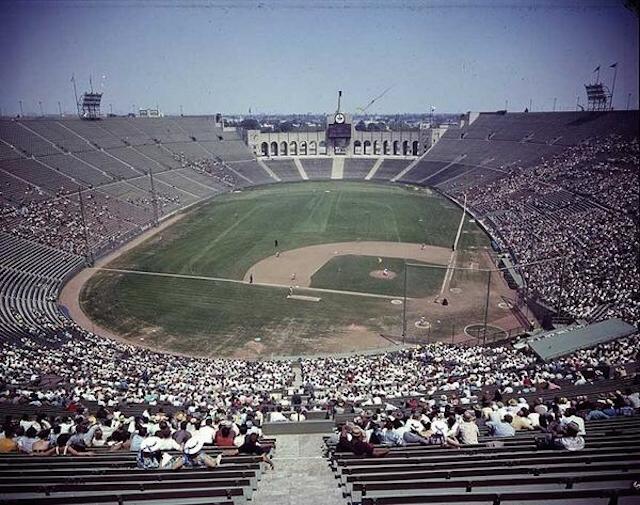
Among other oddities, it was a cozy 251 feet down the left field line, but that was partially offset by a 42-foot screen, which you might be able to make it.
On the other hand, in the 1959 World Series against the White Sox, the Dodgers drew more than 90,000 fans to each of its three home games. That's ... a lot.
Worst demolition
Fare thee well, Ebbets Field in Brooklyn ...
Best entrance
Take it away, Dodger Stadium ...

Up next: Tuesday will be the San Francisco Giants' turn.
>> Want more franchise bests/worsts? CHC | MIL | STL | CIN | PIT |CLE | DET | MIN | CHW | KC | NYY | BOS | BAL | TOR | TB | MIA | WAS | NYM | PHI | ATL | COL