Summer League Buzz: Agent double-dipping on NBPA's agenda
The NBPA is looking into preventing agent conflicts between GM's, coaches and players all having the same agents or agencies.

LAS VEGAS -- Back in November, National Basketball Players Association executive director Michele Roberts expressed her concerns to CBSSports.com about agents double-dipping by representing players, coaches and GMs -- a clear violation of long-ignored union rules.
Now, as the NBA gathers in Vegas to conduct all its offseason business, the union's executive committee could be ready to take action.
League sources confirmed a Grantland report that the NBPA's executive committee will take up the issue of agent conflicts when it meets here on July 20. The most likely solution -- as with the majority of issues in this realm -- will be a compromise, a person familiar with the discussions said Monday.
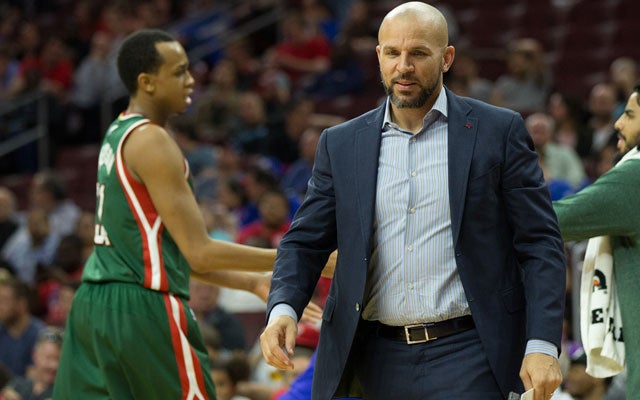
As soon as Roberts was elected to replace the deposed Billy Hunter last July, she was bombarded with complaints about the laxity of the union's enforcement of the regulation prohibiting player agents from representing coaches, GMs or anyone with decision-making power over personnel. As documented by CBSSports.com, the issue came to a head when Nets coach Jason Kidd -- represented by Jeff Schwartz's Excel Sports Management -- tried to topple GM Billy King and gain full decision-making control within the Brooklyn Nets.
Schwartz, who represented Kidd for most of his playing career, also represented several of the Nets most important players, including Deron Williams, Mirza Teletovic and two free agents who ultimately left the team -- Paul Pierce and Shaun Livingston. Though Kidd's official representation was shifted to Excel's coaching division, led by former union official Hal Biagas -- Hunter's nephew -- Kidd himself identified Schwartz as having negotiated his exit from Brooklyn and his new deal as coach of the Bucks.
It is widely known in the NBA that the coach who was forced out in Milwaukee to make way for Kidd, Larry Drew, has long retained player agent Andy Miller as his advisor on contract matters -- if not his official agent of record. As Grantland pointed out, the Excel connection followed Kidd to Milwaukee, as the Bucks have since drafted Excel client Rashad Vaughn and signed another Excel client, Khris Middleton, to a four-year, $70 million deal.
Notably, though, the Bucks did not even land a free-agent meeting with Excel client Tyson Chandler, who left the Mavs to sign with the Phoenix Suns.
There are plenty of gray areas in NBA business, but this is one that Roberts clearly wants to eradicate -- or, at least clarify. In November, Roberts told CBSSports.com, "We can't allow the status quo to remain, i.e., people to act in defiance of the rule because the rule is the rule." But Roberts also understands that she will need to work closely with player agents as she prepares for a potential labor showdown with the owners in 2017, when either side can opt out of the collective bargaining agreement that was ratified in 2011.
"I also want to try to do it in a way that makes sense for everyone," she said. "If it appears that the rule is not something that we can work around, then it's time to enforce it."
She told Grantland for a story published Monday: "I respect the agents, and I don't want to antagonize them unnecessarily. But I don't work for them. I work for the players."
League sources familiar with the dynamics of this touchy subject told CBSSports.com that the remedy most likely to come out of the executive committee later this month is a requirement that representation of players and those with personnel authority must be separated -- a legal concept known as the "Chinese wall."
The only other solution would be to bar entire agencies from representing players and decision-makers simultaneously. But that would seem to violate Roberts' desire not to antagonize constituents she'll need in the coming labor fight, since large agencies like Excel, CAA, Wasserman Media Group and Mark Bartelstein's Priority Sports represent the lion's share of NBA players and also have divisions that handle coaches and executives.
Whatever outcome the union decides, Roberts made it clear to Grantland that there will be no more ambiguity.
"My only position for now," she said, "is that whatever rule we end up with, we are actually going to enforce it."
For the NBPA, that would be something new.
Playoff seeding changes coming?: The NBA could finally be ready to address flaws in its playoff seeding formula. In a meeting on Monday in Las Vegas, the league's competition committee closely examined the rule that currently gives a top-four seed to a division winner regardless of record, league sources told CBSSports.com.
The Board of Governors, which meets Tuesday, will be updated on the discussion, though it's possible that a specific change won't be recommended to the Board for a vote until October, a person familiar with the discussions said.
As part of the debate about whether a division winner should automatically qualify for a top-four seed, the committee also examined whether a division winner should get a tiebreak over a non-division winner with a better record. The two rules obviously go hand-in-hand.
This season, Portland received the No. 4 seed in the Western Conference by winning the Northwest Division with 51 victories. The Blazers were seeded higher than the Grizzlies (No. 5) and Spurs (No. 6), who each won 55 games.
The committee is made up of ownership representatives Joe Lacob (Warriors) and Nick Arison; general managers Masai Ujiri (Raptors), R.C. Buford (Spurs) and Sam Presti (Thunder); and coaches Rick Carlisle (Mavericks) and Doc Rivers (Clippers). Lakers GM Mitch Kupchak had a conflict and did not attend the meeting. Former New Orleans Pelicans coach Monty Williams has yet to be replaced.
Moratorium talk: The topic of the free-agent moratorium did come up, but despite the presence of Rick Carlisle and Doc Rivers -- combatants in the recruitment of flip-flopping free agent DeAndre Jordan -- there was no consensus that the procedures should be changed.
The free-agent negotiating period is in place primarily to give accountants and lawyers from the NBA and NBPA a chance to close the financial books and set the salary cap and luxury-tax levels for the coming season after the league's fiscal year ends on June 30. Rather than have extended downtime that could invite even more tampering than already occurs, players and teams are allowed to discuss deals beginning on July 1, but none can be finalized until the moratorium is lifted. This year, contracts could be signed beginning on July 9.
One concept that is gaining momentum in league circles -- proposed here by SB Nation's Tom Ziller -- is to end the league year between the Finals and the draft. That way, the lawyers and accountants would have plenty of time to close the books, and any revenue and expenses associated with the draft would be shifted to the following league year. This makes sense, since the draft is essentially the first event of each new NBA season.
The only question then would be whether to allow players to sign contracts immediately on July 1, a notion that has substantial opposition among league decision-makers. Giving players the opportunity to meet with several teams and make informed free-agent decisions is a process that exists to prevent exactly what happened in Jordan's case. Of course, even with plenty of time to decide without being under duress, Jordan changed his mind, anyway. It wasn't unprecedented, but what league officials have to decide is whether this was an event unique to Jordan and his circumstances or a function of a larger problem that needs to be solved.
The NBA is loath to overreact to one-off events, but there's a strong push from some team executives to implement some kind of change to the moratorium period for next year. Rest assured, whatever changes occur won't impede the league's stranglehold on the news headlines in July, a month that the sport now owns like never before.