
MLB, MLBPA should no longer turn a blind eye to Mets' payroll issues
The MLB and MLBPA can no longer ignore with the payroll issues plaguing the Mets, a team in the game's largest market.

Thursday night, the Mets ran into the buzzsaw known as Clayton Kershaw, getting shut out in a game in which Kershaw threw maybe 10 stressful pitches total (LAD 3, NYM 0). In a vacuum there is no shame in getting shut out by Kershaw, he's the best in the business, but there are plenty of reasons for the Mets to feel ashamed these days.
For starters, this is the lineup the club ran out there against Kershaw, emphasis mine:
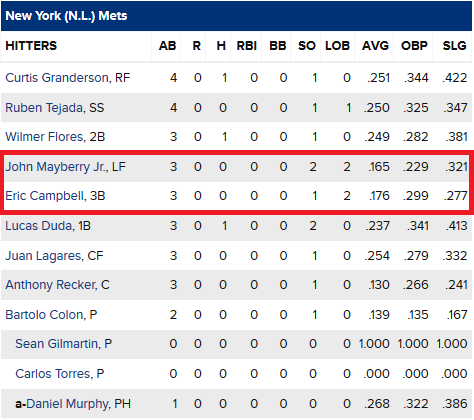
Geez, it's no wonder why Kershaw took a stress-free perfect game into the seventh inning. The Mets had sub-.180 hitters batting fourth and fifth against Kershaw. July is almost over. The season isn't young anymore. That lineup is really bad.
Mets: 2nd team in Live Ball era (since 1920) to have #4 & #5 batter in starting lineup each enter game w/ 100+ AB and BA under .180 (Elias)
— ESPN Stats & Info (@ESPNStatsInfo) July 24, 2015
Of course, bad lineups are nothing new for the Mets, who rank second to last in baseball with an average of 3.43 runs per game. They're averaging just 2.5 runs per game over their last 30 games, which is unfathomable. The need for more offense -- specifically in the outfield and at shortstop -- is obvious.
Sure, the Mets have been hit by the injury bug, with both David Wright and Travis d'Arnaud sidelined for several weeks with injures. Wright and d'Arnaud are arguably the team's top two hitters and no worse than two of their best five hitters. Tough to replace those guys. The real problem is the Mets haven't even made an effort to replace them.
The team's only notable transaction so far this season has been claiming outfielder Kirk Nieuwenhuis off waivers from the Angels, the same Kirk Nieuwenhuis the Mets lost on waivers to the Angels two weeks earlier. It was a lateral move. It got them right back to where they started. The lack of movement is borderline negligent at this point.
The offense has been a major problem for weeks, but the real issue lies much deeper. It's the team's payroll. According to Spotrac, the Mets came into the season with a $101 million payroll, the 22nd highest in baseball. That's lower than legitimate small market teams like the Brewers, Twins, Padres and Reds, among others.
This isn't a one-year blip either. The Mets were 17th in MLB with a $99 million payroll last year. The year before that they were 16th at $90 million. You have to go all the way back to 2012 to find the last time the Mets were in the top half of MLB in payroll, and that year they ranked 12th at $108 million. That's a bad trend. They're ranking lower and lower each year.
Mets owners Fred and Jeff Wilpon were caught up in the Bernie Madoff ponzi scheme a few years ago and, as of this February, they owe the trustee over $75 million in recovered funds according to ESPN New York's Adam Rubin. The Wilpons purchased the Mets in 2002 and for a while ran high payrolls -- they sported a $142 million payroll as recently as 2011 -- but team payroll has been slashed tremendously since the Madoff scandal.
It's getting to the point where the Mets won't even put salary savings back into the team. The club has insurance on Wright's contract and reliever Jenrry Mejia was suspended 80 games after testing positive for a banned substance, saving the team a portion of his salary. Here's the math:
$81,967 - Mets insurance savings every day Wright spends on the DL $4.43M - Savings through today from Wright insurance & Mejia suspension
— Chris (@tpgMets) July 22, 2015
And yet, on Thursday, GM Sandy Alderson told reporters that $4.4 million in savings (and counting!) does not give the team any added payroll flexibility at the trade deadline:
Alderson says the insurance money Mets have recouped from Wright's deal won't allow them more financial flexibility in trades
— Mike Vorkunov (@Mike_Vorkunov) July 23, 2015
That is unbelievable. I hope Alderson is just posturing and trying not to give other teams the impression he has money to spend so he can make he best possible deal. I really hope that is the case, because otherwise the Mets are a total embarrassment. To themselves and MLB.
Things have gotten so bad that one fan started a Go Fund Me campaign to help raise $3 million so the Mets could add a bat at the trade deadline:
The fan, Etan Bednarsh, is not serious of course. The campaign is meant to publicly shame the Mets for their offense and payroll problems. To say the fan base is upset with the state of the offense would be a big understatement.
After running Frank McCourt out of the game due to financial problems a few years ago, the league has done little with regards to the Wilpons during their recent payroll woes. In fact, MLB floated the team a $25 million loan a few years ago to help cover basic day-to-day expenses. Former commissioner Bud Selig is close with the Wilpons and it's hard not to view this as preferential treatment following the McCourt drama.
"I've known both Fred and Jeff Wilpon a very long time," said commissioner Rob Manfred to Rubin recently. "I know they are absolutely committed to winning and that they will spend money when they think they can spend money and have it be effective in terms of making that team better."
The evidence says otherwise, that the Wilpons will not spend when it could improve the team. They have long lost the benefit of the doubt. Even with that miserable offense, the Mets are three games back both in the NL East and of a wild-card spot. That stellar young pitching staff is keeping the club in contention despite the offense's best efforts.
Any other large market team would be aggressively looking to improve their offense at the trade deadline given how close they are to contention, and the ability to absorb salary would be a nice trade chip. Carlos Gonzalez (owed $45 million through 2018), Jay Bruce ($19.5 millon through 2016), Troy Tulowitzki ($108 million through 2020) ... those types of players should be options for the Mets, but ownership's unwillingness or inability to add payroll doesn't allow it.
The MLB Players' Association has been mostly quiet through this whole payroll slashing/Madoff scheme business. A few years ago the union raised concerns about the Marlins' payroll -- remember when the Josh Johnson contract extension came out of nowhere? That was because the union complained the team's payroll was too low -- but nothing like that has happened with the Mets.
Here's what MLBPA chief Tony Clark told Mike Vorkunov of NJ.com about the Mets' payroll situation back in spring training:
"We monitor everything," he said. "It is an opportunity for us, as we monitor, to learn, understand and appreciate the dynamics of any one particular club at any one particular time. To the extent that a club has a plan and is functioning according to that plan, depending on what those considerations are and how they manifest themselves in respect to the payroll and the play on the field, we will interject ourselves when necessary.
"But rest assured whether it's New York or anywhere else, we watch very closely what is happening and often times have conversations that don't end up on the front page but are happening behind the scenes for understand and appreciate what is going on."
So the union is monitoring the situation but not yet doing anything. It's time for something to happen. The Mets are a large market team with a beautiful six-year-old ballpark and their own television network that is slashing payroll and reportedly refusing to take on cash at the deadline. MLB and the MLBPA shouldn't let this continue.
Remember, we aren't talking about a team that should be spending an extra $10 million or so. This is a New York team with a new ballpark. The Mets' payroll should be up around the $189 million luxury tax threshold, alongside the Tigers and Red Sox and Angels. The market affords them that luxury. But, for starters, how about just getting payroll up into $140 million range, in the upper half of the league? That would be a nice first step.
The Mets have a championship caliber young rotation, but Alderson & Co. have not given them a quality supporting cast, in large part due to payroll restrictions. If that doesn't change and soon, the club will miss their window to win, because guys like Matt Harvey and Jacob deGrom are going to get mighty expensive through arbitration real soon. It's time for MLB and the MLBPA to get involved, the same way they did with McCourt a few years ago.