
NEW YORK -- "Do you want to be great?"
There's a very small population of the world that ever gets to seriously entertain such an ambitious and potentially braggadocios query. Even when you break it down to the elite few hundred individuals in the basketball world playing in the NBA, you still only have a handful of players who get to truly consider that possibility.
By the end of the 2013-14 NBA season, we had more than a few teams that were not necessarily intentionally losing games -- because that flat-out doesn't happen -- but they weren't putting the best possible product on the floor because losing was advantageous to the team's future. One of the big reasons for this team-building strategy was to have a shot at drafting Andrew Wiggins -- the spindly Canadian pogo stick with all the potential in the world.
Eventually, Wiggins found himself as the No. 1 pick in the 2014 Draft and two months later was moved to the Minnesota to be the centerpiece of the Timberwolves' latest rebuild. It's been 10 years since the Wolves have made the playoffs, and the level of failure on the floor of Target Center since Kevin Garnett was traded to Boston in 2007 has been rather embarrassing.
Since the Garnett trade, the Wolves have won the fewest games in the NBA with a record of 177-388 -- worse than even a Charlotte Bobcats/Hornets franchise that had the worst season in NBA history (7-59 in 2011-12) during that span. The Wolves are currently the poster franchise for perpetual futility.
The task of pulling the Wolves out of such failure and returning them to the playoffs isn't just on their latest young phenom in Wiggins, but it's mainly in the hands of the part-owner/president/coach Flip Saunders. Wiggins is the future star of this team, but the expectations and the draft position don't mean anything if Saunders and his coaching/development staff can't harness the potential of the young wing and turn him into something great.
And more importantly, Wiggins has to want to be great.

Wiggins defended Dwyane Wade during the final 4:48 of a close game in Miami. The Heat saw one of the best perimeter scorers in NBA history being defended by a rookie less than two weeks into his career and decided to attack.
"He asked me if I wanted to be great," Wiggins said.
During the final 10 possessions of the game, Wade was asked to attack on seven of them. Wade scored six points in those seven possessions, with two of them coming against Wiggins' defense and one on a switch by the Wolves that left Wade isolated against Mo Williams. Twice Wiggins made Wade pass out of his move because he was covered so well, once Wade knocked down a baseline jumper right in the face of the rookie, and another time Wade split poor pick-and-roll coverage by Nikola Pekovic and drove in for a big dunk.
Wiggins didn't shut down Wade but he also held his own in yet another feet-to-the-fire test Saunders has been putting him through. Wiggins has had to defend Jimmy Butler, Joe Johnson, James Harden and Wade over the last few games, forcing him stop guys that are adept at getting buckets. If you're a scorer in the NBA and facing the Wolves, Wiggins will be assigned to defend you as he tries to learn and comprehend just what it means to be an elite defender.

These assignments are just a drop in the bucket of what it will take to turn Wiggins' potential into a reality. It's something the developmental/assistant staff works on every day as they try to turn Wiggins into their next Kevin Garnett -– a sublime two-way player that can help change not just this franchise's lot in the NBA but the way the position is played around the league. But how do you unlock that potential?
"We've put him on other team's top players, defensively," Saunders said, "and does he get some lessons learned? No question. That's what it means to be a rookie. But I believe really how he's played and what he's done, he's not trying to do too much -- play within a system. He's done it extremely well.
"People that have watched us play, we'll see a three- or four-minute stretch where he'll be able to take over a game offensively. Eventually, we're hoping he's going to be able to do that over the course of 48 minutes and not just three or four."
What has typically made the NBA's best defenders excel is that they couple their incredible physical gifts with a mentality of being hungry to defend. It's a challenge they look forward to even though while "defense wins championships," it's ultimately a thankless job in the public eye. Nobody pays to watch a great on-ball defender. They pay to see buckets because scoring drives entertainment value. The great defenders are trying to stop that entertainment from happening every time down the floor. That matters.

Andrew Wiggins gets excited about playing defense -- a rarity for a 19-year-old in the NBA.
"It was fun," Wiggins said following a night in which Joe Johnson lit him up in the fourth quarter but the Wolves pulled away with the road victory in Brooklyn. "It was exciting. He makes you work.
"I take pride in [defending the opponent's best scorer]. It's something that excites me, gets me amped for the game, just thinking about [guarding] the team's best scorer."
Not many players have fun when one of the best scorers in the NBA is taking it to them. Johnson scored 11 points in that fourth quarter with 10 of them coming against Wiggins (the other one coming after Ricky Rubio fouled him on a reach-in). Perhaps it was fun for Wiggins because it was yet another defensive learning experience, and he was able to get two key stops on Johnson as the Wolves secured the victory.
Finding a player that finds defense to be fun and something he craves is what you want out of any NBA prospect. Memphis staunch defensive wing Tony Allen said as much to Shaun Powell back in the 2012-13 season.
"I take pride in this," he said. "This is what I do. And not too many people want to do what I do. It's high risk and low rewards. There ain't no glamour, magazine covers, hype and definitely no money."
The difference is that Wiggins will get the glamour. He is appearing on magazine covers and television commercials. Wiggins has all the hype in the world, and a healthy career could net him hundreds of millions of dollars. We just have to figure out how good he can become.
Saunders has often made the comparison to Garnett when talking about Wiggins, how Wiggins is a two-way player the way Garnett was almost immediately in his career. Saunders used to put Garnett at the top of a pseudo-defensive zone (back before they were as legal as they are now) to create havoc for opposing lead guards. We've seen some glimpses of this with Wiggins, but it's not quite a regular practice yet.
Saunders is also careful about making comparisons between Wiggins and other players. The coach doesn't think it's fair to the rookie, but he also wants him to become his own player on the court. As long as he keeps the two-way capability, Saunders believes Wiggins will become a star.
David Thorpe, executive director for the Pro Training Center in Clearwater, Fla., and NBA Analyst for ESPN.com, offers up an interesting and exciting comparison for the defensive end of the floor in a former Los Angeles Lakers defensive guru.
"Start thinking about the best defenders ever to play this game," Thorpe said. "To me, I don't know if anybody's compared this before but I think he's the most similar to Michael Cooper. Really long, more athletic than Coop was and he was a special athlete. With the disposition of 'I like this, I can do this.'"
Thorpe has been a basketball coach for 27 years and has worked with dozens of players who have played in the NBA or in international pro leagues. Two of his clients at Pro Training Center include Wiggins' teammates, Corey Brewer and Kevin Martin. Brewer has been known as a defensive role player in this league -- "a mosquito-type pest defender," Saunders said.
Wiggins is slight of build like both Brewer and Martin, but his length and quickness make him the prime defensive player for the Wolves moving forward. His commitment to sound defense, even at this early stage in his career, has kept him out of the "Gamblers Anonymous group" that Saunders worries about on the defensive end of the floor. While Wiggins is certainly susceptible to making rookie mistakes on defense, overall he's been reliable.
"He's got everything to be as elite as, like I said, Michael Cooper," Thorpe said. "He's a better athlete than Bruce Bowen. Think about the best wing defender. That's why I say Coop because he's got that chance. Active feet, active hands. Really long with great size to guard 1, 2, 3, and 4s. As he gets stronger, he'll be able to defend a lot of stretch-4s.
"If he doesn't become a First Team All-NBA Defensive player, it's a failure by him and his coaching staff. You can't say that about a lot of guys, but that's his future."
Trying to enhance Wiggins' defensive capabilities by adding more muscle to his frame would be a mistake. In doing so, you risk a loss of athleticism and future injuries.
"It would be a gigantic, enormous, criminal mistake if he were to bulk up," Thorpe said. "I believe, and I believe over the next 10 years we'll see it more, that's one of the reasons why guys get hurt so much more. Their skeletons are made to hold a certain body type. Bone density is different with every player. There's a combination there of your bones and your muscles that you need to respect. He is this incredible athlete that needs to look like that at all times.
"I think Wiggins is so elite as an athlete, it would be a shame to lose that so he can be stronger. He's going to develop strength anyway over time."
The comparison harkens back to Garnett once again because KG never put on much bulk, but he still grew stronger. It allowed him to take the punishment of playing power forward in the NBA while avoiding costly injuries most of his career. But Wiggins needs to keep that athleticism because it's what separates him from being potentially good and being potentially great.
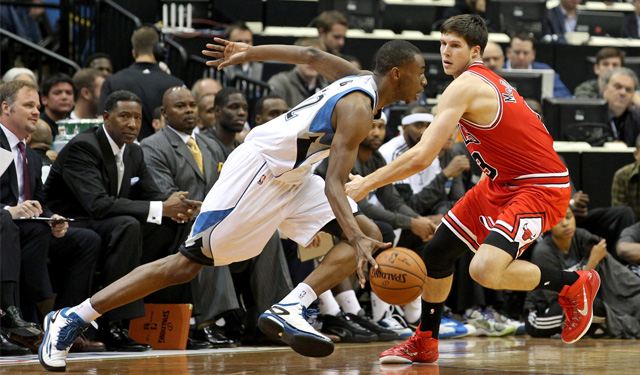
Show up early enough to a Wolves game and you'll see a couple of things. Assistant coach Ryan Saunders will put Wiggins through some dribbling and shooting drills. Following Flip Saunders' firing in Washington, the Wizards retained Ryan for two seasons as he helped
In the Wolves' pregame warm-ups, there will be passes through each drill in which Wiggins looks like he's starting to grasp the skills he's being asked to possess. The ball will pop off his fingers and return to them from the ground as if he were finagling a yo-yo. On the next pass through the drills, it may look as if Wiggins were attempting to dribble a football, showing just how much work has to be done.
Immediately after the physical sessions on the court, you'll see Ryan Saunders and Wiggins sitting in chairs on the sidelines with a laptop. They're reviewing video of what the opponent likes to do on both ends and how Wiggins can take advantage of certain spots on the floor. But getting to those spots is tricky when you haven't quite developed the strength or skills to do it.
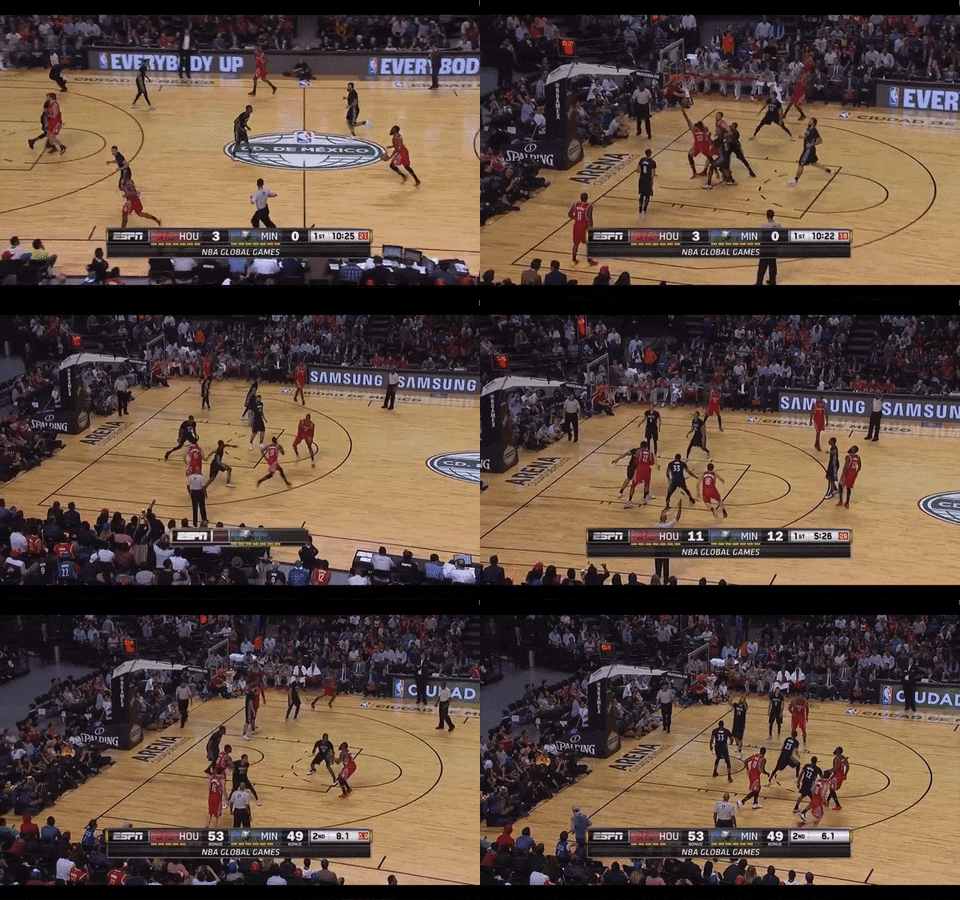
According to SportsVu tracking data, Wiggins has 179 touches in six games this season (the Wolves have played seven but one game was in Mexico City where the arena does not have player tracking cameras installed). Wiggins has driven the ball to the basket just 12 times in those 179 touches, which makes sense considering he still struggles with dribbling.
When Wiggins is attacking the basket, he's much more confident going baseline than going toward the middle. That can be tricky because most teams try to force offensive players there because the baseline acts as a sixth defender. With Wiggins attacking, the court is always tilted toward the baseline, almost as if there is a magnetic pull between him and the line.
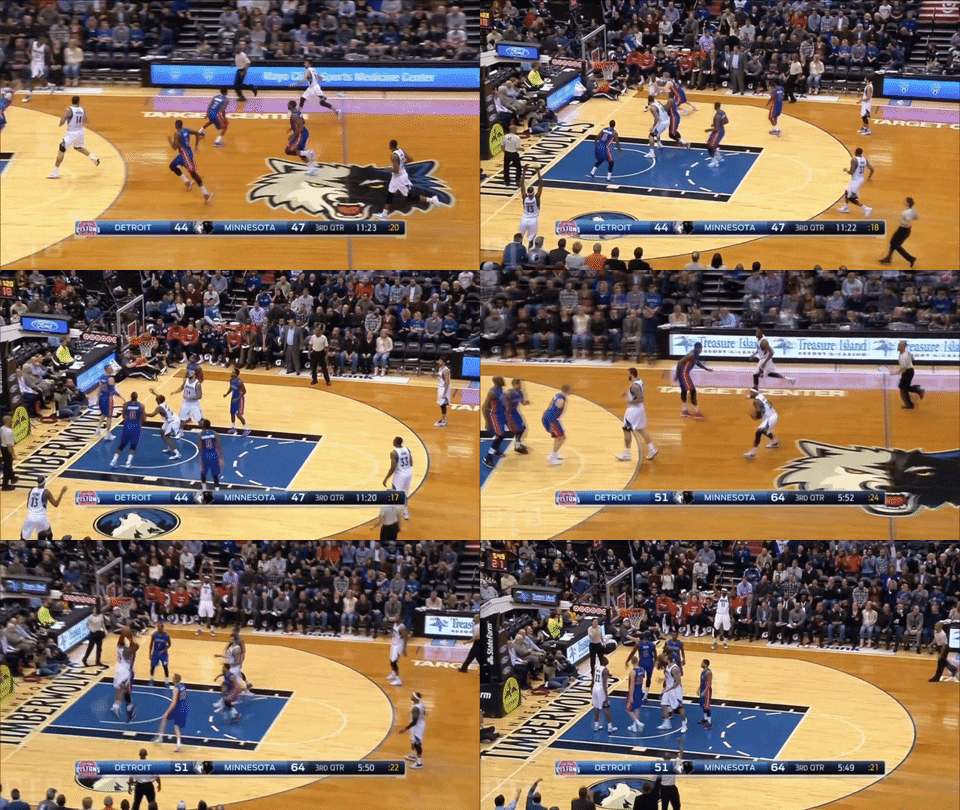
The Wolves are heavy into film sessions, dedicating time every day to showing players things to improve upon, things they're doing well or things to look out for with the opponent. Thorpe suggests a way to build confidence and awareness in Wiggins' dribbling ability is to show him film where the spaces on the floor are and where they want him to get on the floor. By showing him the visual aspect, it helps develop the necessary ball handling skills to attack those places. It's a way of training 1-on-0 in practice that gives Wiggins the understanding of where the other nine players will be when it's time to apply it to a game setting.
It makes sense. While Wiggins struggled at times to assert himself offensively in his one year at Kansas -- and some of that can be chalked up to a lack of assertiveness at times -- the floor of a college game isn't spaced like the NBA. As Wiggins admittedly works on learning the pace of the NBA, the spaced floor of an NBA game is something he can take advantage of because of his athleticism.
"I feel like it's better for me," Wiggins said when I asked him about the transition from college to the NBA. "I like to go to the basket, so I feel like the more space there on the court, the easier it gets for me."
Understanding that space and being able to navigate it and explore it for the most efficient opportunities will be the key to how good he can become offensively. You want to marry production and efficiency because one without the other, no matter which one it is, doesn't help you become a great player.
"Unless you're LeBron James, Kobe Bryant in his prime, a few other guys, and Dwyane Wade, you going baseline is going to be a 10 or 15 percent chance of success," Thorpe teaches his players. "Those guys are just so athletic with size that they can get to an angle and still use the backboard.
"Well, when I say it now, I'll add Andrew Wiggins to that list. He is long and athletic. He's done it a couple times where he's gone baseline, there's no angle to use the backboard, and he still does. Because he can jump really high and he's long enough to be able to create that angle situation."

It doesn't matter if we’re a little over an hour from tip-off in Brooklyn or a little over an hour from tip-off in Miami, the routine is the same. Wiggins and Ryan Saunders are working hard on one-dribble pull-up jumpers, spot-up jumpers, and moving to either side before unleashing a solid shooting motion.
Rip through and get balance on your shot. Make sure the footwork and base of your jumper are solid. Form, repetition, and comfort are everything.
When the shot isn’t falling out of the post in warm-ups, Saunders abandons his post as passer and provides resistance as a defender. It immediately snaps Wiggins out of a cold streak on his shooting and the rhythm is found again. Drills are over and they’re back to the laptop, reviewing pertinent scouting for the night’s game.
“Just getting into a rhythm,” Wiggins explains about the routine with Saunders. “Making shots and seeing the ball go through the hoop before the game begins.”
The jumper looks relatively comfortable. In fact, he looks more at ease taking a step-back jumper than he does attacking the basket. The footwork is quick and the movement is compact. It’s something he flashed at Kansas, and it’s something he’s relying on with the Wolves.
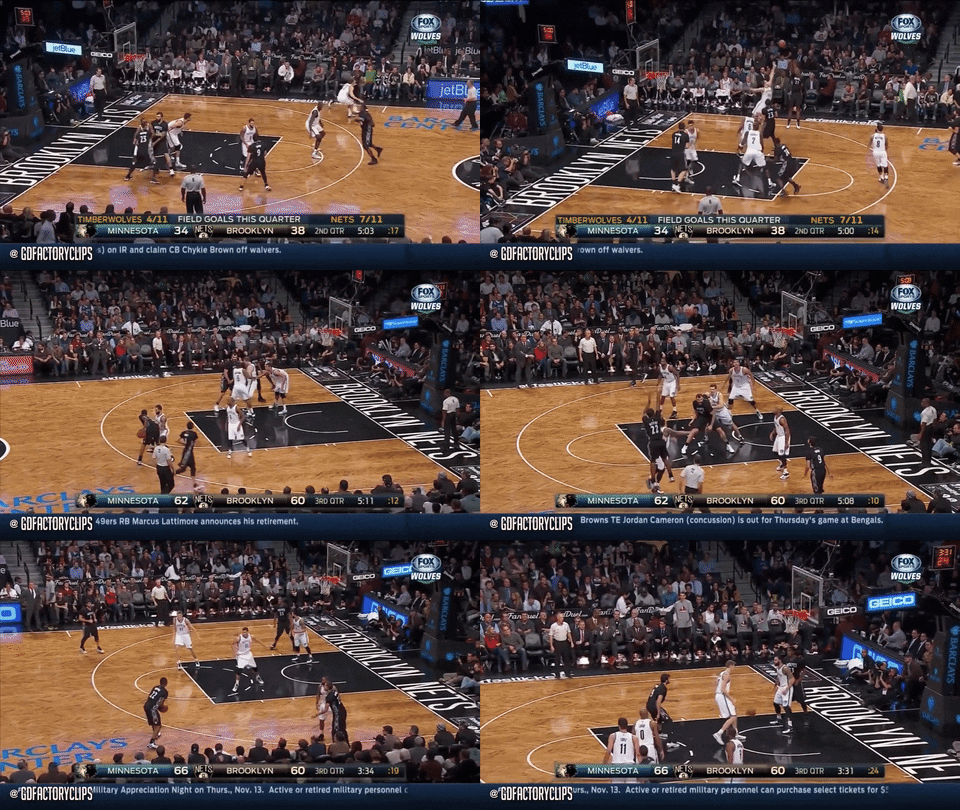
“I, personally, think his shot looks really nice for a 19-year old, as good as almost any 19-year old that has that kind of athleticism,” Thorpe said about Wiggins. “I think the bigger thing now is I think he looks more concerned at times with looking good when he shoots it than just trusting his shot and just stroking it.”
Thorpe has honed plenty of jumpers in his time, and maybe his ability to help Kevin Martin keep such a funky delivery so pure and consistent is at the top of his résumé when it comes to coaching. But in discussing Wiggins trying to look good with his form, Thorpe talks about when he worked with Martell Webster while he was on the Wolves.
Webster was always a good shooter when he was with the Blazers, making 37.2 percent of his 3-pointers when he was with the Portland Trail Blazers. When he joined the Wolves, he dealt with a serious back injury that debilitated quite a bit of his movement and effectiveness on the court. His 41.7 percent from 3 his first season with the Wolves dropped to 33.9 percent in his second, injury-riddled season.
Thorpe started asking Webster to bank in 3’s from the top of the arc. Bank in the 3 and back up a step or two. It forced Webster to stop aiming the shot so much and just let it fly with a natural form that doesn’t require thinking when shooting. Wiggins could benefit from a similar skill development process.
Wiggins could also benefit from shooting to make shots. It sounds basic, but some guys who have reputations as not being assertive or aggressive enough, end up taking shots to prove that they’re assertive or aggressive. The only reason you should ever take a shot is to make the shot. It’s a mentality that is surprisingly lacking in a chunk of players in the NBA because of all the pressures and outside forces. The best shooter and scorers put up shots to put up points.
“Like most rookies, he’s had times when he’s been spectacular,” Flip explained, “and he’s had times when he’s had what you’d call ‘wasted minutes,’ where you haven’t noticed him on the floor. Try to eliminate as many wasted minutes and empty minutes, and try to turn those into productive-type minutes.”
When Wiggins floats offensively and doesn’t make himself active on both ends of the floor, he comes out of the game, much to the chagrin of many fans. But it’s to remind Wiggins that he has to earn his time and not be given a sense of entitlement in this league just because of his draft position. The Wolves want him working toward greatness.
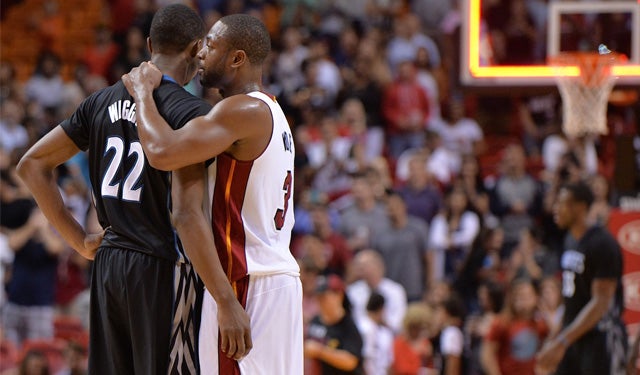
"He said to keep going hard," Wiggins said when I asked what Wade said to him. "He asked me if I wanted to be great and I said yes. He said I've got all the tools to be great, just keep working."
You'll hear Saunders talk about facilitating Wiggins' development and the development of all the young, promising players the Wolves have on their roster. But the development of Wiggins will be the difference between ending the playoff drought or continuing the streak of futility.
"Do you want to be great?"
He does and everybody around him believes he will be.
With a smile on his face, Wiggins said, "Already, I'm thinking about what [Wade] said and I'm going to carry it with me for a long time now."