Knicks-Pacers: Roy Hibbert's denial inside is a big Knicks problem
In Game 1 of the Knicks-Pacers series, Roy Hibbert shut down the interior, a place where the Knicks have to be successful.

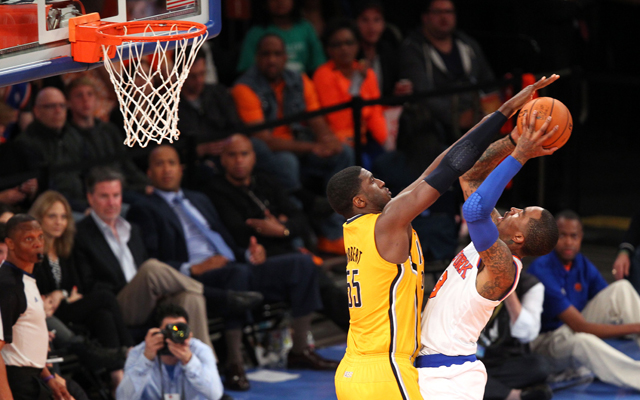
In a league that is so perimeter-oriented, Roy Hibbert showed in Game 1 against the New York Knicks why the Indiana Pacers' reliance on having him protect the rim is so important for their success.
The Pacers were the best defensive team in the NBA this season for a multitude of reasons. They protected the 3-point line better than any team in the league. Opponents only shot 32.7 percent from downtown against them because they rotate well and aggressively close out on shooters. Only the Chicago Bulls allowed fewer attempts from the corner three spots, but no team allowed fewer attempts from above the break or a lower percentage from both locations.
The biggest reason they were able to defend so aggressively on the perimeter is because they don't have to worry about giving up buckets inside. Hibbert helped the Pacers allow a league-best 53.3 percent inside the restricted area this past season. The second-best team, the Denver Nuggets, was a full two percentage points behind them at 55.3 percent. Nobody turns shots away inside like the Pacers and they reminded the Knicks of that in the opening game of their second-round series.
The Knicks took nearly half of their attempts inside the restricted area but couldn't find any kind of success in there. Take a look at their shot chart on the day:

Converting only 44.1 percent of their shots inside was the main reason the Knicks couldn't get enough momentum on offense to defend their home court against the Pacers. And Hibbert is a big reason they were able to turn away so many shots inside.
This is something the Knicks have struggled with all season long and they struggled with converting interior shots in Round 1 against the Celtics. They had the worst restricted-area percentage in the opening round at just 52.4 percent, which was down from the 57.9 percent (21st in the NBA) during the season. When the Knicks struggle inside, they become solely a perimeter team, and we know the Pacers can defend the perimeter.
It's not like the Pacers or Hibbert were perfect in protecting the interior. They gave the Knicks 23 free throw attempts, and Hibbert had five fouls in the game. But he also blocked five shots and contested a handful more.
The thing you notice the most when Hibbert is challenging shots is he's not afraid of contact. That can be both a good and a bad thing. It's good that he fits into the Pacers' idea of "bully ball" on defense. He doesn't allow the offensive player to have space to get the shot off and takes away a lot of room for a fluke make against him because of his height and length. The bad thing is it gets him into foul trouble because of the contact he happily takes on.
His presence inside can easily get into the Knicks' heads.
On most attempts inside, Hibbert does a great job of staying upright defensively. Considering he's 7-foot-2 and has a wingspan near about 7 1/2 feet, that's like trying to shoot over a coach who tries to affect your shot with a push broom. Even if the Knicks can get the shot off without Hibbert tipping it or sending it the other way, you either have to be an expert at putting English on the ball off the glass or hope Hibbert's contest leaves an offensive rebounding opportunity for your team.
The Knicks attacked in the right way. They ran only 15 isolation sets and ran 54 pick-and-roll plays, according to Synergy Sports. But we saw a similar attack from the Miami Heat in the 2012 playoffs. The way the Heat got around it is by using Hibbert more in high pick-and-rolls to pull him away from the basket. The Knicks could make a similar adjustment to suck the defense in and either get easier shots at the basket or create space on the perimeter to get their smothering outside attack going.
But they're going to have to change something when attacking Hibbert. They don't have anybody who is longer than him, and they don't have anybody who can consistently jump over him on attempts. The only other thing they can hope for is that he'll foul out early and not approach the 39 minutes he played in Game 1.