Why young NBA big men are struggling to stay on the floor and what future holds for Zach Edey, Dereck Lively
Recent injuries to young 7-footers are raising more questions about durability

•
9 min read
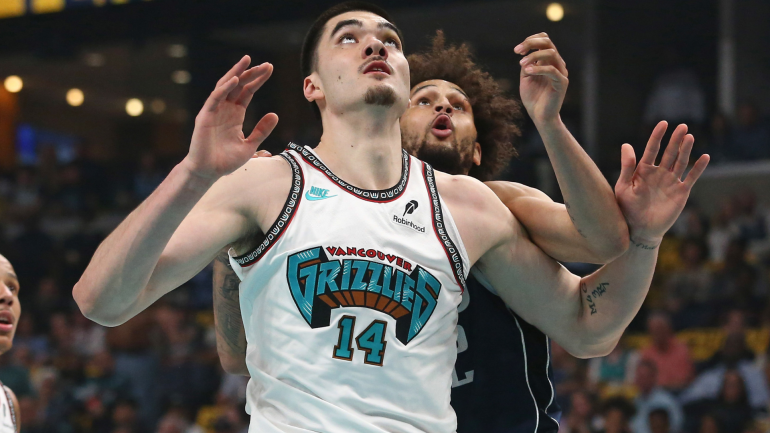
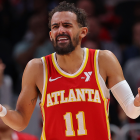
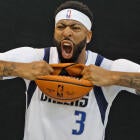
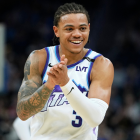
Recent injuries to Dereck Lively II and Zach Edey may not stand out as especially newsworthy to the casual NBA fan. But to draft enthusiasts and those who study roster trends, the injuries to Lively and Edey (7-foot-1 and 7-foot-3, respectively) are indicative of a concerning recent trend related to the durability, or lack thereof, of young big men.
There were two centers picked in the first round of the 2023 NBA Draft: Victor Wembanyama at No. 1 and Lively at No. 12. As rookies they played 71 and 55 games, respectively. Last year, those numbers dipped to 46 and 36. This year, they are on track to dip again. Wemby just returned from a calf injury, and now has played 13 of 25 games this season. Lively played just seven times before it was announced he would miss the rest of the season after foot surgery.
The 2024 draft had better big man depth up front. Alex Sarr (2nd overall), Donovan Clingan (7th), and Edey (9th) were lottery picks. Kel'el Ware (15th), Yves Missi (21st), and DaRon Holmes (22nd) went in the first round. Of those six, only Missi played in more than 67 games as a rookie, while Holmes missed the entire season.
In total, those eight first-round draft picks have played in 655 of a possible 1012 regular season games since they were drafted. That's an average of 65% -- or roughly 53 regular-season games per year.
Now, of course, some of this is contextual, but we can acknowledge that there could be a pattern forming. With six of those 8 players already slotted as starters, there are possible implications not just for those teams, but maybe even for the league as a whole in terms of how they go about assessing potential durability during the draft process.
To better explore the issue, we spoke to three anonymous NBA scouts.
Why are players, and especially big men, getting hurt more frequently?
Last month, Warriors head coach Steve Kerr spoke about the correlation between pace of play and the increase of injuries, saying the Warriors medical staff "believes that the wear and tear, the speed, the pace, the mileage is factoring into these injuries."
The burden on big men could be even more daunting, according to league sources. "We are asking these players with such size, mass, and length to cover more ground and complete more strenuous activities," one source said. "They have to guard and switch on the perimeter and make plays out of ball-screens, which causes much more downhill momentum than just sitting in the post. Throw is the level of athlete, physicality, and pace and there's more tread on their tires as the year progresses."
That logic seems virtually universal at this point. As Kerr said back in November, "everyone understands it's easier to score if you beat the opponent down the floor, get out in transition. But when everybody's doing that, the games are much higher-paced. Everyone has to cover out to 25 feet because everybody can shoot 3s."
If big men in the league are being asked to do more than ever before, that makes durability more important than ever before, and the processes by which some organizations assess that can differ.
How do franchises assess risk factors in the pre-draft process?
There is a certain baseline that virtually all 30 teams subscribe to. They're all interested in past injuries, procedures or surgeries and lingering issues. It is also standard for draft workouts to include medical exams with team doctors and medical staff.
Beyond that though, there can be some real variance in the way teams approach this topic in the pre-draft process.
"Every team is different on how deep they dive into injury potential and how risk-averse they are," one scout told CBS Sports. "Like everything else, ultimately teams are going to bet on if the talent outweighs the risk."
Some teams prefer to leave it up to their medical staff. "They give us green, yellow or red flags, and if it's yellow, they'll outline what the concerns are. But at the end of the day, we have to make our own judgement."
Others try to rely on the intel gathering that is part of their scouting process to better illuminate the "recommendations" of the medical team. "Have they missed games? Have they missed practices? How far back do we know that history? Is there a history of injuries in the family background? If he's missed things, is it a real injury or is there a low threshold for pain? Further, does he take care of his body? Is he doing the proper work in the training room and taking advantage of every opportunity?"
Another variable that defers per organization is the level of cohesiveness and trust that exists between the front office and the medical team. "Having a great medical staff, that you trust, is a huge factor in the draft process, especially when you get guys in the building." For the best front offices, that aspire to win the margins in every area across the organization, the medical team is just another such category.
What's interesting, though, is that while the front office, and ultimately the GM (or head of basketball operations), is dependent on the medical team's recommendations to make the best decisions possible, the amount of control a GM has over his medical team can vary by organization. While there are some executives that have the authority to make any changes they want, when asked if any GM could replace members of his medical team or go out and recruit more qualified ones, one scout answered, "I don't see that happening [everywhere]."
Beyond the organizational differences in process, the way in which the final decision is executed can also vary by team. "Some owners want final say, and it is incumbent on the front office to sell their vision." Others, let the final draft day decisions be made by the head of the front office, but even then, personal context is important. The more job security the GM has, the more latitude he has to take chances. "For some GMs, if the wrong guy gets injured, it could be a reason why they get fired. The more secure GMs can say 'F it, let's do it.'"
Of course, those more secure GMs are probably the same ones who have the freedom to build the best medical teams, the most thorough scouting intel, and the best practices of organizational collaboration and growth.
What's next for Lively and the Mavs?
In the wake of Nico Harrison's departure, the Mavericks don't have a long-term solution about who is running their front office, and apparently won't have one until the offseason. Michael Finley and Matt Riccardi are being called Interim Co-General Managers until then. Simultaneously, now minority owner Mark Cuban is getting input again, while there is speculation that head coach Jason Kidd could also be in consideration for the GM job. In other words, there are way too many cooks in the kitchen, and the person with ultimately authority -- majority owner Patrick Dumont -- hasn't shown the basketball knowledge or context to make these strategic decisions.
The lack of organizational leadership or hierarchy comes at a critical time for shaping the future of the franchise. With Harrison's vision of building a title contender around Davis and Kyrie Irving now rarely viewed as than more than the butt of a bad joke, expediting the rebuilding process around Cooper Flagg should be the top priority.
The challenge with that though is that outside of this upcoming 2026 draft, the Mavs don't control their own first-round pick again until 2031. The 2027 pick goes to Charlotte if it's not in the top two. OKC has a right to swap in 2028. Houston has the right to swap in 2029 (although Dallas owns an unprotected first from the Lakers), and San Antonio or Minnesota may have swap rights in 2030. In other words, the Mavs are incentivized to lose now, which is why there is speculation around potential deals for Anthony Davis.
Ultimate NBA trade guide: 100 candidates who could move as basketball trade season unofficially begins
Sam Quinn
Further complicating matters is that Lively, who is now out for the season, is eligible for an extension this summer. If not, he's headed toward restricted free agency in the summer of 2027. Two years ago, the idea of not extending Lively would have been almost inconceivable as the rookie played a key role in the Mavs run to the NBA Finals while blocking shots, being all over the offensive glass, exceptionally efficient at the rim, and a great lob partner for Luka Dončić. Now, his archetype could still be hugely valuable alongside Flagg, especially because of their shared Duke lineage and that Lively is viewed as such a great culture guy. The present reality though is his future is just as unclear as who will have ultimate decision-making authority from the front office.
What's next for Edey and the Grizzlies?
Let's face it, Dallas and Memphis have more in common that just young, injured big men. They have franchises that are in a state of flux, albeit for different reasons. While Grizzlies' GM Zach Kleiman is viewed in a vastly different light than Harrison was across the league, he is facing a snowballing number of challenges, which mostly stem from the status of Ja Morant.
Morant just returned from a calf injury that kept him out for almost a month. Before that, his productivity was the lowest it had been since his rookie season, his lack of effort glaring enough that it was called out on an Amazon Prime broadcast, and his public comments about the current coaching staff only making matters worse. Combine that with some off-the-court issues, and Morant's days in Memphis now seem numbered, but moving on from their point guard means essentially a complete course correction for the franchise. We saw the first evidence of that with this summer's Desmond Bane deal, but trading Morant would mark an undeniable new path that could spur additional roster decisions.
The silver lining for the Grizzlies is that they've aced the last two drafts, and thus already starting acquiring young assets, of which Edey is clearly one. The former Purdue big man's transition to the NBA has been far easier than most anticipated, when he's healthy. In that same 2024 draft, they came up with two second round steals, selecting Jaylen Wells at 39 and trading for the rights to Cam Spencer at 53. Wells was named NBA All-Rookie First Team last year and most recently has averaged 18 points per game over his last eight. Spencer is averaging 11 points and 4 assists through 25 games this season while posting 48/45/94 shooting splits. It was more of the same in the most recent draft, as they took Cedric Coward at 11, who already looks like a long-term building block after putting up 14 points, 6 boards, and 3 assists through his first 25 NBA games.
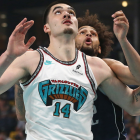
For Edey in particular, durability has always been a talking point because of his sheer size, even by NBA standards. His most recent setback, which his agent, Mark Bartelstein, described as "a management plan to optimize Zach's long-term health in consultation with the Grizzlies and medical experts," doesn't appear to change any of that. Bartelstein added that, "Following this step, the short, and long-term, prognosis for Zach is excellent." The reality though is that Memphis is smart enough to know that drafting Edey would require extra layers of medical care over the years. Simultaneously, it would also dictate some roster and style of play considerations as even the best version of Edey isn't going to be better suited in specific defensive coverages and schemes.
Again, none of that has changed, but has changed is the conversation about his ultimate ceiling in the league, given how dominant he's been in spurts. Ironically, it's that accelerated growth, along with that of Coward, Wells, and Spencer, which may actually make it that much easier to turn the page on the next iteration of the Grizzlies, however different that may end up being.