NFL Coaching Carousel: Which coaching archetype fares best?
There have been 80 full-time head coaches hired since 2002: is it best to hire a former head coach, offensive coordinator, defensive coordinator, position coach or college coach?

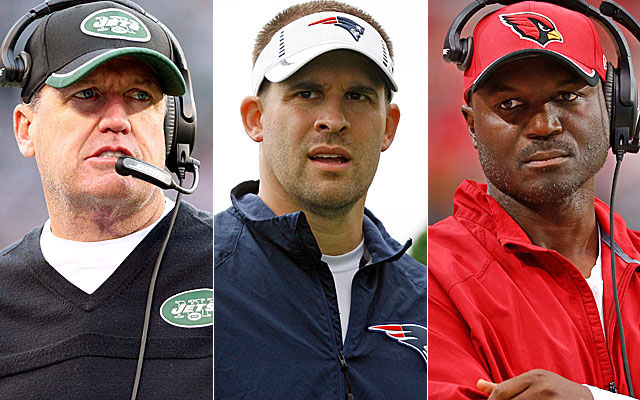 Rex Ryan, Josh McDaniels and Todd Bowles are head coach candidates. (USATSI)
With Black Monday upon us and at least four teams -- the 49ers, Bears, Falcons and Jets, as of now -- looking for new head coaches, now is as good a time as any to look back on the recent history of NFL coaching changes to see which coaching archetype makes for the best hire. Should your team hire a former NFL head coach, an offensive coordinator, defensive coordinator, position coach or college coach? Everyone's got an opinion, but the past can give us a far better window into what actually works and what actually doesn't than just guessing.
The Houston Texans entered the league back in 2002. Since that point, NFL teams have made 83 coaching changes, not including interim coaches who only held the job for a few games before giving way to a new full-time head coach. That means Jason Garrett (who was an interim coach after Wade Phillips was fired and then named the full-time head coach) counts, but Jim Tomsula (who served as an interim coach for the 49ers between the full-time tenures of Mike Singletary and Jim Harbaugh) doesn't.
Of that group of 83 hires, 14 of them were former NFL head coaches, 22 were offensive coordinators, 23 were defensive coordinators, 11 were position coaches, 11 were college coaches, one was a Canadian Football League coach and one was a front office executive.
(Note: Some coaches fall into more than one of the above buckets, so in an effort to simplify things, each coach's categorization is from their most recent job prior to being hired as head coach. That means Norv Turner counted as an offensive coordinator when he took the Chargers job in 2007 even though he had previously been a head coach in Oakland, because he spent the 2006 season as the 49ers' offensive coordinator.)
So, which coaching archetype is best? The answer changes whether you're looking for a quick bump in year one or more sustained success in the long-term.
First, lets take a look at how each archetype fared in terms of winning percentage.
| Coaching success rates (by percentage) | ||||
| Coach Type | Year 1 Win Increase | Win % in Full Tenure | Prior Coach Win % | Win % Change |
| Former HC | 2.25 | 0.471 | 0.378 | 24.6% |
| OC | 0.59 | 0.479 | 0.488 | -1.8% |
| DC | 2.04 | 0.483 | 0.467 | 3.4% |
| Position | 1.73 | 0.492 | 0.520 | -5.4% |
| College | 2.27 | 0.499 | 0.508 | -1.8% |
The "Win % Change" column is expressed as a percentage. A 0.471 winning percentage for former head coaches throughout their tenure is 24.6 percent better than the 0.378 winning percentage those teams posted under the prior regime.
If that's a little difficult to understand, take a look at the same data expressed in the form of wins per year.
| Coaching success rates (by average) | ||||
| Coach Type | Year 1 Win Increase | Wins/Year in Full Tenure | Prior Coach Wins/Year | Wins/Year Change |
| Former HC | 2.25 | 7.54 | 6.05 | 1.49 |
| OC | 0.59 | 7.66 | 7.81 | -0.14 |
| DC | 2.04 | 7.73 | 7.47 | 0.26 |
| Position | 1.73 | 7.87 | 8.32 | -0.45 |
| College | 2.27 | 7.98 | 8.13 | -0.14 |
Despite what you may have heard, college coaches in their first year in the NFL have given teams the largest average year-over-year win increase. The sample is only 11 coaches so it doesn't exactly debunk the theory that college coaches can't succeed in the NFL, but it's certainly interesting that the recent data goes against conventional wisdom.
College coaches are followed closely by former NFL head coaches and then defensive coordinators on this front. Offensive coordinators, interestingly, had the lowest average year-over-year win increase.
Note that "Year 1 Win Increase" numbers for each archetype are all positive. That's to be expected because teams usually do not change coaches unless they were bad in the previous season. Bad teams usually have high draft picks, and team performance usually tends to regress toward .500 over the long term to begin with.
Over the long term, college coaches also averaged the most wins per year in their full tenure as coach, while former NFL head coaches came in last in that category. Former NFL head coaches, though, took over teams that won only 6.05 games per year under the prior regime, far worse than any other coaching archetype.
Taking a closer look at wins per year under the prior coaching regime reveals more interesting trends. College coaches and position coaches took over teams that were, on average, over .500 under the previous regime. That allowed those teams to take more of what is viewed as a risk by hiring a coach from outside the usual circle of coordinator and head coach candidates. Meanwhile, the teams who fared the worst under the previous regime tended to go what is viewed as the safest route by hiring a former NFL head coach.
So, what does this all mean for this year's openings? Jason La Canfora reported a whole host of potential candidates, with five former NFL head coaches, 10 offensive coordinators, four defensive coordinators, four college coaches and one position coach making his list.
Of the four teams currently searching for a coach, the Jets had the worst record this season at 4-12, and indeed La Canfora reported that the Jets are mostly interested in big name former head coaches. The 49ers had the best record of the four teams with current availabilities at 8-8, and they were the only team in La Canfora's report considering a position coach -- their own defensive line coach Jim Tomsula. That all jibes with the track record of teams in the last 12 years. Whether it will actually work out that way remains to be seen.