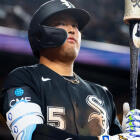
Draft Day Dilemmas: How early should you draft Carlos Correa?
Based on his production as a rookie, Carlos Correa looks like a slam dunk first-round pick, but as Scott White points out, history isn't exactly on his side.

Shortstop is terrible.
It's not a big secret. If the position was as abounding in high-end talent as most every other, Troy Tulowitzki, with all of his injury concerns, wouldn't have been a first-rounder all those years.
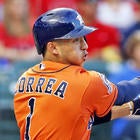
But Tulowitzki isn't the standout he once was, and replacing him at the top of heap is a 21-year-old with only 387 career at-bats to his name: reigning AL Rookie of the Year Carlos Correa.
Just how good was he last year? Well, that other shortstop who nearly beat him for top rookie honors with a monster second half, Francisco Lindor, still averaged 0.4 fewer Head-to-Head points per game than Correa last season. That's like the difference between J.D. Martinez and Nori Aoki. And if you Rotisserie owners project Correa's numbers over a full 162 games, he would have had 36 home runs and 23 stolen bases ... as a shortstop.


That's huge and makes Correa what Tulowitzki once was: the one shortstop whose numbers would make him a stud at any position, deep or shallow. Thus, investing a first-round pick in him seems appropriate.
But unlike Tulowitzki, who we all held our breath before drafting that early, some Fantasy owners seem all too eager to build their teams around Correa, like it's a given he'll pick up where he left off when recent history shows it's anything but.
The sophomore slump sounds like superstition, like something fatherly coaches tell too-big-for-their-britches types to keep them becoming complacent, and that's generally how I've treated it over the years. But that approach has served me poorly.
I was all-in on Brett Lawrie and Eric Hosmer in 2012, drafting them as early as Round 3 and 4 -- and their rookie numbers said they deserved it. Lawrie had nine home runs and seven stolen bases in 150 at-bats, making him out to be a possible 30-20 guy at what was then a weak position, and Hosmer, in a robust 523 at-bats, looked like the second coming of Joey Votto. He at least has settled into something productive, but he hit only .232 with a .663 OPS as a sophomore. Lawrie, meanwhile, increased his home run total as a sophomore by a whopping two despite 344 more at-bats and has been something short of adequate since then.


Remember when Yasiel Puig took the league by storm in 2013, doing his best Mike Trout impression with a .319 batting average and .925 OPS? He didn't live up to the second-round price tag with just 16 home runs as a sophomore and continued to regress last year. And his then-AL counterpart, Wil Myers? Yup, hasn't been the same since. Then there was Desmond Jennings in 2012, Will Middlebrooks in 2013, Jorge Solerlast year ... the list goes on and on.
And before you say, "Yeah, those guys were pretty good prospects and all, but they weren't Correa, a former No. 1 overall pick," consider the case of Jason Heyward. Baseball America named him the top overall prospect, ahead of the uber-hyped Stephen Strasburg, prior to his rookie 2010 season, when he appeared destined for stardom with an .849 OPS. He hit .227 the following year and has mostly underwhelmed since.
In each of those cases, we made the mistake of thinking we knew what we were getting when we hadn't seen enough to make that determination, and it cost us dearly. But at least it didn't cost us a first-round pick. That's the one point in the draft where a wrong pick could ruin you. Given the stakes, isn't an abundance of caution warranted? And if an abundance of caution is warranted, isn't even, say, a 15 percent chance of failure for Correa reason enough to pump the brakes?


But again, even Tulowitzki, with all of his risk, was worth a first-round pick in his heyday, and I'm not saying Correa isn't. You have to realize, though, that some first-round picks are more deserving of the gamble than others.
Obviously, if you have one of the first three, you're using it on Bryce Harper, Trout or Paul Goldschmidt, and Josh Donaldson and Clayton Kershaw seem like obvious choices to go ahead of Correa as well. But Giancarlo Stanton, Anthony Rizzo, Andrew McCutchen, Manny Machado, Nolan Arenado, Miguel Cabrera, Jose Altuve and A.J. Pollock, given how they've progressed to where they are now, are also safer bets for first-round production than Correa. Their upside may not be as high, but they're less likely to burn you.
But see, that's 14 players in all, including Correa, and chances are you play in a league with less than 14 participants. Let's assume it's the standard 12. If you have one of the last two picks in the first round, you could use it on Correa and still get another of those safer options, most likely Altuve or Pollock, with your second pick. If your second-rounder is first round-caliber, what does it matter where you actually took him?
That's when I can get behind rolling the dice on Correa: when the first-round designation is only a technicality. Maybe it's nitpicking, maybe it won't make a real difference in the end, but I'd rather not find myself in a place where I'm asking Edwin Encarnacion or Buster Posey to be my best player. Because as good as they are, they're not that.