In Toronto, hometown hero Cory Joseph makes a name for himself
Raptors guard Cory Joseph is doing everything he can to get his team to the next level.

•
8 min read

TORONTO -- The polite Canadian is upset. You can hear Cory Joseph over the sounds of balls bouncing, sneakers squeaking and trash talking. He is in a shooting contest with Toronto Raptors assistant coach Jerry Stackhouse and teammates James Johnson, Norman Powell, Patrick Patterson and Lucas Nogueira, and he will not stop yelling. It looks like he’s trying to throw everybody else off.
When the competition is over, he explains: On one of his shots, the ball collided with another one before it made it to the rim. His teammates tried to count it as a miss. Naturally, he felt cheated.
“I had to obviously go to the sidelines and check the replay and get the confirmation,” Joseph deadpanned. “That’s it. And then I won the game after that.”
Joseph, 24, and Stackhouse, 41, have been shooting together all season, and other Raptors have joined in. They go around the 3-point line, first to three at each spot. Every time, Stackhouse sees Joseph's demeanor change when the competition starts. Stackhouse calls it a laser focus. Joseph wouldn’t be here without it.
Here, in this case, is home. Joseph grew up in Pickering, ON, a little east of Toronto, and says it’s a little different being downtown now. He sealed the deal on his four-year, $30 million contract in July while “just relaxing” at his older brother Devoe’s place, then he headed to his mother’s house for a celebratory dinner. Joseph’s parents met as university basketball players, and Devoe plays professionally in Montenegro. They used to go to Raptors games together, so joining the team was, as he said at his introductory press conference, “literally a dream come true.”
The hometown hero estimates he’s done 15 times more interviews this season than last year at this time. “I’m not great at it, but I’m getting better every day,” he said, as if he were talking about a flaw in his game. Nowhere else would he get this much attention, and it’s only intensified as the season has gone on. Joseph’s averages of 9.0 points and 2.8 assists aren’t extraordinary, but he’s been arguably the best backup point guard in the league. Given that he’s third in the NBA in fourth-quarter minutes and finishes almost every game alongside Kyle Lowry, it seems a little silly to even call him a backup.
“He’s meant a lot,” Raptors guard DeMar DeRozan said. “If you could give an individual player award to a teammate, Cory should get it. Not just basketball-wise, either. As a teammate, as a friend, for his positive energy around the locker room when we’re on the road. It’s hard to find guys like that. He’s one of the best.”
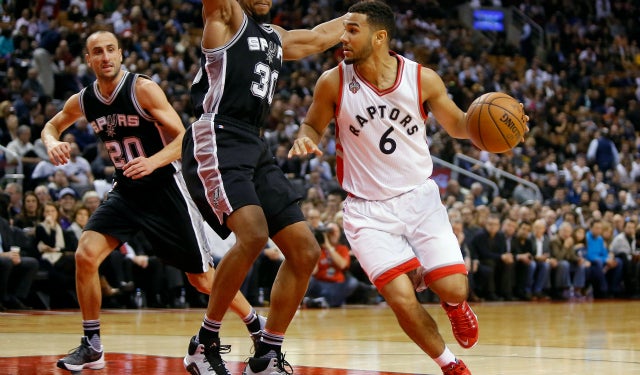
Joseph didn’t anticipate his role being this big, but he said he wanted “to show everybody who I am as a player, and what I’ve been learning for the past four years.” The San Antonio Spurs drafted him with the 29th pick of the first round in 2011, and he remembers having to look himself in the mirror after his first couple of weeks. “I was just a kid,” he said, and knew he had to improve in a lot of areas if he was going to stay in the league.
He barely played as a rookie, but his second season went differently. Joseph asked to go to the D-League when getting DNPs, filled in for an injured Tony Parker as a starter and played meaningful minutes in the NBA Finals. From there, he kept earning more opportunities. Parker never said no when Joseph wanted to go over film with him. T.J. Ford helped him stay positive. Steve Nash worked with him each summer. He won a championship and, eventually, a raise.
“He left us a completely different player,” San Antonio guard Manu Ginobili said. “I was not a big fan of his in the first year. I couldn’t see where his potential was. But with patience, hard work, he was a really hard worker and he turned into a really solid player.”
In Toronto, Joseph is shooting 68.4 percent in the restricted area, which is slightly better than Stephen Curry. He says he worked on that every single day as a Spur, watching tape of Parker and telling himself he wanted to be one of the best in the league around the basket. Now he is always confident he can get clean looks, and he is more aggressive than ever to create them.
This is one of many success stories for the Spurs’ player-development system, but coach Gregg Popovich doesn’t want the credit. Popovich points to Joseph’s work ethic and says, “You don't make somebody that way.” Stackhouse agrees, saying that what separates Joseph is that he wants to do everything he can to prepare himself to perform.
“The Spurs do a hell of a job of developing players,” Joseph said. “I learned a whole bunch with the Spurs, and if I didn’t get drafted by them, who knows?”
Joseph feels he was blessed to land up in San Antonio. “It’s never just one person,” he said, adding that Spurs assistant coaches Chip Engelland, Chad Forcier, Becky Hammon and Ime Udoka all played a part in him being ready when he got his chance. That might not have mattered, though, if he was not the type of kid who shoveled snow and shot with gloves on in the driveway.
“Obviously they helped me become a better NBA player,” he continued. “They give you all the tools for you to get better, and they give it to you in a good way. But it’s up to you if you want to do that or not.”
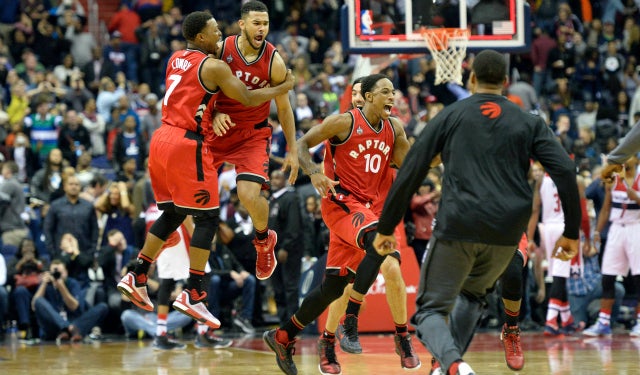
On Nov. 28 in Washington, Joseph caught the ball in the corner and shot it without hesitation. There was no time to think about it, anyway -- the Raptors trailed by one point and time was about to expire. He swished it for the win and ran toward his screaming teammates, who jumped all over him. Postgame, he made sure to mention the extra shooting he’d been doing with Stackhouse.
“You teach your body to do things a certain way, even when you’re fatigued you can have success,” Stackhouse said. “At the end of a game, for him to hit a game-winner, to be ready the way we work on it every day, I mean, that’s gratifying for not only him, but for me, too.”
Joseph has never played anywhere near this much, so Toronto now has to be mindful of not running him into the ground. He struggled offensively in recent road games in Indiana and Miami, and Stackhouse reminded him that he had to get his rest. The two of them played 1-on-1 every day in training camp, but not so much anymore. Joseph is matched up against shooting guards a lot of the time, which can be physically and mentally draining.
Regardless of how Joseph has been feeling, Stackhouse said he’s been “a model of consistency.” Joseph will pester Stackhouse if he leaves out a deflection in his defensive grades, and he will refer to him as an “old fart” in an interview, but he will never question him when he identifies a missed assignment.
If Joseph keeps producing and the third-place Raptors remain near the top of the Eastern Conference, he could be a part of the Sixth Man of the Year discussion. DeRozan believes he should win it.
“If you don’t care about that stuff, you’re not a basketball player,” Joseph said. “Everybody cares about that stuff. But is it a first priority? No. Obviously first priority is for the team to go as far as we can.”
The only time Toronto won a playoff series, Joseph was a few months from turning 10. When Vince Carter missed the shot that could have taken the Raptors to the conference finals, Joseph was heartbroken. Last year, Toronto was swept in the first round. The season before, it was eliminated in Game 7 at home. Joseph’s teammates sometimes ask him about playing in the finals, and he tells them that the Spurs spoiled him with success. He adds that he’d like for the Raptors to keep him spoiled, and it would mean everything to him to advance here.
“It’s something you can’t put into words,” Joseph said. “For the city, it would be amazing. But then again, that’s thinking ahead. And I don’t like to do that.”
Joseph believes part of why he made it is that he never tried to visualize all of this before it happened. He knew he had to do things the hard way, and he just tried to get more comfortable doing what he was asked to do. When he wasn’t playing, he didn’t blame anyone else.
“I didn’t only want to be a jersey; I wanted to be a name,” Joseph said. “I had to create that name for myself and prove every day anything I did, whether it was shooting competitions, 3-on-3, when I went down to the D-League.”
Shooting competitions? Joseph calls himself a different player with more responsibility now that he’s in Toronto, but it’s clear some things have carried over.
“Still the same approach,” Joseph said. “Nothing changes. Still creating my name and still getting better every day. Still working very hard. That’s never going to stop. That’s who I am.”