Bryson DeChambeau, Xander Schauffele among stars who need to make strides in these specific areas
To return to the top of the sport in 2026, some players will need to find their games in ways that propelled them to prior success

If you asked PGA Tour players to define their biggest weaknesses, you would wind up getting myriad different answers: some based on feel, some based on numbers, some based on imagination and some based on what they have accomplished in the past and the heights to which they have previously soared.
Weakness is all relative, of course. A historically good driver of the golf ball who experienced a down season in that area may still have a long-term perspective on his skill set. The same holds up and down the bag. On the other end of the spectrum, players may view certain parts of the game as a lost cause, almost with hopes of occasionally strong weeks complementing the cornerstones of their game.
Let's take a look at where players may have dipped in 2025 -- both from a short-term standpoint and from a "he really needs to fix this" point of view. Were they just down years and not the beginnings (or continuations) of downward trends?
Viktor Hovland's driving
The best iron season of Hovland's career -- he finished second to Scottie Scheffler in terms of strokes gained approach in 2025 -- was met with the worst driving season of his career. Oh, golf, such a fickle game. The former FedEx Cup champion lamented throughout the season that the big stick was in an uncomfortable spot, and it is not a stretch to say it was one of the reasons why he did not win the U.S. Open, where he finished solo third.
"Yeah, a little bitter about my driver," Hovland said at Oakmont. "Just can't seem to figure it out. It's like a lingering problem all this year, so it's kind of pissing me off."
But where exactly did things go wrong with Hovland off the tee?
Hovland's driving statistics
| Category | Value | Rank |
|---|---|---|
Strokes gained: Off the tee | 0.099 | 83rd |
Driving distance | 303.3 | 87th |
Driving accuracy | 63.13% | 58th |
Left rough tendency | 9.09% | 4th |
Right rough tendency | 14.39% | 74th |
Distance from edge of fairway | 25' 6" | 56th |
| Ball speed | 173.95 | 101st |
| Club head speed | 115.64 | 107th |
The biggest takeaway from above? Hovland moved in the wrong direction in terms of speed. In his memorable 2023 season, the Norwegian had an additional 4 mph at his disposal in terms of average ball speed and 3 mph in club head speed. Coincidentally, the faster he swung, the more accurate his ball flew within a tighter window.
Some of this regression could be due to injury -- Hovland had to withdraw from Sunday singles at the Ryder Cup due to a nagging neck injury that popped up at the Travelers Championship -- or less speed training in general. No matter the cause, the effect handcuffed him at various points in the year.
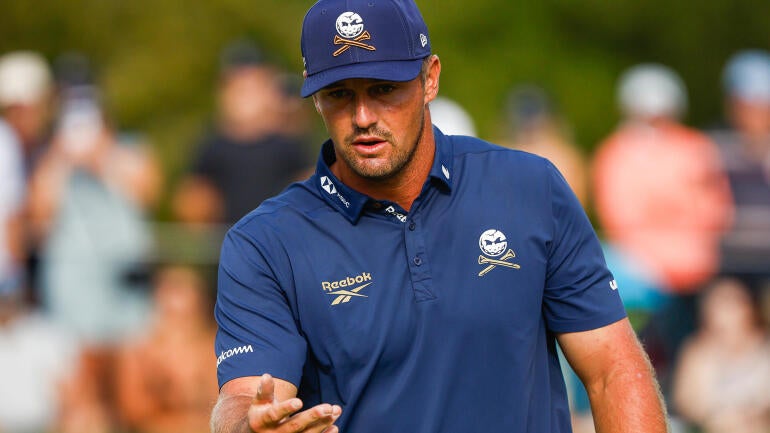
Bryson DeChambeau's iron play
DeChambeau has never been the best iron player in the world, but he has always been capable of piecing together high-end performances. In 2025, he never really did that outside of a LIV Golf event in Korea, which doubled as his only victory of the season.
On the major stage, the two-time U.S. Open champion was held back by this area of his game. It was a significant reason why he was unable to hold onto his lead Sunday at the Masters after grabbing it two holes into the final round, and it is why he fell off the pace Saturday at the PGA Championship.
It just was not good enough, and at those venues, it was exposed.
DeChambeau attempted to rectify the situation -- he replaced his 3D-printed Avoda blades that made noise at the 2024 Masters with a new set from LA Golf ahead of the U.S. Open and played a different golf ball in hopes of producing less spin. The results weren't necessarily there in the second half of the summer, but the thinking is and with a full offseason of tinkering under his belt, DeChambeau will have something up his sleeve for 2026.
Collin Morikawa's short game
Morikawa's obsession with hitting the fade is so deep that he asked Santa Claus for it on Christmas. Seriously. Who knows if he got it under his tree, but it won't matter if his short game does not take a step in the right direction. It's true that Morikawa's iron play is not as good as it was in 2020 and 2021 when he won two major championships, two other PGA Tour events and the DP World Tour Championship, but it is not that far off.
He still ranked third on the PGA Tour in strokes gained approach this year behind only Scheffler and Hovland. That is a place where he can do damage, but if he wants to win big tournaments -- which he has not done since the 2023 Zozo Championship ... err ... Baycurrent Classic -- he needs more than just his iron play.
To keep up with Scheffler, McIlroy and DeChambeau, Morikawa needs the entire arsenal. He lacks length and does not seem intent on chasing any, so his path to victory is slimmer, and it tightens even more with the state of his short game. Ceiling performances are still there when everything clicks, but the floor drops from underneath him when his fade isn't fading.
In 2025, Morikawa experienced the worst total strokes gained season of his career in large part because it was his second-worst around-the-green campaign and his second-worst on them. This comes just one year after he put together his second-best total strokes gained season -- better than 2020 and 2021 -- thanks to his best season both on and around the green.
So, why wasn't it his best, then? Because he had his worst approach year. But with his irons back in tow, that should no longer be a worry. Instead, the focus should be on how he can improve chipping, pitching and putting.
Xander Schauffele's putting
Schauffele's driving numbers are a bit noisy from a statistical standpoint. His return from injury came at a point in the schedule that featured some of the most difficult driving courses on the PGA Tour, and oh yeah, he put a new driver in the bag as well.
That's a lot of variables to juggle, but where Schauffele seriously fell short was another spot where the variables were at a minimum: on the putting surface. This past season marked the first time in his career that he bled strokes to his PGA Tour counterparts with the putter in hand. He ranked 139th overall, lost almost 0.20 strokes per round and even switched putters during the postseason for a hot second.
Strokes gained: Putting by year
| Year | SG: Putting | Rank |
|---|---|---|
2025 | -0.184 | 139th |
2024 | 0.510 | 12th |
2023 | 0.667 | 5th |
2022 | 0.343 | 32nd |
2021 | 0.480 | 16th |
| 2020 | 0.366 | 33rd |
| 2019 | 0.244 | 46th |
| 2018 | 0.196 | 66th |
| 2017 | 0.402 | 27th |
Much like how driving can set up a player, putting bleeds into the rest of one's games. If putting stalls, well, it is more difficult to score, more difficult to scramble, and players are less likely to get up-and-down from greenside bunkers. Schauffele is a prime example of this.
In 2024 -- albeit in the best season of his career -- he ranked first on the PGA Tour in scrambling and 12th in strokes gained putting. This past year, again, he ranked 139th in putting and 136th in scrambling. His conversion rate dipped from 71% to 58%. His sand-save percentage dropped by about 5%, too. One-putt percentage by the same clip.
These are all numbers about his saves, but scoring figures paint a similar picture. He averaged about two fewer birdies per tournament and played the par 3s and par 4s in an over-par fashion. This came after a season where he led the PGA Tour in par-3 scoring and played the par 4s under par. If you're doing that, you're winning major championships or two in the case of Schauffele.
There is good news, however. Schauffele surged past the field in his lone start of the FedEx Cup Fall to pick up a win in Japan. Although the numbers from the tournament were tracked incorrectly, based on the all-important eye test, Schauffele passed with flying colors on the greens. The same rang true at Bethpage Black where he was a bright spot for the U.S. team.
There are myriad reasons to be bullish on Schauffele heading into 2026. His driving continually got better, his iron play remained sharp, and he proved in a different sense that he is tough as nails. Perhaps most important of all? He is not going to putt this poorly again.