Eight things you need to know about Thunder-Warriors Game 2
Examining if the Warriors can make the adjustments they need and if the Thunder can steal two in Oracle

The Thunder shocked the world in Game 1 of the Western Conference finals. Considering the Thunder were the No. 3 seed and eliminated the 67-win San Antonio Spurs in six games, calling Game 1 a shocker is a bit insulting. But that's how great the Warriors are, we wind up feeling like OKC felled the small ball Goliath.
It only took them throwing 40 rocks and hitting only 15 to do it.
So headed into Game 2, where does this series stand, and what do we need to understand for both teams? Some thoughts before the Warriors and Thunder face off in Game 2.
FOR THE WARRIORS
1. Steve Kerr is kind of in a tough place. This sounds like a joke, but I'm serious. There are so many times when you can tell Kerr is disappointed with the Warriors' shot selection. But he can't really criticize, because, well, those shots usually go in. And they went in last season, too. This is who the Warriors are. For all their precision and ball movement, they are built upon absolutely absurd, unfathomable, crazy levels of shooting. Those shots always go in.
Except, in Game 1 ... they didn't.
Kerr talked about rushing shots after Game 1, and that was the sentiment you found from Warriors media and fans on social media. Klay Thompson hoisting before his fingers had really even grabbed the ball, Draymond Green constantly looking to create his own shot, Stephen Curry taking the quick shot over what could be a better one. The Warriors were "rushing." The reason we say that is that those shots didn't go in.
If they fell, we're just talking about how the Warriors "out-executed" the Thunder. Instead we're hearing the following: "Man, the Warriors lost when Westbrook and Durant combined to shoot 17 for 51!" If we presented a scenario where Westbrook and Durant combined for 17 for 51 in Game 1, most would suggest the Thunder would have no shot of beating the Warriors.
But Golden State's shots didn't fall, and now we're left to wonder if the Warriors were "out of rhythm" or if the Thunder "rushed them."
To be sure, the Thunder took away the premium stuff the Warriors get. They didn't get those easy shots. Curry turned the ball over several times when the Thunder sent two defenders. That's what the Warriors are great at, along with everything else: punishing you if you try and take away their spectacular plays. Removing that stuff tempted them even more.
But I'm still left wondering how much of this was just "the Warriors missed shots they'll make next time." Do the Warriors actually need to find better shots? Or do they just need to shoot them again, and most likely they'll go in and everything's fine? This is why it's tough for Steve Kerr. When you're a team that played brilliantly all season and didn't really have to, how do you demand they change their ways, when that won you 73 games? Kerr needs a stress ball on the sideline to deal with this kind of balance.
2. "Big-shot hunting." It's easy to describe a lot of the Warriors' shots as attempts as "kill shots." But for the sake of sensitivity, let's refer them to "big shots." They go for those shots that are demoralizing, that leave the opponent frustrated and dismayed. And they hunted for them, religiously, in Game 1.
They went for the knockout punch in the third quarter, and the more they missed, the more the Thunder crept closer. If Golden State had just gone out and run its standard offense, it might have worn down OKC and not fallen behind so badly. But again, trying to figure out how much of the Warriors' standard offense is comprised of those kind of shots is difficult.
However, that mentality and that approach to trying to demoralize the Thunder might be one they want to change. Steven Adams spoke at length before Game 1 of the Spurs series about how San Antonio made those kinds of plays, and how you have to steel yourself mentally against them. The Thunder won't get rattled, that's evident from how they've responded to being down double-digits on the road over the last seven games.
A big number on this? The Warriors will absolutely ruin your life with 3-pointers off offensive rebounds. You play defense, you get a miss, finally, and then you give up the rebound, your defense is scrambled, and you surrender a 3-pointer. They break your spirit.
The Warriors were 0 for 3 on 3-point attempts after an offensive rebound in Game 1.
3. The Draymond Green tension. Remember that tirade Green went on at halftime this season, complaining about Kerr not wanting him to shoot? Yeah, that's back. Green took 20 shots to Stephen Curry's 22 in Game 1. He took Enes Kanter off the dribble and attempted (and made) a pull-up jumper off a crossover. (Once again, I ask, how do you really judge a good or bad Warriors shot?) He launched a contested 3-pointer with 13 on the shot clock instead of feeding Curry, who had Kanter on him. (Zach Harper broke down that play, and much more, in detail here.)
You want Green confident. You want him barking and smiling, contributing. You want him making the defense pay for the focus they give Curry and Thompson. But you don't want him taking 91 percent of Curry's shot total. Green is most dangerous when he's a playmaker, feeding Festus Ezeli or the corner man off the short roll with Curry in pick and roll. The Thunder, to their credit, didn't help off the corner man, brought help to disrupt the lob, and made Green try and beat them.
How does Green balance being confident and aggressive with taking fewer shots? He doesn't. You don't really want Green playing any different. This is one of those elements in this series where the Warriors simply have to punish the Thunder so much that they wind up breaking and send more help, which opens up more. You don't change Green at all. You want him making better decisions, yes. But the same thing goes for Curry's seven turnovers (including some outright plain-ol' stupid passes). Green's performance was a symptom of the Warriors' offense, not the disease.
4. Losing Game 1 wasn't that big of a deal, and yet ... Look, Golden State responds in Game 2, and we're right back where we started, with Golden State looking like a superior team that happened to have a bad night and now the series is a best-of-5. Do you trust the Warriors, after winning 73 games, to win three of five, even with three of those on the road in OKC? Absolutely. A win Wednesday night and there's absolutely no cause for concern. Game 1 could have just been a blip.
However, Game 2 is a must-win. It just is. The Warriors are phenomenal, the best team, record-wise, in the history of the NBA. But teams that have gone up 2-0 on the road have won 90 percent of all series in NBA playoff history, and are 13-0 in such situations in the conference finals, via WhoWins.com. So no team has ever lost after going up 2-0 on the road. Granted, no team has ever had to face these Warriors. But going down 2-0 is going to do something bad to the Warriors' psyche, headed into what is an environment just as loud and just as energized as Oracle Arena.
The Warriors win, and we can reset our expectations, say that at least the Thunder have given themselves a chance but are back as an underdog. If the Warriors lose Game 2, it's going to be time to slam on that panic button. There's just no way around it.
FOR THE THUNDER
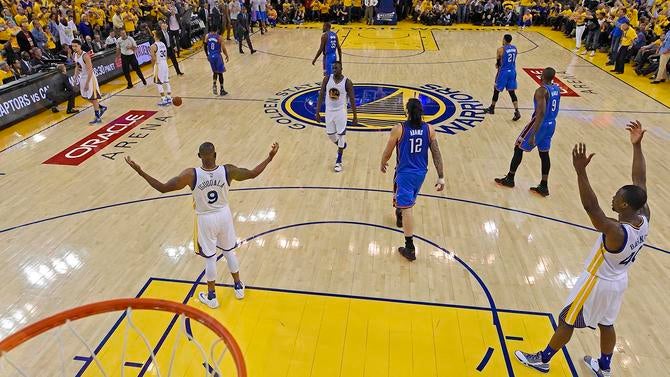
1. The hilarious triumph of hero ball. Did you know that the Thunder ran 13 isolation plays in Game 1, according to Synergy Sports? And they scored a whopping 11 points on them, shooting 5 of 13 from the field in such situations. Total disaster right?
Except consider this. The Thunder created 10 points on eight passes out of isolation. That's a cool 1.25 points per possession, which is terrific. Somewhere in the Spurs series, the Thunder figured out that seamless ball movement and complex chicanery were not going to do for them what "Give the ball to their best guys and let them cook" will. The Warriors have great defense, which was a big part of why Westbrook and Durant couldn't hit water if they fell out of a boat in Game 1. But the Thunder kept at it, kept pounding and eventually Durant knocked down a clean look on a mid-range jumper to seal the game.
This is a key thing going forward. The Thunder role players have stepped up just enough to make the Warriors want to stay home. Dion Waiters in particular has been great, but Serge Ibaka, Adams, Kanter, and Randy Foye are all making enough shots to where you can't just abandon them to go bring help on Westbrook or Durant. And if you leave those two in man coverage with only one help guy behind them, they're going to win that battle most times. That's how good they are. The Thunder players trust one another right now, and that is giving teams fits. They need to continue to do so, while keeping Westbrook in a balanced state of distribution, to give themselves the best chance to win.
2. This is a stat. The Warriors are not guarding Andre Roberson. They're giving him the Tony Allen treatment. He was a team-worst minus-8 in 20 minutes of Game 1. Only Randy Foye finished with a negative plus-minus, and his was only minus-1. Roberson's shot is just not good, and not reliable.
But I found this stat really fun/funny. The Thunder are now 3-0 in games in which Roberson hits at least one 3-pointer. Just one of those weird things.
3. Two key battles of plus-minus. Plus-minus has all sorts of problems, especially in a single game. You shouldn't take an outright correlation between what a plus-minus says and how a player played. You can play great and have a bad plus-minus, or play terrible and be plus-16. It's a function of how the team performs.
However, I am a believer that you have to manage certain areas of impact. For example, the Warriors throughout the playoffs are a plus-7.7 per game with Andre Iguodala on the floor. He's their defensive stalwart, the "calming influence" who takes some of the chaos out of their play and keeps everyone locked in, especially defensively. He makes so many little plays that his value is often underrated; it's why he won Finals MVP last year. Iguodala was only a plus-one in Game 1, and a minus-16 in close to 18 minutes in the second half. The Thunder beat the pants off the Warriors when one of their key weapons was on the court. That's a big deal.
Just as big is Enes Kanter. Kanter was a minus-8 in the first half, a plus-9 in the second half. Kanter is averaging a plus-2.9 mark in the postseason after a negative net in the regular season. If OKC can win stints with Iguodala on the floor, and separately, with Kanter on the floor, it flips things for them.
4. Be ready. The Warriors are going to target Kanter in pick and roll more. They're going to throw more help, from different spots, at Durant and Westbrook. They're going to make more shots. They're going to create more free throws. They're going to play with urgency. The Thunder cannot afford to be complacent and feel like they got the split. They put the Warriors down in Game 2 and Golden State's psyche is going to go haywire, especially with the dissonance between their being an all-time great team, and down 2-0. The series isn't over if the Warriors win, it's not a must-win game for OKC.
But the Thunder may have an opportunity, and they need to seize it if it's there.