How should the Jets handle the Percy Harvin situation?
New York reportedly has until March 19 to decide whether to keep the mercurial wide receiver.

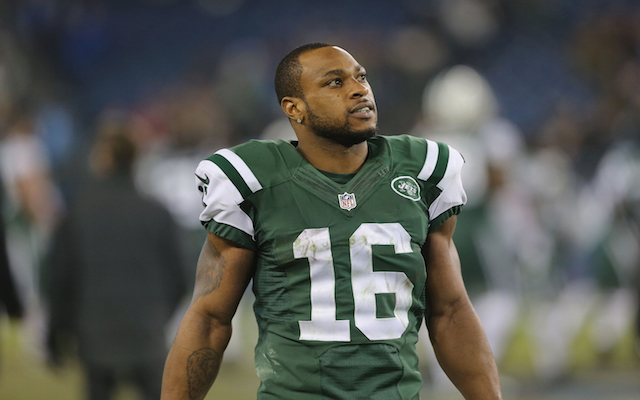
According to a report from Rich Cimini of ESPN New York, the Jets have until March 19 to make a decision on the future of wide receiver Percy Harvin. Harvin has four years and $41.5 million remaining on the contract he signed with the Seattle Seahawks before being traded to the Jets last October, but none of that money is guaranteed. If the Jets elect to move on from Harvin, they will not be on the hook for any dead money.
Harvin's cap hit for the 2015 season is $10.5 million, and even including that hit, the Jets have over $45 million in cap space this offseason, according to Spotrac, a website that tracks salary details for every NFL team and player. Releasing Harvin on or before March 19 would bring their cap space up to around $57 million, more than any other NFL team save for the Oakland Raiders.
What all that means is that the Jets have more than enough financial resources to keep Harvin if they so choose. What it comes down to is whether they think the production he provides on the field is worth the money and the potential headaches they would be on the hook for if they decide to keep him. Harvin has been prone to injury throughout his career -- he has dealt with persistent migraine issues as well as various physical ailments that have resulted in him playing only 23 of a possible 48 regular-season games over the past three seasons. Depending on your source of information, Harvin also either is or is not a divisive locker room force. There were rumors of such tension during his time in both Minnesota and Seattle.
When he has been on the field, Harvin's production has fluctuated on not only a year-to-year, but also a game-to-game basis. He has not exactly been a paragon of consistency. This season alone he had three games with no more than one catch, as well as three games with seven or more. He followed up an 11-catch, 129-yard performance in his second game with the Jets with just five catches on 13 targets in his next three games. He has strung together consecutive games with more than 75 yards receiving only seven times in his career.
But when Harvin does get going, there are few players in the NFL more explosive on a play-to-play basis. More than nearly any player in the league, Harvin is a threat to score from every area of the field. His top-end speed in the open field is almost unmatched, and his quickness in tight spaces allows him to elude tacklers. His versatility as an offensive weapon is also rare: He can execute screens, quick slants, jet sweeps, go routes and traditional handoffs with near-equal proficiency.
However, that versatility is also at times a drawback; Seahawks offensive coordinator Darrell Bevell remarked that at times Seattle had to contort its offensive scheme just to get the ball into Harvin's hands. It's debatable whether the Seahawks did a good job of that -- Harvin produced just 242 yards on 38 offensive touches across 10 regular-season games in Seattle. Most often he was handed the ball on a jet sweep or thrown a screen, and he was rarely tasked with using his speed to get down the field. Put simply, Seattle did not get Harvin the ball in open space and let him go to work, but rather got him the ball and expected him to create open space himself. That approach was not very successful.
The Jets used Harvin in different ways than Seattle, and it lead to slightly more success. After not being targeted on a single pass 20 yards or more down the field in five games with Seattle this season, Harvin was targeted nine such times in eight games with the Jets. He caught a larger percentage of his targets with Seattle than with New York, but averaged more than twice as many yards per reception with the Jets. He also ran 81 of his 109 pass routes with the Seahawks this season out of the slot, while he did so for just 34 of 194 pass routes run with the Jets. Alignment and depth of target matter when you're trying to get a playmaker the ball. If he catches it on the move and already in open space, he's more likely to break a big gain than if he has to do most of the work himself on a smoke screen or bubble.
Still, it's not as though Harvin was wildly successful with the Jets. He caught 29 passes for 350 yards in eight games, adding 22 carries for 110 more yards, and he scored just one touchdown. That's not production worthy of a $10.5 million salary, even if we include the added value he brings as a kick returner. He fared quite well in that arena with the Jets, as he had throughout his career in Minnesota and Seattle.
New York has a new offensive coordinator in Chan Gailey, who in his various stops has run variations of spread schemes in an attempt to get his players the ball in open space. The Jets also seem likely to enter next season with a new starting quarterback -- whether it's one of the top two draft prospects in Jameis Winston or Marcus Mariota or one of the many who will be available in free agency or the trade market -- and they'll want him to have top-flight weapons available to ease the transition. That's seemingly a good philosophical fit for Harvin, but again, there's that pesky $41.5 million he's owed over the next four years. The Jets can afford it now, but as they build their roster in the future, they may not want to be tied to such a highly paid receiver whose production has never quite matched up with his skill level.
Should the Jets decide to move on, there will be no shortage of suitors for Harvin's services. There are 15 teams that enter the offseason with over $20 million in cap space (though two of them are the Jets and Seahawks) and more figure to join them after restructuring and cutting season gets underway. Teams like the Raiders and Browns have money to burn and a huge need at the position, while the Bengals, Chargers, Eagles and Panthers have less cash but also make for intriguing fits. It seems rather unlikely that Harvin will get another big-money, long-term deal (though of course it is still possible), but he could wind up in an advantageous situation that works out better for him in the end.