Will Gary Kubiak, Peyton Manning meet halfway on offensive approach?
Is Peyton Manning a bad fit for Gary Kubiak's run-first, balanced approach or is the 39-year-old starting to show his age? Maybe a little bit of both. Manning's numbers are down and is taking a beating -- and the Broncos need to figure out how to fix it soon.

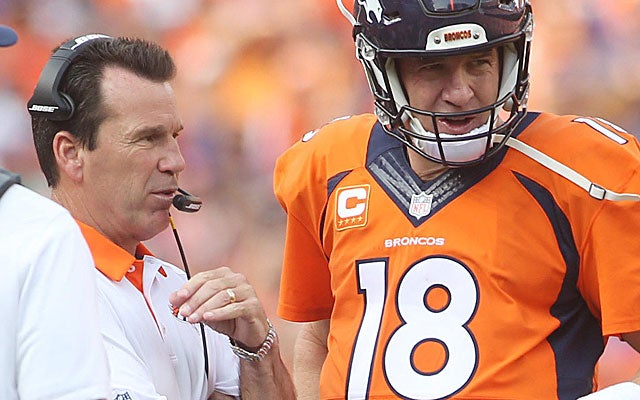
The Broncos, after two off-kilter weeks trying to integrate Peyton Manning into Gary Kubiak’s offense, remain very much a work in progress. While sources said it’s very likely that Manning gets increased opportunities in the faster-paced, no-huddle scheme which he prefers moving forward, numerous NFL scouts and execs believe that alone is not enough fix the situation.
Denver’s front office and coaching staff are intent on establishing the run game and implementing a balanced offense. The belief is that it would protect Manning from the increased beatings he's taking while dropping back behind a sagging offensive line. The Broncos want to preserve the 39-year-old quarterback, especially after he began breaking down in the final quarter of the 2014 season.
Manning prefers to be in shotgun as much as possible, but that also allows opposing defenses to pin their ears back and attack the passer. An offense can only run so many draw plays, and there are concerns about Manning’s durability if he continues to throw the ball as much as he has been asked to in the past.
Where Denver finds the balance between old and new remains the key, with one veteran Manning observer noting that the extra time it takes Manning to think and feel his way through Kubiak's offense is detrimental to his health. While going shotgun all the time probably isn't the answer either, letting the Hall of Famer simply do what he does best and is most comfortable doing might make the most sense. Simply going back to what Manning ran under former coach John Fox comes with complications as well, particularly due to the turnover in personnel around him since then.
Conversations with several evaluators who have watched Manning closely, including some who have done advance work on him this year and last, revealed concerns. They say it extends beyond whether he is lining up directly behind center and running Kubiak’s offense or if he’s able to dictate tempo and get into shotgun as he chooses.
These scouts pointed to the lack of velocity, decreased accuracy (especially when asked to throw outside the numbers and more than 20 yards), an inability to use the whole field and a tendency to feel phantom pressure as part of the natural signs of decline for any quarterback Manning's age. One scout who has studied Manning closely noted that he did not sense a rapid deterioration in Manning’s arm as much as he believed it was issues with Kubiak’s scheme, particularly asking the aging vet to waggle occasionally and boot out to his left. That has exacerbated some of the problems in Denver’s offense dating back to the final games of last season.
“You don’t have to defend the field against him the way you used to,” one evaluator said. “The deep stuff is either overthrown or underthrown. I’m not saying he’s done, and he can still beat you and his mind allows him to compete. But everyone gets older and he looks like a 39-year old quarterback to me.”
Another evaluator who has watched Denver’s film from the first two weeks said, “It’s obvious he’s not really comfortable unless he’s doing his thing in the shotgun. Kubiak is going to have to meet him in the middle more there. Can they protect him and can they run the football? If they can’t, it’s a lot to expect of him to carry the team for 16 games at this stage of his career.”
The scouts detailed a template for defending Manning that has become increasingly common and other teams are expected to replicate when possible. Manning is becoming increasingly wary of being hit, they said.
“He hates anticipated pressure and he’s playing skittish in the pocket,” as one scout described it.
Both of the Broncos starting tackles are “finesse guys,” as another scout put it, which wouldn’t exactly stir confidence in Manning.
“He’s going to protect himself,” this scout went on to say. “If the pocket is totally clean and he can get his entire body into the throw, he can still throw a fastball when he needs to. If there’s pressure, or he perceives there is pressure, then he’s going to go down pretty quickly.”
With Manning unable to connect on passes that travel more than 25 yards in the air, teams are increasingly willing to bring five or more players on the rush, play cover 1 (a single high safety) and have at least one corner in press-man at the line, hoping to derail Demaryius Thomas and/or Emmanuel Sanders at the line of scrimmage. In his last six games, including the preseason, one scout had Manning 2 for 29 with an interception on passes of 25 yards or more.
The Ravens did it incredibly effectively in Week 1, and it was a defense the Colts (coached by former Ravens coordinator Chuck Pagano) utilized very effectively in a playoff win over Denver last year. The Chiefs had great success at times Thursday with similar principles.
Denver’s next opponent, Detroit, while lacking the standout press-man corners of other teams, is coached by another product of that Ravens defense -- coordinator Teryl Austin -- so I would anticipate plenty of early pressure there as well.
When Manning is under duress, teams are squatting and jumping on some sideline passes, where his balls have tendency to flutter. He’s thrown two pick-sixes that way already this season and got away with several dropped potential interceptions on those routes Thursday night.
Denver’s offensive-line play has been downright shoddy at times, compounding problems, and the run game has yet to get going. The good news for the Broncos is they don’t have too many elite, fearsome defenses on the schedule this season. But, as scouts pointed out, Manning is already taking hits at a rate that has to stir concern about how he will be feeling and performing deep into the season. Denver is shooting for a Super Bowl in what could be the last season for many of its top players in a Broncos uniform. It's worth noting that two meetings loom with San Diego and the Chargers' defensive coordinator is Chuck Pagano’s brother, John, who has been pretty effective with a similar approach on Manning in recent years.
Through the first 12 games (13 weeks) of 2014 -- including September, October and November -- Manning was the second-highest rater passer in the NFL with a 107.8 rating (behind only Aaron Rodgers), with 36 touchdowns to just nine interceptions. He completed 66.8 percent of his throws, and he averaged 40 attempts and 311 passing yards per game (7.8 yards per attempt) while being sacked just 13 times.
In seven games since -- from December on, including the postseason -- Manning has a rating of 75.7 (out of the top 20 in that span), with seven touchdowns to eight interceptions. He’s completing 60.7 percent of his throws and averaging 36 attempts for 233 yards per game (6.5 per attempt). He’s also been sacked 13 times in the shorter timeframe.
Sources said the change in organizational philosophy with Manning began last November, when general manager John Elway and others atop the organization supported a more run-heavy approach following a 22-7 loss to the Rams in Week 11. Denver ran the ball only nine times in that game, and Manning was hit early and often while throwing 54 times for 389 yards with two interceptions. Some were panicked about the state of the offense despite that being a rare occasion when the team didn’t score at least 21 points. Manning, bruised and battered, suffered a muscle injury the next week against Miami.
By then it was made clear to everyone involved that more attention had to be given to the run game, sources said, with it very clear where Elway and the Broncos’ brain trust stood on this issue.
Manning’s injury, concerns about how he would hold up down the stretch, his limited practice time and the increased effort being put into the run game had something to do with the rhythm and tempo of the passing game lagging. The nature of Denver’s offense changed from then on, fully taking root in December.
After a one-and-done playoff loss to Indianapolis, Elway and the top brass were even more convinced that major changes were in order if the team was going to peak in the winter and Manning was going to survive a full season at age 39. Elway decided to move on from Fox and his staff and go with Kubiak, his long-time friend and confidant. The seeds of that transition were born in that ugly loss in St. Louis.
Manning’s health and questions about his productivity moving forward led to some awkward negotiations in the offseason in which he ultimately agreed to a pay cut to stay. He can make all of that money back should Denver win the Super Bowl.
Manning now earns $15 million in base salary in 2015 -- rather than the $19 million he was originally set to make. He is signed through 2016, though obviously everything is year-to-year at this stage. Denver was originally seeking for Manning to earn $9 million this season -- which is now Tom Brady’s annual base salary -- plus incentives, sources said, but he and agent Tom Condon balked at that. After some back and forth, the sides agreed on a deal. There were definitely some in the organization willing to let him depart if a compromise could not be struck, however.
When coaching the Texans, Kubiak passed on a chance to land Manning as a free agent and preferred to remain with Matt Schaub at the time. Manning eventually chose the Broncos over Tennessee and other suitors.