Astros vs. Rangers: Explaining rally-busting replayed tag call on Marcus Semien's batting glove in back pocket
This was a pivotal moment in the Astros' Game 4 win on Thursday night

By
Matt Snyder
•
3 min read
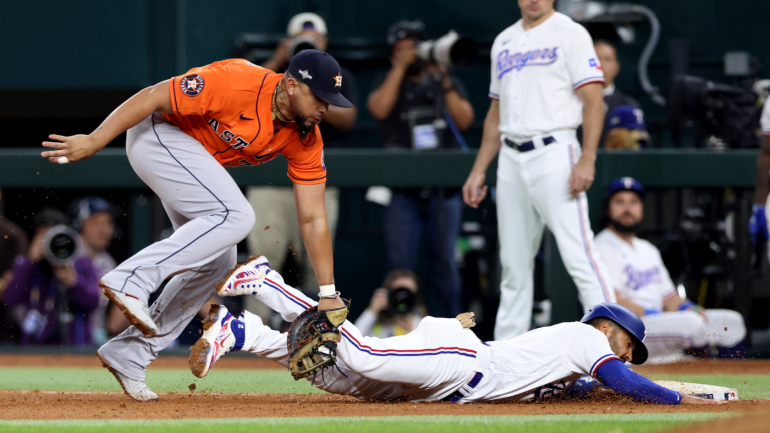
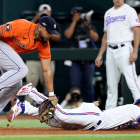
During the bottom of the fifth inning in ALCS Game 4 on Thursday night, the Texas Rangers were trailing the Houston Astros, 7-3, but had a bit of a rally going. Leody Taveras and Marcus Semien singled to start the inning, bringing superstar shortstop Corey Seager to the plate. Seager, who had hit a home run in his previous at-bat, lined out this time. And it ended up being a double play, after replay review overturned the initial call of safe at first base when Semien slid back to first base in an attempt to avoid the tag from José Abreu.
Abreu did tag Semien. Sort of. It seems pretty clear that he got the batting glove hanging out of Semien's back pocket and that's it. Watch:
Got him on the batting glove!
— FOX Sports: MLB (@MLBONFOX) October 20, 2023
HUGE double play for the Astros!
📺: FS1 pic.twitter.com/2IwpUvi8oh
We've seen players awarded first base when only their jersey is hit by a pitch, but we also know that on review, MLB has clarified that the strings hanging off a defender's glove don't count and the actual glove needs to touch the player for it to be a successful tag. Where does a batting glove hanging out of a pocket fall?
Apparently, it counts as tagging the runner. Otherwise the call wouldn't have been overturned.
"You want to get back on a liner," Semien said after the game. "I was caught leaning a little bit, tried to get back. Just bad luck."
Here are two definitions from the official MLB rulebook that come closest to guiding us to an answer on this one.
A TAG is the action of a fielder in touching a base with his body while holding the ball securely and firmly in his hand or glove; or touching a runner with the ball, or with his hand or glove holding the ball (not including hanging laces alone), while holding the ball securely and firmly in his hand or glove. It is not a tag, however, if simultaneously or immediately following his touching a base or touching a runner, the fielder drops the ball. In establishing the validity of the tag, the fielder shall hold the ball long enough to prove that he has complete control of the ball. If the fielder has made a tag and drops the ball while in the act of making a throw following the tag, the tag shall be adjudged to have been made. For purposes of this definition any jewelry being worn by a player (e.g., necklaces, bracelets, etc.) shall not constitute a part of the player's body.
TOUCH. To touch a player or umpire is to touch any part of his body, or any uniform or equipment worn by him (but not any jewelry (e.g., necklaces, bracelets, etc.) worn by a player). (Touch) Comment: Equipment shall be considered worn by a player or umpire if it is in contact with its intended place on his person.
Notice the parenthetical specifying the laces on the glove don't count. That addition was made in 2016 due to some replay overturns that proved controversial. We can see that jewelry doesn't count, but a batting glove isn't jewelry. It also isn't his uniform. It is equipment, but when it's in his pocket, it isn't being worn.
Take note of that last comment in the "touch" section. Specifically: Equipment shall be considered worn by a player or umpire if it is in contact with its intended place on his person.
That was a batting glove and the intended place on a player's person is his hands, right? If not on his hands, isn't a batting glove not being worn? The league would like us to know that's not necessarily the case.
MLB has a clarification on this in the Umpire Manual Rule Interpretation for "touch."
Regarding the definition of a touch, equipment intentionally placed somewhere by a player should be considered worn in its intended place.
EXAMPLE: Batting gloves placed in a player's back pocket are in the intended place on his person.
There it is. That explains it. Perhaps players will now be a bit less liberal with having their batting gloves hanging out their back pockets moving forward.