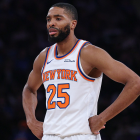
Is Carmelo Anthony a superstar?
Knicks star says he doesn't care whether he's considered a superstar, after he says he's a superstar. And both parts were bad for his public perception.

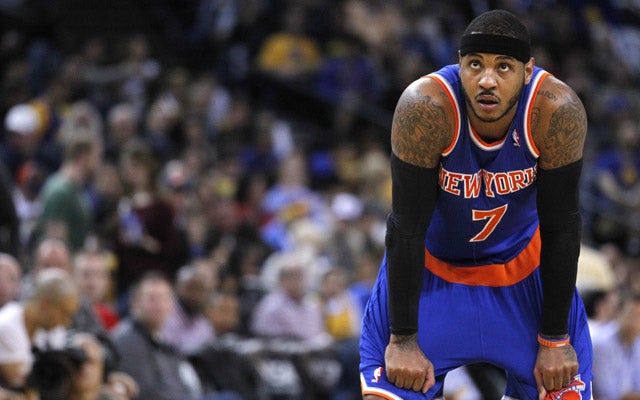
Last week, New York Knicks star Carmelo Anthony sat down with ESPN and said "I think I'm the most underrated superstar."
Anthony then turned around the next day and tried walking it back, saying he didn't feel that way and that that comment was "just the way the conversation was going." If you want to hear the statement Anthony made, without hearing the question that proceeded it, click here and scroll to the 14-minute mark. He clearly makes the statement, but we don't know the context in which he said it.
This prompts two distinct questions we should look at before the season arrives in three weeks: 1) Is Carmelo Anthony a superstar? And 2) should Carmelo Anthony be concerned with how he's perceived when it comes to being a superstar?
Is Melo a Superstar?
This conversation typically gets tossed about in predictably absurd ways. Many think the idea of debating if someone is a superstar is stupid, and they simply bail from the conversation. We'll see you fine folks down for question No.2 below. Others believe that there's no way, based on Carmelo Anthony's relative inefficiency and lack of sustained playoff success that he can qualify as a superstar. And those that believe that Anthony is a superstar simply take it at face value, and state it as fact when they talk about the Knicks. No one goes around saying "Carmelo Anthony is a superstar, and let me tell you why." You don't need to prove that Anthony is a superstar, under that mindset, it's prima facie. You have to prove Anthony isn't a superstar.
Even those that believe he is not and would like to talk about the myriad of reasons he isn't (only two playoff runs beyond the first round, no Finals appearances, no championships, lack of high defensive acumen, lack of offensive versatility, playmaking, and above all else, efficiency) start their argument from the perspective that Anthony is considered a superstar and why that's incorrect.
But therein lies the problem. As long as Anthony is famous enough to be considered as a superstar, he is one.
Superstardom has nothing to do with how good Anthony is at basketball, from any on-court perspective. It's simply a measure of fame. What's important here is it doesn't have to do with popular, as much as it has to do with being famous. For instance, in 2010, most of the world, according to studies, despised LeBron James and thought poorly of him after The Decision. But he was still very much a superstar, because everyone knows who LeBron James is. It was only after reclaiming much of his popularity and then exceeding previous levels by winning two NBA titles that James in fact rose to being a megastar, which is kind of the nexus of being immensely popular and famous.
There's a whole field of study built around the concept of superstardom, and it's fairly fascinating. But the big takeaway is that superstardom is attained by a combination of talent and chance (by virtue of the rules of sport being arbitrary). Where Melo comes in, though, is that he has accomplished a measure of popularity by effectively appealing to a base valuation system (though not on purpose). Anthony is well-regarded by the same kinds of folks who will still swear that Allen Iverson was a top-flight NBA player historically, and that Kobe Bryant's 2006 season will stack up with anyone's. It's about buckets. A dude is able to go out there and score like that, to shoot jumpers like that, to look like that when he plays basketball, and he's a "bad man."
To be clear, the fans who believe these things are not any more right or wrong than those who look at advanced metrics and can't believe Kevin Durant has to be compared to any of these guys, given his offensive efficiency and production. It's two entirely different conversations, but both disregard the other. Anthony fans will dismiss any metric which suggests he's not a top-tier player, and extremist fans of metrics will toss away the idea that a scoring threat by virtue of his very reputation changes the way a defense plays.
However, Anthony's divisiveness within the hardcore hoops fan base only increases his level of fame. Because no one's taking exception with whether Brandon Knight or Joe Johnson or Goran Dragic is a superstar. But there are constant debates about Anthony, in bars and in offices and on every form of communication the internet allows. In that regard, he's much like El Guapo in "The Three Amigos." He's in-famous.
Being a superstar has very little to do with where you rank among other players in your field (but if you were curious, we tabbed Melo No. 12 in our Elite 100). It has to do with whether Saturday Night Live would consider having you host the show, or whether your mom who doesn't follow the NBA knows who he is. It's an idea born not out of the substance of the conversation about the player, but about whether the conversation exists in the first place. And it does with Anthony.
A good example of this? Moses Malone was a 13-time All-Star, a three-time MVP, a Finals MVP, an NBA champion, and almost no one remembers his name among even invested NBA fans. He averaged 31.7 points and 14.7 rebounds in 1982 and he way that history remember sit, there were only three NBA players in the 1980's, Larry Bird, Magic Johnson, and Kareem Abdul-Jabbar.
Whether Anthony is worthy of the title or not is irrelevant, because the question doesn't exist. You can't be unworthy of being a superstar or being a superstar. You simply have to be in the conversation on a global scale. And Anthony is.
Now, the more important question is whether Anthony should care so much about his standing.
Should Melo defend his standing?
Since we just said above that there's nothing that ascribes value to being a superstar, it's a binary condition based on the discussion, you can't actually be "underrated" as a superstar. You can be an underrated player who is a superstar, which is what Melo is actually arguing. The idea is that of everyone who has reached the status of being discussed in those terms, a list which includes LeBron, Kevin Durant, Chris Paul, Blake Griffin, Kobe Bryant, Dwight Howard, and maybe possibly James Harden and Russell Westbrook among a few others, Anthony is the one whose skills aren't appreciated enough.
I'm not going to go into whether Melo's right or wrong, because I'm more interested in what happened next. Anthony, the next day, felt the need to come out and say that he didn't feel that way. That he wasn't misquoted per say, but that he was taken out of context.
Except when you hear the audio, (again, 14:00 in here) even if Anthony was asked "how underrated are you as a superstar?" Anthony still answered in the affirmative, confirming his status as a superstar in his mind and defending his positioning.
And that's where he loses us.
Even people that will defend him for the comment in so far as they agree with him won't like him more for it. Anthony's popular appeal isn't increased by it, because it reveals that not only does he think about himself in terms of being a superstar, and one of the silent contracts that fans have with a superstar is that he never admits it, but that he's not considered a superstar "enough" due to an under-appreciation of his gifts.
On the first point, there's an inherent need for us to never feel that the superstar is separating himself from us (in the royal we, sports fans, culture consumers sense). It was this same line of thought that prompted so much backlash against James when he said after the 2011 Finals that all of his critics would have to wake up to their lives. It's obviously clear that most people that thought LeBron sucked that year would still have to wake up and go to terrible jobs they don't like very much and figure out how to pay down their credit card bill while James was going to go back to his super-mansion and lament losing a basketball game on his bed with pillows made from imported free-range yak or whatever.
But you don't say it.
Which is why Anthony followed it up by talking so much about why he doesn't care about it. He especially stressed this the next day in his comments walking the statement back:
“They took it and ran with it. That’s something I don’t get into. I let you guys write about am I underrated or not. I know what I can do and I know what I’ve done on the basketball court. I know what I can get better at. But as far as you know, self-proclaiming me as being an underrated superstar, that’s out of my league.”
“At the end of the day … you get what you deserve,” Anthony said. “Last year we didn’t make the playoffs. We took a step backwards. Regardless of what type of season I had from a statistical standpoint, it doesn’t matter. Then the year before that it was a different praise … when we did have some team success.
“So at the end of the day for me I want to win, that’s the only thing I want to do. I want to win. And whatever comes with that it comes with it. I accept it.”
via Knicks' Carmelo Anthony clarifies his ‘underrated’ comment - Sports - NorthJersey.com.
Unfortunately for Anthony, anyone paying attention who could be swayed (Melo fans who were never upset with the "underrated superstar" comment didn't need to be swayed and his harshest critics weren't going to suddenly reverse course here) wouldn't after his comments because in some ways, the backtrack was worse. It's you showing up to where your ex is trying to act like you're not upset about the break-up. It's you trying to act cool when it turns out the person next to you on a plane or a coffee shop is Scarlett Johansson.
It's Scarlett Johansson. Normal conversation is not going to be possible, here.
And the two statements "I'm the most underrated superstar... but I don't care" in conjunction just leaves us feeling like Anthony wants that stamp of validation, which is the worst thing you can do in a public relations battle that doesn't involve truly heinous behavior. The public would actually rather you not care about what people say or think about you. That earns respect because it feels more authentic. Anthony betrays this on two levels. He wants you to think of him as a superstar, but not think that he cares if he is one.
Whether Kobe Bryant is authentically making that weird face he does when he gets into a zone doesn't matter, because he doesn't point to it saying "Uh-oh, look at my face!" and he doesn't try and wipe it off in some fake-self-conscious-modesty. Similarly, even if he's intentionally needling teammates in the press to get a reaction from them in practice or in games doesn't matter because he doesn't couch it with protection. He just shoots from the hip, and if that shot is a tactical consideration planned in advance, Bryant doesn't tip his hand to that fact.
Anthony, on the other hand, seems to always want to show you the trick so you know it's not real, then do the trick, then have you call him a magician. That's not how it works.
Anthony's in a hard place, having come up under exceptionally tough circumstances and now faced with the constant spotlight that comes with being a, you guessed it, superstar. He's also a member of a generation of stars that are all very careful in not fanning flames of competitive discord (Chris Paul is friends with everyone off the floor when he's not trying to rip their throats out on it) and in projecting a positive image. They want to be seen as good people. That's different from wanting to be a good person, not that there's any evidence they aren't. It's just a different mechanism.
But Anthony would be best off shrugging off that false modesty. The public wants him to act like he's not a superstar; that's true. But if he's going to act like he's a superstar, he needs to a. not care about wearing a costume that says he's oblivious to it and b. not feel like he has to defend that status. Anthony is supposedly close, to a degree, with Kobe Bryant. He really should take some lessons on how to stop caring and bask in the universe that he's created for himself.
Because, really, everything outside of that is just the noise that helps create his salary.