

Is Patrick Roy's aggressive goalie pulling strategy working?
Colorado Avalanche coach Patrick Roy is the most aggressive in the NHL when it comes to pulling his goalie for the extra attacker. Is it still working? And did it ever work?

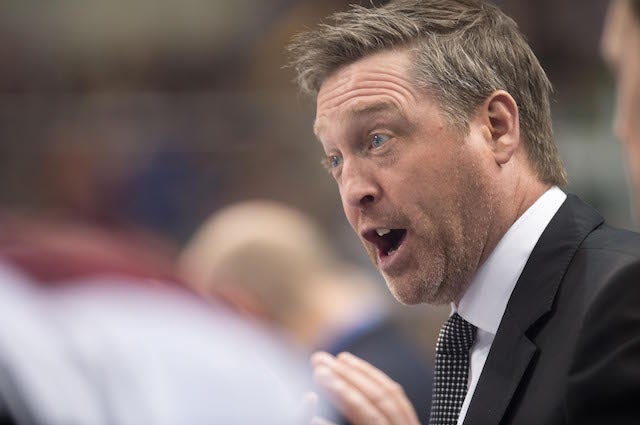
The Colorado Avalanche were 3-0 losers against the Detroit Red Wings on Thursday night, a game that probably wasn't as lopsided as the final score might indicate. With three minutes to play in regulation the Avalanche were right there with the Red Wings, down by only a single goal. That is, until coach Patrick Roy pulled starting goalie Semyon Varlamov for an extra attacker in an effort to tie the game, resulting in the Red Wings scoring not one, but two empty-net goals to put the game out of reach and turn a close, tight game into what appeared to be a one-sided blowout.
It's the type of move that can lead to criticism because it's such an aggressive, out of the ordinary strategy.
Most coaches tend to wait until the final minute of a one-goal game before lifting their goalie, and by then there usually isn't enough time left to get the equalizer, time runs out, and they end up losing anyway.
Roy, on the other hand, almost always goes for the extra attacker with more than two minutes to play and is by far the most aggressive coach in the league when it comes to making the call. The only other coach that might be close to him is New York Islanders bench boss Jack Capuano, but even he isn't as consistently extreme as Roy. Roy is so aggressive that during a game earlier this season in Winnipeg, with the Avalanche trailing 5-1, he pulled Varlamov with more than 13 minutes to play to give his team a brief 6-on-3 power play.
But is the strategy still working? And did it ever work?
First, here is a look at what the Avalanche have done with their goalie pulled from a goals and shots perspective over the past two seasons (with league ranks in parenthesis).
| Colorado Avalanche Success With The Goalie Pulled | ||
| Situation | Goals For Percentage | Shot Attempts For Percentage |
| Trailing By 1 | 57.1 (2nd) | 84.3 (9th) |
| Trailing By 2 | 22.2 (20th) | 76.6 (18th) |
| Trailing By 3+ | 0.0 | 96.5 (2nd) |
When trailing by a single goal the Avalanche are one of the best teams in the league with their goalie pulled, and are one of just five teams to outscore their opponents when the net is empty (the only team ahead of them, Philadelphia, has a goals for percentage of 63.6 percent) while they get the overwhelming majority of the shot attempts, far better than the league average in that situation.
(For what it is worth, in the two years before Roy took over the Avalanche were one of the worst teams in the league in these situations, scoring just 16.6 percent of the goals, 27th in the league.)
When they are down by two, things aren't quite as successful and that would seem to make at least some sense. When a team has a two-goal lead it's going to be more willing to fire pucks at an empty net from greater distances because they don't fear an icing call and a defensive zone faceoff as much, and the team that is in catch-up mode is going to play even more aggressive and perhaps leave more openings for the team protecting the lead to add an insurance goal.
When it came to actually winning games and stealing victory from the jaws of defeat, the Avalanche were pretty successful with it last season, forcing overtime in four of their 18 pulled goalie situations (including once in the playoffs when Roy pulled the goalie with three minutes to play in a one-goal game) and winning three of them, a winning percentage of .166. When you figure that the average NHL team when trailing by a goal in the final three or four minutes of a game probably has a win probability of less than five percent, that's not bad. It is probably earning his team a couple of extra points in the standings that they otherwise wouldn't have had. It's not going to turn a bad team into a playoff team, but when you're on the postseason bubble (like Colorado currently is) or fighting for a division title, it could be significant.
Obviously, Roy hasn't changed much this season when it comes to his decision to send on the extra attacker, having already done so in 19 games. Only five times has he done it with less than two minutes to play in regulation. When you go back to last season, he has only done it with less than two minutes to play nine times out of 38 opportunities.
In their 19 empty-net situations this season the Avalanche have managed to force overtime four times, with all of them coming over the past three weeks. Two of them resulted in wins (including their Feb. 3 game against Dallas), one in an overtime loss, and one in a shootout loss.
In three of those games he made the call to pull the goalie with more than two minutes to play.
In terms of actually winning games and getting extra points the Avalanche are not quite as successful as last season (maybe by only a game), but they are also still probably better than the average NHL team in the same situations (again ... maybe by only a game).
Without those extra six points in the standings this team is completely out of the playoff race right now. As it stands on Friday the Avs are four points back of Vancouver for the final wild-card spot in the Western Conference.
So is it worth doing? Most definitely. At least for now, simply because almost no other coach in the league is doing it with any regularity, which still makes it a bit of an advantage, even if a small one. If every other team in the league did it, that means they would be picking up those extra points that only you were getting and negate whatever small advantage you had.
Whether or not it catches on around the league remains to be seen.
Coaches in every sport can sometimes tend to play things a little too safe because if they do something out of the ordinary (like pull their goalie with three minutes to play in a one-goal game) and it doesn't work they're not going to want to deal with the criticism and face the "why did you do that?" questions after the fact.
On the other hand, NHL coaches are no different than any other coach in any other sport, and if they see something working somewhere else around the league, they are going to try and recreate it.
At times, as it did for Colorado on Thursday, it is going to work against you. But chances are your team was probably going to lose that game anyway.
It's still not yet known what type of NHL coach Patrick Roy is (he looked like a genius last season when his goalie was great; not so much this season when his goalie has been average hasn't been quite as dominant) but in this one area he's at least giving his team a better chance than most other coaches around the league. It may not be much, but it's something.