Sony Michel vs. Lamar Jackson and more developments that will decide NFL Draft success
The choices made by teams throughout the first round of the NFL Draft set up fascinating storylines

Disclaimer: I will not be grading this draft.
Like everyone else, including the general managers themselves, I have no idea how these players just selected will grow and evolve and develop over time, nor do any of us know how they will fit with the new coaches and new teammates and new systems and schemes. No grades. No inflamed commentary. No takes.
But what I do believe it is fair to attempt to surmise here in the immediate afterglow of the selection process is where certain flashpoints emerged that could ultimately dictate the success or failure for the teams involved. We can clearly determine areas -- based on information gleaned from players teams were interested in, the needs of those teams and the selections ultimately made by those teams -- where a franchise made a calculated decision to prize one asset, or collection of assets via trade, over another.
Even without knowing the short- and long-term outcomes of those selections, we have the ability to identify some of the potential risk and reward involved. Even a mere day or two after the draft has concluded, it's fair to note where the nexus of these factors exists and what it may mean down the road for the clubs involved.
Looking for a hot new NFL podcast that's your home for NFL coverage? Look no further. The Pick 6 Podcast with Will Brinson has you covered each day with new episodes around 30 minutes each. Subscribe: via iTunes | via Stitcher | via TuneIn | via Google Play
Who won and who lost? Well frankly, right now, who knows? (I will point out quickly I was impressed Packers rookie general manager Brian Gutekunst showed as much poise and dexterity as he did in his first draft, and I was caught off guard by just how bold the Browns decided to go.) What we do know, however, is where a team chose one set of available options over another, and where to look down the line when the time comes to truly evaluate the evaluators who put together the first round of the 2018 draft.
Here are a few intersections of teams and players that bear monitoring in the years to come. In many cases, teams may end up addressing the immediate needs they passed on in the first round in later rounds, with players who end up far outperforming many guy selected well ahead of them. All of that must be weighed in three or five or 10 years from now.
 Mayfield vs. every other QB
When you hold the first overall pick in the draft and the fourth as well, you control the top five selections. Whether they stayed pat or traded up or back or whatever, the Browns were going to dictate the flow of the board Thursday night.
In taking Baker Mayfield first, they inherently chose him over Sam Darnold, Josh Allen, Josh Rosen and every other passer, and thus over time they'll be judged with that in mind. Could they have taken Saquon Barkley or Bradley Chubb first and landed Mayfield fourth? We'll never know for sure. If the Browns have finally got it right, it won't matter.
 Barkley vs. Chubb vs. Darnold
The Giants could have had any of the three, and based on everything I have heard -- not that they were ever going to take a QB this high -- Darnold was to them the best of the bunch. Will this running back be so impactful that his worth over time exceeds that of a potential top-end pass rusher?
Ward vs. Chubb
The Browns could have had either with the fourth overall pick. Could they have traded back with Buffalo to fourth overall and landed Denzel Ward there (or playmaking safety Minkah Fitzpatrick, who also would fill an immediate secondary void), picking up the 22nd overall pick in the process? Again, we'll never know, but that is some of the opportunity cost associated with making this pick.
Denver believed the value in Chubb -- and Chubb alone of all remaining players on the board -- was so significant it removed them from the trade market; a trade market they were heavily involved in for weeks and very much figured they would be trading down at various times through the process. Which player will be the better pro?
 Allen vs. Rosen
It was firmly established well before the draft that no team was more motivated and more fortified to move into the top of the draft than the Bills, who ended up moving from No. 12 to 7. It was almost as if it was their calling, and when the time came they ended up not even needing to get into the top five to land Josh Allen or Josh Rosen. They were always doing this for a quarterback and they chose Allen, who has tremendous upside but issues with his accuracy. It will be impossible not to intertwine the careers of these two quarterbacks, particularly in Buffalo, as they unfold.
 Hurst vs. Edmunds vs. Moore
The Ravens were one of the most active teams on the first day of the draft, trading down twice to end up with Hayden Hurst, far and away their top rated tight end who fills an immediate void. They did it by walking away from Tremaine Edmunds -- who could have filled an immediate void at linebacker as well -- who was available at No. 16 to the surprise of many (including the Bills, who didn't have to give up that 22nd pick in their swap with the Bucs at No. 7).
D.J. Moore was viewed by many as the top receiver in the draft and also plays a need position and was on Baltimore's radar, but they moved down again at No. 22 when he was available to ultimately land Hurst at 25th overall (from Tennessee). Would Hurst have slipped to the second round?
 Penny vs. Alexander vs. all WRs vs. other RBs
The Seahawks were widely know to be heavily interested in trading down, and they pulled it off twice, starting at No. 18 and ending up at 27 where they took a running back in Rashaad Penny. Along they way they passed on Jaire Alexander, a corner who was on their radar and whom Green Bay -- a team very often with similar evaluations on a player, as Seahawks GM John Schneider is also a disciple of former Packer GM Ted Thompson -- moved up to land.
Receiver is also a spot of need, and by going back to No. 27, Seattle ended up dropping beyond where the top two receivers were selected and took Penny as the second RB off the board behind Barkley. Love that the Seahawks follow their convictions and are not afraid to make big moves, but in a draft they needed to nail, these moves will undoubtedly be monitored over time.
 Ridley vs. Bryan
One of the least kept secrets in the pre-draft process was how much the Falcons loved Taven Bryan, a defensive tackle who may be able to collapse the pocket in the NFL. Obviously, they didn't love him as much as they loved Calvin Ridley, whom they selected with the 26th pick. If they win a Super Bowl with Matt Ryan, Ridley might be a big part of that, even though they are pretty stacked at receiver right now. And Bryan may end up being a project.
 Michel vs. Jackson
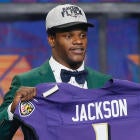
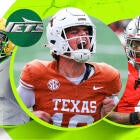
The Patriots had some very strong evaluations on Lamar Jackson and believe he has immense potential; he was in play at least to some degree with the 31st pick. There were a handful of skill players who could fill an immediate need whom the Patriots believed were more vital right now -- with Tom Brady still an MVP candidate at age 40 -- and Sony Michel was clearly one of them.
Baltimore traded for Jackson one spot later to conclude the first round, and New England's hunt for an heir to Brady goes on. Will he be special? Will Michel be markedly better than the slew of low-priced veterans whom the Pats have had good success with in recent years?
Nick Chubb vs. Barkley
It would not be fair to expect Nick Chubb to have the kind of career Barkley is projected to have as the second overall pick, but the fact the Browns took a running back at the start of Day 2 indicates they felt this was a compelling need.
Does Barkley have a Hall of Fame career? Is Chubb a strong contributor for a long time? Knowing the Browns could have grabbed Barkley at No. 1 and still chosen between two of the top four quarterbacks on their board adds even more intrigue to the inevitable re-drafts and what-ifs that this draft will uniquely engender.