2018 NBA Draft: Trae Young, Collin Sexton and the original Ricky Rubio sin that teams keep repeating
If everyone understands the importance of shooting come game time, why don't teams draft accordingly?

By
Brad Botkin
•
10 min read
In 2009, the Minnesota Timberwolves made two of the all-time draft blunders when they selected Ricky Rubio and Jonny Flynn, with consecutive picks, directly ahead of Stephen Curry, who went No. 7 overall to the Golden State Warriors. Nine years later, Flynn has been out of the league since 2012, while Rubio has had an unremarkable, if not outright disappointing, NBA career that includes zero All-Star selections and one playoff appearance.
Curry, meanwhile, has become a three-time champ and two-time MVP.
And perhaps the single-most terrifying cautionary tale in league history.
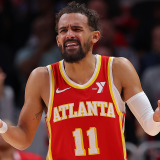
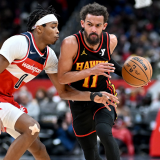
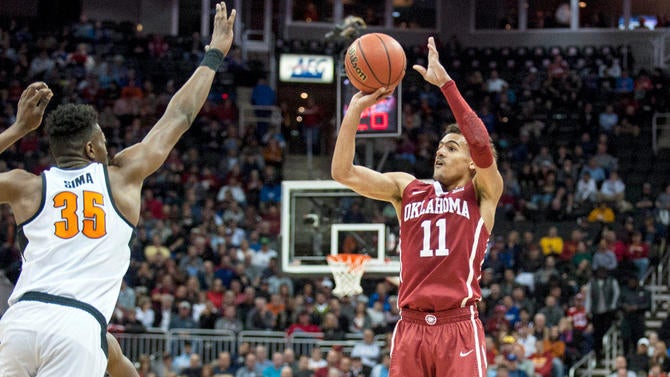
Fast-forward to 2018, and enter Trae Young -- a no-conscience, 19-year-old bomb-launcher cut straight from the Curry cloth. Had the Curry phenomenon, and subsequent 3-point revolution, never happened, Young's potential -- as we tick down to Thursday's NBA Draft in Brooklyn -- would almost certainly be viewed through a more critical prism than the one that currently has him as a potential top-five pick. GMs and scouts would perhaps be more willing to downgrade him for the typical red flags that he's too small, that he's not athletic enough, that he can't play defense. But those are the same things they said about Curry, and nobody wants to make that mistake twice.
Which begs the question: If Curry has forced us to rethink the way we value -- and ultimately draft -- point guards who can shoot, why hasn't Rubio forced us to do the same for point guards who can't?
"Teams think that because these guys are such great athletes, they can just learn to shoot," former NBA All-Star Mark Price told CBS Sports earlier this year. "It's not that easy."
Since 2009, the following perimeter players have all been drafted in the lottery despite real concerns surrounding their shooting: Tyreke Evans, Rubio, Michael Kidd-Gilchrist, Michael Carter-Williams, Shabazz Muhammad, Dante Exum, Marcus Smart, Elfrid Payton, Emmanuel Mudiay, Justise Winslow, Ben Simmons, Kris Dunn, Lonzo Ball and De'Aaron Fox.
The jury is still out on Ball and Fox, both of whom struggled mightily to shoot at times during their rookie seasons, and Simmons is clearly an exception as a 6-foot-10 point guard with otherworldly passing and defensive skills. Other than that, take a look at those names.
Carter-Williams is clinging to a back-end rotation spot on his fourth team in five years. Muhammad, likewise, is barely a NBA player. Exum, though still a bit of an unknown, has proven to be nothing more than a decent backup as he's averaged five points and two assists during his four-year career, two of which have been almost entirely lost to injury. Orlando gave up on Payton and traded him for basically nothing to Phoenix. Denver sent Mudiay packing. Minnesota did the same with Dunn. In three seasons with the Heat, Winslow has fluctuated between borderline starter and borderline unplayable. Evans, a career 31-percent 3-point shooter, has re-lit his career and is now a relatively attractive free agent mostly because, you guessed it, he's become a good shooter.
Is it an oversimplification to suggest that shooting, particularly for point guards, is a make-or-break skill in today's game? Probably. Is there context to all these stories? Of course. But there is a common denominator here: In today's NBA, if you're a point guard, or any kind of perimeter player for that matter, and you struggle to shoot, no matter what other skills you bring to the table, you are in for an uphill battle. We've seen this time and again with not a single one of these aforementioned players -- with the possible exception of Marcus Smart, who is obviously a very good player but is still probably incapable of leading this own team -- even coming close to living up to his lottery-pick billing,
Put simply: If the draft is a gamble, and any decent gambler calculates his odds by factoring in past results, why do teams keep playing with fire with these non-shooting point guards when they have been burned so many times? Fast-forward, again, to 2018, and this time enter Collin Sexton.
Now, before we go any further, let's be clear that Sexton is not a bad shooter. He's pretty good, in fact, from inside 17 feet with a nice little pull-up game off the dribble, but he can look pretty unnatural when he extends even to the college 3-point line, which is three feet shorter than the 23.75-foot NBA line. Range is not going to be a dependable part of his game to start. Furthermore, he shot just 29 percent on catch-and-shoot jumpers in his one year at Alabama, meaning he's not going to be any kind of real threat off the ball any time soon.
That's a big part of this. The most lethal point guards in today's game are the ones who remain dangerous when they give up the ball, who continue to draw attention and ultimately stretch defenses to open up driving lanes with their mere presence, who can come off a pin-down screen as effectively as they can create for themselves off the dribble. Curry is the most obvious example of this, but Damian Lillard, Kyrie Irving, James Harden, Chris Paul and even a guy like Jamal Murray with the Nuggets -- all these players are dual-threat shooters.
It's a small sample size, but this is one of the truly crazy stats entering Thursday's draft:
Trae Young had only 19 uncontested three point attempts as a Freshman.
— TS% Eliot (@Cosmis) June 18, 2018
He made 14 of them.
We know about Young's ability to pull up off the bounce, with a Curry-like hair trigger, from 30 feet and beyond with ease, but this ability to shoot off the ball is a big deal. Your whole offense will run differently because of it. Cutting lanes will magically open up. Defenses will become preoccupied and more prone to lapses. And this is to say nothing for how much easier this makes the game for the shooter himself when he doesn't have to create everything in an isolation setting against a set defender. When Steve Kerr came to the Warriors, one of his foremost initiatives was to get Curry easier shots. He did this by taking him off the ball and running him around screens.
Young can produce in this capacity right away. Are the concerns about his size and defense warranted? Absolutely. The playoffs showed us how important it is to be able to switch any position defensively, and how spotlighted you can be if you can't do that. Come playoff time, a guy like Young is going to be put in a thousand pick and rolls to see if he can guard his lunch against bigger, longer players. Curry has worked his tail off to become a pound-for-pound above-average defender who has shown an ability to hold his own against the league's most elite players. If Young wants to be the next Curry, he'd be wise to immulate his defense as much as his offense.
Still, even if the defense is a problem to start, even if Young can't do anything other than shoot and get creative with his handle for a while, the kid shot 46 percent on all catch-and-shoot jumpers last year despite having defenders draped on him everywhere he went. That's virtually the exact same percentage that Klay Thompson, probably the best catch-and-shoot player in the NBA, put up last season.
Sexton simply can't do this, and there's no real evidence to suggest he'll ever be able to. He's a ball-dominant player who, first and foremost, wants to take his guy one-on-one in a head-down fashion. He's an off-the-dribble, mid-range dependent shooter. And for the most part, unless he's going to become a great cutter and finisher (tall order at 6-foot-3 and lacking touch around the rim), defenses can largely forget about him once he does pass the ball. This severely hampers your ability to affect the whole court, and thus, the whole game, and you often end up standing around waiting for someone just to pass it back to you. Wizards fans know about this with John Wall. As do Thunder fans with Russell Westbrook.
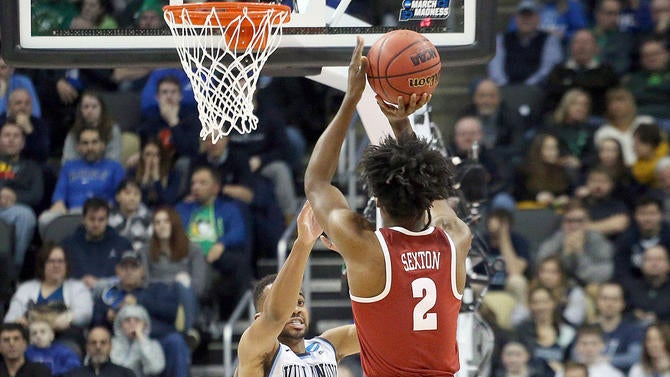
Wall and Westbrook, of course, are world-class athletes, which allows them, depending on how you define these kinds of things, to still play at an elite level despite being poor shooters. You'll hear similar things about Sexton. You'll hear how athletic he is going to the hole, even though he finished just 47 percent of his shots at the rim last year, which put him in the 27th percentile in all of college basketball. You'll hear how confident and aggressive he is, how he has the potential to be an elite on-ball defender.
All these things might be true. Just keep in mind that every one of those aforementioned players who came into the league as a bad shooter also came into the league with evaluation cards doting all over their myriad of other abilities. Carter-Williams and Payton had the height to see over defenses. Mudiay and Evans were brute, get-to-the-rim tough guys. Dunn and Winslow were elite defenders. Rubio was a savant passer. Meanwhile, their draft profiles all mention some variation of "needs to improve his outside shooting" almost as an afterthought, as if it is merely one skill among many and thus doesn't deserve any special weight in the evaluation process. But it does deserve more weight. We've seen this over and over.
"With where the league is at right now, no, I don't think you can be an elite point guard without being a shooter," Warriors guard Shaun Livingston told me earlier this season.
None of this is to suggest that guys can't improve, or that we don't have them misread, for whatever reason, to begin with. Donovan Mitchell, for instance, was seen as a questionable shooter with questionable shooting numbers in his two seasons at Louisville, and thus fell to No. 13 in the 2017 draft. But one Western Conference scout told CBS Sports that he thought all along this was due to Mitchell having to take difficult shots in college as the only real creator on his team. Further, Jazz assistant coach Johnnie Bryant told me that Mitchell is the fastest learner he's ever been around.
Context. Capacity for improvement. These things matter. There are plenty of examples of guys who came in as relatively poor, or at least limited shooters, and eventually turned themselves into solid ones. Jason Kidd. Tony Parker. Mike Conley. Kawhi Leonard. One source close to the league, who has helped advise teams on their draft picks, told me a story about showing up to a summer camp where all the balls were scuffed. When he asked what the deal was, he was told that Kyle Lowry had been working on his shot for the past week or so with those same balls, and let's just say he wasn't hitting all net. Lowry came into the league as a downright awful shooter. He's now borderline elite.
So it can happen. Guys like Sexton, who isn't even 20 years old, can absolutely get better, and to some degree, that should be the expectation now that basketball is a full-time job, particularly when Sexton's work ethic has been touted by so many people. Just keep those expectations in check. Like Price said, anyone can get better, at least marginally, at anything they work at, but to get significantly better at a skill like shooting, which is a born talent like anything else, is easier said than done.
By the same token, to suggest that anyone who's a natural shooter has some kind of free ride to NBA success is to pretend that Jimmer Fredette and Nik Stauskas and Brady Heslip -- who might be one of the purest shooters on Earth yet can't crack an NBA roster -- don't exist. Dynamic shooting is the key -- off the dribble, off the catch, in transition, from deep range and with a soft touch on floaters in the lane. These days you have to do it all, and Trae Young, as a shooter, can do it all. Collin Sexton can't.
Could it really be that simple?
History suggests, yes, it could be that shooting is that important in today's game. Yet here we are, less than 48 hours from the 2018 NBA Draft, with all the evidence of past drafts to inform us, with many experts still predicting Sexton will go ahead of Young, just as Rubio went ahead of Curry in 2009, just as Kidd-Gilchrist went ahead of Bradley Beal and Damian Lillard in 2012, just as Mudiay and Winslow went ahead of Devin Booker in 2015, just as Kris Dunn went ahead of Jamal Murray in 2016. For a league full of people who hate to make the same mistake twice, you have to wonder if someone is about to do it again.