- Draft Prep Tiers: C | 1B | 2B | SS | 3B | OF | SP | RP
- Heath's Sleepers | Breakouts | Busts |
- Scott's Top 100 prospects | Sleepers | Breakouts | Busts
The good thing about Fantasy baseball is, the best teams in real life tend to be the best teams for Fantasy, too. Whereas there are only so many touches and snaps to go around in New England – every touchdown Brandin Cooks scores is one Rob Gronkowski can't – that isn't an issue in Fantasy baseball.
In fact, the best teams often have a multiplicative effect in Fantasy baseball. Every Carlos Correa home run may not drive in George Springer, but at the very least, it keeps the lineup moving, bringing Springer one spot closer to another chance to accrue value. When it comes to lineups that are loaded with talent, the more the merrier.
You don't want to pay for past production in Fantasy, you need to pay for what a player is going to do in the future. You want to catch young players on the upswing, especially if they are about to hit a level they've never been before. Here are 10 hitters who could hit that level in 2018:


In real baseball, Seager is already a legitimate superstar. He was an MVP candidate in 2016, and would have been one in 2017 if not for an injury that hampered his play in the second half.
In Fantasy, however, he's never reached that level. His career .305 average is one of the best in baseball, and no fluke, but his counting stats have left something to be desired -- no more than 77 RBI in any season, a career-high of 26 homers, only 85 runs in 2017, nine career steals… He's been good, but not really great for Fantasy. I don't see him running more anytime soon, but the run production numbers almost have to improve from 2017. The place he really needs to take the next step is with power. Seager's line drive swing makes him one of the best bets for batting average, but in order to take the next step he needs to get into the 30-35 homer range. If he does, there's obvious first-round upside here. First, he needs to hit the ball in the air a bit more.


Buxton's hyper efficient base stealing will always make him a valuable Fantasy option, but the rest of his offensive profile is still closer to replacement level at this point. He strikes out too much, and hasn't proven he can consistently drive the ball when he does make contact. We've seen flashes before -- September, 2016, and the second half of 2017 -- but consistency remains an issue, If he can get the strikeout rate to 25 percent, all of a sudden it's a lot easier to see him hitting .270 with 20-plus homers. Add in a few more steals from being on base more often, and well… it doesn't take a big improvement to get him to second-round value. It just might be the hardest improvement left, however.


Contreras isn't as good of a hitter as Seager, but his limitations are similar. He makes loud contact all over the place, and his pull-happy approach has helped maximize his raw power, too. However, just eight players in the majors hit the ball on the ground more often than Contreras did last season. If all he does is repeats his 2017 but without missing a month due to an injury, you're probably looking at the No. 2 catcher in Fantasy, with a bullet. He'll probably never challenge Gary Sanchez, but if he starts elevating the ball more, we could have a legitimate two-catcher tier at the top.


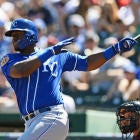
Moncada is pretty much in the same place Buxton was a year ago. He's proven himself in the minors, having logged 125 games with an .855 OPS between Double-A and Triple-A -- Buxton had played 122 games with an OPS around .890 between Double-A and Triple-A at this point last year. However, the majors have been a much tougher test than anticipated, as Moncada's line after 251 plate appearances sits at .229/.331/.399. That's actually better than Buxton's, thanks to Moncada's better patience at the plate. He still strikes out too much, but then again, so did Buxton. If he cuts that to more around the one-quarter mark, as he was in the minors overall, there's still significant upside for this power-speed threat.

It's pretty clear Gregory Polanco was just never healthy last year. He showed improved power in 2016, and he backed it up with an improved batted-ball profile across the board. He was a popular breakout pick, but a shoulder injury got his season off to a bad start in the spring. He also dealt with a groin injury in April, an ankle injury in May, and three different trips to the DL with hamstring issues. Polanco reinvented his offseason workout regiment, and if spring results are any indication, Polanco is about to have a monster season because the 26-year-old is hitting .368/.415/.737 through 13 games. He's batting third for the Pirates, and still has 30-homer, 25-steal potential. I want him in as many leagues as I can get him.


Two seasons into his career, and Mazara is… Just a guy. He's basically produced the same line in each season, hitting .266/.320/.419 as a rookie, followed by .252/.323/.422 in his second season. He has a great spot in a great lineup, and gets to call a great ballpark home, but hasn't shown the ability to take advantage of that yet. Still, this was one of the top prospects in baseball when he got called up, and he won't turn 23 until late-April. He needs to figure out how to at least hold his own against lefties if he's ever going to live up to his potential, but you'd be a fool to write him off yet. We're going to be chasing this guy's potential for years to come, even if he never lives up to it.


I'm all-in on Schwarber this year. I'm usually skeptical of "I'm in the best shape of my life" claims, but Schwarber actually looks great. He's crushing the ball in spring, running well on the bases (four steals!), and is even drawing better reviews in the field so far. If he can hold his own in left field and against lefties, there's no real limit to what Schwarber can accomplish with the bat in his hands. He'll never win a batting title, but he could be a top-10 hitter anyway, thanks to his power in this lineup. We saw big improvements in the second half of 2017, and I'm expecting him to build on them. He's one of the top values on Draft Day right now.

Like a few players before him, Bell needs to start hitting the ball in the air more. He showed the raw power is there in 2017, with a 19.1 percent HR/FB, but he probably showed us his power ceiling with his current approach, as he hit more than half of his batted balls on the ground. The good news is that Bell has been hitting the ball in the air a lot more in spring play, and that's one of those trends that can be predictive even in Spring Training. If Bell becomes a 40 percent flyball rate hitter, you're talking about 30-35 homer potential, and with his contact skills, the batting average should improve, too. He was never much of a power hitter in the minors, but scouts always believed his plus hit tool could eventually lead to above average contributions, and we could be seeing the first signs of that in spring.



These guys are basically the same person. They've shown flashes in the majors, and there's no doubting that they hit the ball hard. The problem is, they haven't hit the ball nearly often enough to take advantage of that. However, Grichuk is on a new team in Toronto, one that has a history of getting the most out of exactly this kind of player. His pull-heavy, swing-hard approach should work well in Rogers Centre, and he has legit 35-plus homer potential.
Soler was absolutely awful in his major-league opportunities last season, posting a .503 OPS in 110 plate appearances. However, he still crushed the ball in Triple-A, and has continued that in spring play. He'll get a chance to play everyday, and despite feeling like he's been around forever, he's only about two months older than Aaron Judge. When you get a chance to bet on elite pedigree late in the draft, take it.