TCU is penning a blueprint every irrelevant power-conference school can follow
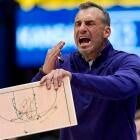
First-year coach Jamie Dixon has the Horned Frogs off to a 13-3 start

By
Gary Parrish
•
3 min read

TCU did something this week that it had not done in 30 years -- i.e., win a men's basketball game at Texas -- and there are lots of reasons why it happened. The most obvious is that Texas is worse and more vulnerable than it's been in a while; no sense in ignoring that fact. But to focus on that is to miss the larger point, and the larger point is this: TCU is a real program now.
These are not your father's Horned Frogs.
They're not even your older brother's Horned Frogs.
TCU was, not too long ago, nothing more than a bottom-tier C-USA program that lost games in anonymity. But the move to the Big 12 enhanced revenue to the point where the school found itself in a position to operate like a true high-major with aspirations, if it wanted. So the administration decided to do it. And now look.
The Horned Frogs are 13-3 with three top-85 KenPom wins and zero sub-30 losses. They're ranked 32nd at KenPom and 35th in the Sagarin. So the record is good and the computers suggest it's not fluky.
But let's back up.
Because you can't properly understand why everything I just typed is true without first understanding what it took to make this happen, and what it took to make this happen is a serious commitment to the sport. It started with a $72 million renovation to what is now known as Schollmaier Arena, but it didn't stop there. TCU's administration also decided to push all-in in all of the ways that matter -- by allowing their coaches and players to travel in a first-class way, by enhancing the recruiting budget, by basically doing everything they had to do to convince a man with Jamie Dixon's resume to accept their head coaching job last March.
Sure, it helped that Dixon is an alum and that Pitt fans had grown oddly tired of a coach who had guided them to 11 NCAA Tournaments in a 13-year span, including three Sweet 16s and an Elite Eight. (Who knew that wasn't good enough for Pitt?) Those things, combined, gave TCU a chance with Dixon that would've otherwise not existed. But understand this: Dixon -- TCU graduate or not, under-appreciated at Pitt or not -- would've never gone to TCU without TCU agreeing to give him every resource necessary to operate like a top-shelf program.
That means chartering flights -- which TCU will do for all but one trip this season, and that's never happened before. And though TCU is a private institution that's not required, and is also unwilling, to provide budget numbers, a source told CBS Sports TCU's investment in basketball now ranks well within the Big 12, and that the school committed to Dixon in ways that it had never previously committed to any coach.
"They've given Jamie everything he needs," another source said.
The result: Dixon became the first TCU coach in history to start 8-0 at the school, has a legitimate chance to take the Horned Frogs to the NCAA Tournament for the first time since 1998, and will enroll a recruiting class this summer that currently ranks third in the Big 12 and 29th nationally, according to 247Sports.
In other words, the present is interesting and the future is bright.
And, like I've said and written before, it should serve as a lesson for most struggling power-conference programs with access to power-conference money, and the lesson is this: The only thing holding you back in this sport is you.
I'm not suggesting any power-conference school can become Kansas or Kentucky, North Carolina or Duke, Arizona or UCLA, Indiana or Louisville. But what I am again insisting is that the majority of power-conference schools have the ability to be consistently relevant in basketball if they A) commit strongly to the sport financially, B) build nice facilities, C) hire the right coach who hires the right staff, and D) provide that right coach and his right staff with the resources to compete.
TCU did it and is now reaping the benefit.
Perhaps your favorite school will be the next to get it right.