Examining how Wizards will handle Bradley Beal and his pursuit of a max deal
The Wizards' guard is going to have one of the most interesting free agency situations this offseason

By
Sam Vecenie
•
6 min read

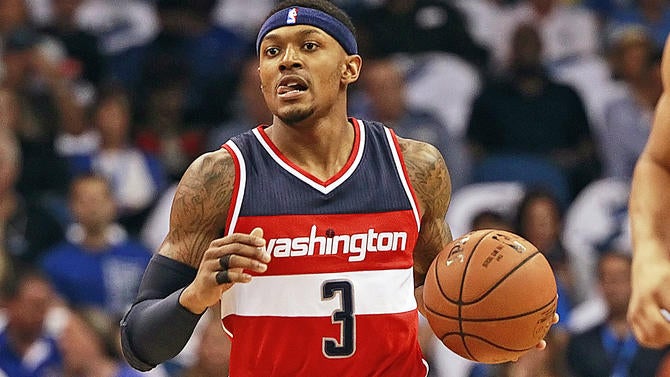
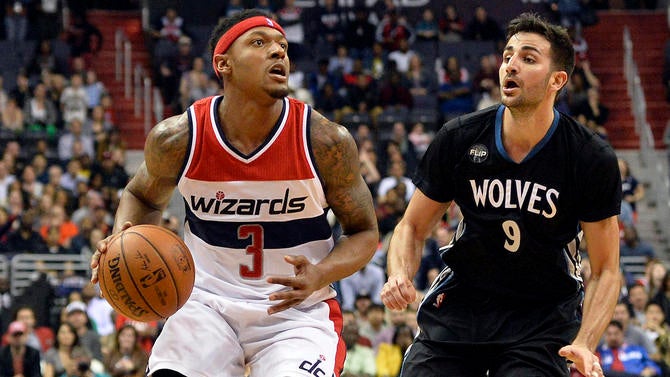
Bradley Beal is going to be one of the more sought-after restricted free agents this offseason, and he knows it.
The 6-foot-5 shooting guard out of Florida will hit the market this offseason with seemingly one goal in mind: to get a max contract, from whoever will offer it to him.
"I want to be valued the right way," Beal told the Washington Post on Monday. "I feel like I'm a max player and that's what I'm looking for. If Washington can't meet that requirement then I may be thinking elsewhere. I'm pretty sure that they probably won't [let me go]. At the end of the day, that's where I want to be. I think a deal will probably get done but you just never know."
Can you blame Beal for feeling this way? He's coming off his best season yet as a pro, averaging 17.4 points on an efficient 54.7 true-shooting percentage to go with 3.4 rebounds and 2.9 assists per game. Over his four years in the NBA, Beal has hit 39.7 percent of his 1,100-plus 3-point attempts with a deviation of only two percent in those seasons. Plus he did all of this before he turned 23 years old, and is only months older than likely 2016 NBA Draft lottery picks Buddy Hield and Denzel Valentine. Basically, Beal is already a consistently elite shooter, he helps a bit in multiple areas of the game and, again, he's still extremely young. Really, the only concern here are the injuries -- particularly to his right leg -- that have forced him to miss 81 games in his first four seasons.
While that propensity to miss games will possibly cause some pause for teams, it's unlikely to cause enough pause to force Beal to miss out on his goal of a maximum contract -- and as I'll explain below, there are ways to create injury insurances. Simply put, the laws of supply and demand will take hold here. There are too many teams that have boatloads of cap space due to the rising salary spike and not enough players to fill it with, as 25 teams could have at least $21.7 million in cap space this offseason, and 19 teams could have upwards of $30 million available to spend.
That's a lot of money sitting around on the market, and Beal is undeniably one of the 10 best assets that could be available. As he notes above, the Wizards likely realize that, and are almost a lock to match whatever contract is handed to him. If Beal is to receive a max contract, it will likely start at approximately $21.5 million (based on the $92 million salary cap estimate that NBA teams are operating under), and he'll receive raises on that level each season. So given that it seems likely that Beal will get a maximum contract offer -- probably from the Wizards when it's all said and done -- why isn't it done yet?
Well, the reason for that has to do with the way cap holds work and the way the Wizards want to chase free agents this offseason. A cap hold is a number that is essentially tied to any free agent that has Bird rights on your team -- the rights that under the collective bargaining agreement allow teams to go over the salary cap to sign a player. Let's attach some numbers to this. Even though Beal will not officially be on the Wizards' roster, he will still count against their cap at a $14.2 million cap hit (his "cap hold") unless they decide to renounce the rights to match any other team's offer to him -- something they will undoubtedly not do.
So why does this matter? Because the Wizards have waited to sign Beal, and they have further wiggle room with their cap space to offer free agents. Particularly, the Wizards will have the difference of the $21.5 million that he would receive as a starting maximum salary and the $14.2 million that he currently counts against the cap to offer to free agents that they otherwise would not have. That's approximately an extra $7.3 million for the team to play with and offer to free agents -- such as Kevin Durant and others Washington will be in the mix for. As long as Beal doesn't sign anywhere else, the Wizards have that extra space. It's the same deal as how the Spurs ended up having enough cap space to sign both LaMarcus Aldridge and Kawhi Leonard to contracts last offseason.
That's where things get a bit tricky though, and where the Wizards really need to walk a tight rope here. Certainly, the team will want to keep that space open as long as possible in order to maximize its talent haul in free agency. However, the Wizards also can't really mess around with Beal, as if he signs with someone else quickly, it starts a clock on the time they have to spend their money. Beal's certainly not at Leonard's level, so while it's likely he'll receive a maximum offer eventually, it's not a foregone conclusion and it could lead to him signing elsewhere in order to guarantee himself one.
The good news for the Wizards is that Beal has significant incentive to wait them out. If he's to sign a maximum contract with another team, he is only entitled to 4.5 percent raises on a four-year contract, taking the deal to a total of approximately four years, $91.7 million given current estimates (again, dependent on where the salary cap exactly falls, these figures are approximate). However, if he waits for the Wizards, the team can offer him 7.5 percent raises and a five-year contract worth approximately $123.5 million, including $95.6 million over the course of the first four seasons (note: as Beal's contract will expire in July, he is no longer subject to the designated player rule).
Whether or not the team would go to a five-year deal is up for debate given Beal's injury history. The team could look to insure itself against another Beal injury, just as the Nets did with Brook Lopez in his previous contract. The Vertical's Chris Mannix reported that the Nets put language into the Lopez deal allowing them to "cut Lopez's salary by 50 percent in 2016-17 and 75 percent in 2017-18 if Lopez suffers another significant injury to the fifth metatarsal in his right foot."
A contract structure like this could be the most beneficial to all parties involved, as it could minimize risk for the Wizards while also potentially maximizing reward for Beal. However, it throws in yet another wrench into the negotiations, as Beal could be offered a deal that features no such insurance language in one contract while another team decides that they want to offer a deal only with that in play. What does he do if he's offered a four-year, fully guaranteed deal from someone else versus a five-year deal that could have injury language in it from the Wizards? It's a tough call given the increased raise structure and extra year, and creates more questions in terms of the above-discussed salary cap situation for the Wizards.
Regardless, it's clear that the Beal negotiations are going to be one of the most-watched this offseason for plenty of reasons, both in terms of the player himself, and the team that currently has his restricted free agency rights. It does seem likely that the Wizards will eventually give him a maximum contract, but the timing and structure is going to be just as important as the offer itself.