In Philadelphia, the Sam Hinkie-led Sixers give 'rebuilding' a bad name
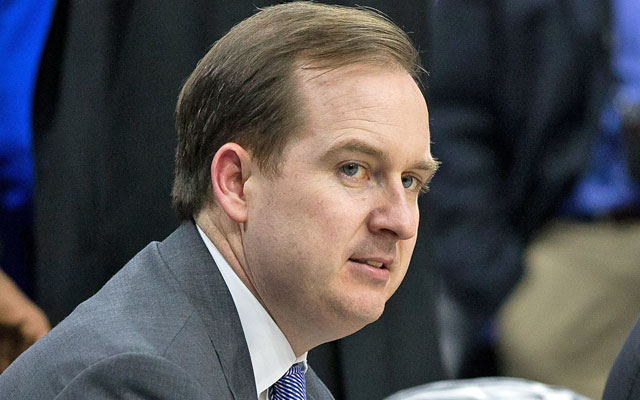
The Sixers are a mess. While Sam Hinkie's ultimate plan is to rebuild this franchise through swapping assets, it's nowhere close to panning out. Instead, it's only creating a negative culture.

By
Ken Berger
•
9 min read

The Philadelphia 76ers last won a basketball game on March 25, more than eight months ago. Granted, no basketball games were played from mid-April through September (at least for teams that didn't make the playoffs, a condition that has become all but permanent for pro basketball fans in the City of Brotherly Love.)
At last, the Sixers' experiment in asset-swapping, draft-pick hoarding, new-age rebuilding or tanking -- call it whatever you want, the results are the same -- has hit rock bottom. This is often the goal when you are taking over a distressed asset, especially when you are a Stanford business grad like general manager Sam Hinkie is, and when you work for a group of private equity billionaires led by managing owner Joshua Harris.
The problem is, the Sixers as a basketball asset are becoming ever-more distressed. Hinkie's plan keeps challenging the depths of rock bottom, with no end in sight (except that the Lakers are coming to town on Tuesday night, representing a glimmer of hope that the home team finally will be able to celebrate an actual victory).
Even if so, it will be a hollow one -- and short-lived. The Sixers have won 19, 18 and zero games in Hinkie's three seasons in charge of the most widespread effort to be bad at everything on purpose outside of the federal government. For the second consecutive season, the team lost the first 17 games it played. Now 0-18, with a 28-game losing streak dating to last season, the Sixers -- a proud organization once represented by Wilt Chamberlain, Billy Cunningham, Moses Malone, Julius Erving, Bobby Jones and yes, Allen Iverson -- hold the record for the longest losing streak in major North American sports.
The previous NBA record, 26, had been shared by the 2010-11 Cleveland Cavaliers (the season after they lost LeBron James to Miami) and the 2013-14 Sixers. Next up, the worst record in NBA history -- 9-73, held by the 1972-73 Sixers.
Let's allow the 2-14 Lakers to breeze through town -- on the first game of an eight-game road trip, with hometown boy Kobe Bryant on his last legs -- before we start wondering if these Sixers might lose all 82.
If they do -- and I'm only half-joking -- will it be viewed as the pathetic, anti-competitive failure that it is? Or the ultimate triumph for a plan whose sole purpose appears to be losing in order to someday win?
"I'm not even sure if it's tanking," said one agent who vows to keep his clients away from the Sixers at all costs. "You have to think they believe it would've turned a little by now."
Yet, with a roster featuring only one player with more than two years of NBA experience -- Carl Landry, who is expected to be sidelined until January following wrist surgery -- the Sixers have what is demonstrably their worst team of the Hinkie era. One rival executive surmised that at least five players on the roster don't belong in the NBA.
"There's nobody there, and nobody will go there," the agent said. "Nobody. Cap space won’t matter. You know who’ll go there? Guys that are trying to steal money."
On the bright side, the man in charge of organizing this mess, Brett Brown, is doing the best 0-18 coaching job in NBA history. The Sixers have lost their last five by a total of 24 points -- all on the road, including a 116-114 loss to the Rockets in which James Harden dropped 50.
Houston is the analytics incubation chamber in which Hinkie's NBA career was born, rising to the position of right-hand man to GM Daryl Morey, founding father of the NBA's money-ball era. And with both franchises struggling -- the Rockets are 7-10 and have already fired coach Kevin McHale -- some executives within the league are beginning to wonder if the analytics revolution has reached the point of being exposed.
"They're like that hedge fund guy that raised the price of that pill from a buck to $750," a somewhat dystopian coaching industry source said, referring to the drug Daraprim, a common treatment for parasites. "They don’t see the human side of the market."
The human side hit the Sixers like a slap in the face over the weekend, when their most important player, Jahlil Okafor, was involved in a fight outside a Boston nightclub. Sixers and NBA security are investigating, and disciplinary measures could be forthcoming.
In subsequent reports, it was revealed that the rookie had been involved in two other recent incidents. According to the Philadelphia Inquirer, Okafor had a gun pulled on him at a Philadelphia nightclub in October. About three weeks ago, Okafor reportedly was pulled over on the Ben Franklin Bridge for driving 108 mph.
The part of the story that was missing was which direction Okafor was driving; I'm guessing toward Jersey, with his bags packed.
While 19 is young for the NBA, it's old enough to be responsible for your own actions. Okafor, the No. 3 pick in the 2015 draft, apologized on Twitter over the weekend.
"I own my choices personally and now publicly," he said.
But the incidents -- combined with the Sixers' incessant losing and lack of veteran leadership on the roster -- have some in the NBA wondering when the organization will take responsibility for its own choices.
"When you’re building a business culture, you're dealing with human beings," another prominent agent said. "Especially with athletes, you've got to have a rapport with these guys. It’s a culture of communication and transparency, and none of that exists."
Last season, the Sixers had veterans Luc Mbah a Moute and Jason Richardson on the roster and still lost 64 games -- third worst in the league. They secured the third pick in the draft for the second consecutive year, selecting Okafor. A year earlier, they had used the third pick on Kansas center Joel Embiid, who has yet to play a minute for the team due to recurring foot injuries.
League sources say Sixers management was comfortable with the medical information it had on Embiid heading into the 2014 draft. The team attributes Embiid's continued absence (he's likely to miss the entire season again) to subsequent setbacks.
Nonetheless, in the third year of Hinkie's rebuilding plan, most of the harvest has yet to come in. Nerlens Noel, the sixth pick in 2013 acquired from New Orleans in the Jrue Holiday trade, missed his entire rookie season but has begun to assert himself as a defensive presence (though not much of an offensive one).
Dario Saric, acquired for 10th pick Elfrid Payton in 2014, remains in Turkey and may not come stateside until 2017, when he would no longer be bound by the rookie wage scale. Michael Carter-Williams, Hinkie's first pick at No. 11 overall in 2013, won Rookie of the Year but was dealt to Milwaukee this past February in a three-team trade that yielded a first-round pick that used to belong to the Lakers. That pick is top-3 protected in 2016 and '17 and unprotected in 2018.
As you begin to unravel it all, the Sixers' asset-swapping reads more like a Goldman Sachs balance sheet than an NBA roster. The human side gets lost, except that players are humans who are represented by other humans called agents.
Case in point: Continuing a practice first popularized in Houston (and most famously with Chandler Parsons), the Sixers offered 2014 second-round pick K.J. McDaniels an above-market, two-year guaranteed deal that would've put him under the Sixers' control for four seasons -- with non-guaranteed minimum salaries in years three and four. Respected agent Mark Bartelstein had no interest in his client being treated like a low-level future trade pawn, so he opted instead for a one-year, non-guaranteed deal.
Bartelstein called Hinkie's bluff, and won. In an example of basketball imitating finance, the Sixers decided to send McDaniels -- where else? -- to Houston at the 2015 trade deadline in exchange for point guard Isaiah Canaan and a second-round pick. McDaniels re-signed with the Rockets this past summer for $10 million over three years.
"Their inability to establish a rapport with agents and probably with other teams is definitely going to lead to their demise," an agent said of the Sixers' regime.
The next big test for Hinkie (if he lasts that long) will involve Okafor, who according to league sources will strongly consider the tactic that Greg Monroe utilized in Detroit last season: signing a one-year qualifying offer and becoming an unrestricted free agent rather than agreeing to extend his rookie deal. That decision is a few years off, but there's no evidence that the Sixers actually will be competitive by then.
"The culture you're building, it's all negative," a league source said. "... This is a five- or six-year plan with no end in sight."
The Sixers' continued advances into the black hole of losing have some agents and executives within the league wondering whether commissioner Adam Silver should step in. Then-commissioner Larry O'Brien did so in the early 1980s when he invoked the Ted Stepien rule -- a response to the clownish Cavs owner making a series of plundering trades that cost the team several years of first-round picks. Under the rule, teams are forbidden to trade away future first-round picks in consecutive years.
But what would Silver do in this case, exactly? There is no rule against stockpiling future picks, which makes Hinkie the anti-Stepien in a way. The Sixers own the rights to use or swap five first-round picks in next year's draft alone. The list of future second-round picks is even longer, stretching all the way to 2021.
The NBA Board of Governors, made up of ownership representatives from all 30 teams, had a chance to reform the draft lottery in 2014 to short-circuit the Sixers' tanking, but the change fell short of the three-fourths vote required for approval.
In the end, what crime has Hinkie committed? Depending on health and the timing of Saric's arrival, the Sixers could have as many as nine first-round picks on the roster next season. This season, they have five drafted players injured and were granted a roster exception to carry 16 players as a result.
On paper, and in theory, it all made sense. When Hinkie took over for former GM Tony DiLeo, he had to contend with the wreckage of the ill-fated Andrew Bynum trade, in which the Sixers sent out Andre Iguodala (who's since become an NBA champion in Golden State), Mo Harkless, Nic Vucevic and a future first-round pick (which Hinkie recouped from Orlando in the Saric deal) -- all for a loopy, injury-prone center who never played a minute for them.
"It all went up in smoke," a league source said. "They didn't have anything left."
But three years later, the new regime has little to show for it except hope, epic amounts of losing and enough transaction receipts covering draft-pick credits and debits to have a ticker-tape parade.
A parade; something the Sixers haven't had in 32 years. If they beat the Lakers on Tuesday night, Sixers fans might just want to gather on Broad Street, index fingers raised in the cold winter air to commemorate victory No. 1. There's no telling when the next one will come.