The Rangers were a bad team Henrik Lundqvist could not save
Before you blame the New York Rangers' playoff loss on goalie Henrik Lundqvist, you should look at the skaters in front of him and the management that assembled them.

By
Adam Gretz
•
5 min read

PITTSBURGH --When you look at Henrik Lundqvist's final playoff numbers this season, as well as the fact he ended up getting pulled in each of the New York Rangers' final two games of their five-game loss to the Pittsburgh Penguins, it would be easy to put the bulk of the blame on him for their dismal showing and early exit.
It would also be incredibly lazy.
It is fair to say that Lundqvist was not at his best this postseason, but that only illustrates what was the biggest problem with the 2016 version of the New York Rangers. They were only going to be as good as Lundqvist would allow them to be, and would only go as far as Lundqvist could carry them.
After Saturday's 6-3 loss Lundqvist talked about being a little embarrassed and feeling "helpless" during a second period Penguins onslaught that saw them score four goals in 15 minutes. But this was not a game, or a series, or even a season you can hang entirely on the goalie.
This one -- all of it -- goes to a combination of the 18 skaters in front of him that were outskated, outplayed and outskilled over their five playoff games (and most of the season), and the management that assembled such a flawed group that was almost 100 percent dependent on their goaltender to bail them out every single night.
The workload he had to face this season because of the team in front of him was almost comical at times.
The Rangers ended the regular season attempting only 47 percent of the 5-on-5 shot attempts (Corsi) and gave up more than 57 total shot attempts per 60 minutes, both among the bottom-five in the entire league (via Hockey Analysis). The reason those numbers matter is because it is the sign of a team that is spending entirely too much time in its own end of the ice defending and chasing the play. Teams that finish as poorly as the Rangers did in those areas not only tend to miss the playoffs, they tend to be among the worst teams in the league.
This season alone there were only four teams that finished the regular season worse than 48 percent Corsi and allowed more than 57 total shot attempts per 60 minutes. The Rangers were one. Ottawa, Arizona and Colorado were the other three. Last year that group included only Toronto, Calgary, Colorado and Buffalo.
Since the start of the 2007-08 season there have been 36 teams that finished with similar numbers. Only 10 of them went on to make the playoffs. Out of the teams that did make it, only five of them ended up winning a round that year and only four of them ended up returning to the playoffs the next season.
In other words: The Rangers did not play like a playoff team this season and the only reason they even made it was because of their goalie.
It was only when he was not at his absolute best that you saw what the 2015-16 New York Rangers were really about.
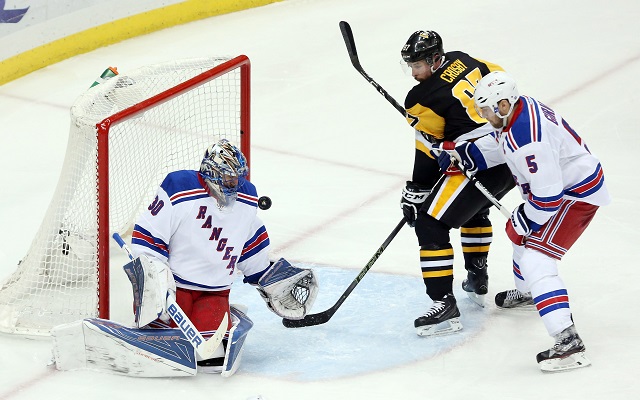
You saw it when Lundqvist slumped through the month of December and the Rangers went on a 18-game stretch where they won only five games. You saw it again in the playoffs.
It is a testament to his game-changing ability that the Rangers were able to collect 101 points during the regular season.
The problems spots on this team are easy to identify. The defense is just ... slow. Ryan McDonagh, Dan Girardi, Marc Staal and Kevin Klein are getting older and are not the players they were even two or three years ago. Making matters worse is that all are signed to long-term deals. That quartet is all under contract for the next three years until Klein's deal expires, and during that time they will take up close to $19 million in cap space (via General Fanager). McDonagh is signed for another year beyond that, while Staal and Girardi are signed through 2020.
Other than Keith Yandle and Dan Boyle (who was scratched on Saturday, a day when the Rangers dressed seven defensemen) there is no real puck-moving threat that can help get the play out of their own end or be any kind of an impact player in the offensive zone. It is possible that both of them will be gone next season as free agents.
You simply can not win in the NHL today with a defense that is that slow on the blue line and can not play the puck. Just look at the way this series played out. The Penguins' defense not only had the speed and skating ability to win races to pucks and quickly and efficiently move it out of the zone, but the speed of the Penguins' forwards simply feasted on the lack of mobility on the Rangers' back end.
Lundqvist acknowledged after the game he needed to be better in Games 4 and 5 and that he just was not up to making the big saves, but also correctly pointed out that with the way the Rangers played and the number of chances they gave up it was going to be difficult to win.
Given the amount of time and space Penguins players had on some of their goals in this series, it was like they were playing a different game. When Rangers' defenders were not running into each other at the blue line as the Penguins soared into the zone, they were simply getting beat.
When a team is as depedent on a goalie as the 2015-16 Rangers were there is a very thin line between success and failure. If that goalie is great it can mask a lot of flaws and make a team think it is better than it really it is. But all it takes is an injury to that goalie, or a slump, or a matchup against a team that is simply superior across the board for everything to completely unravel.
The Rangers' record in the regular season will tell the story of a team that was pretty successful. In the end they were pretty much what the Montreal Canadiens would have looked like if their world class goalie did not get injured.