
How West Virginia has become college basketball's unlikeliest national title threat
Chances are, you can't name a single player on Bob Huggins' squad

•
6 min read

One of the best things about college basketball is its immunity to monotony.
Styles of teams and coaches drastically vary at every level. Every year we get to see, from big-time schools to small-town programs, how you can win (and lose!) with wildly differing philosophies. Watching those differing doctrines slam up against each other is one of the biggest appeals, at least for me, with this sport. The game is fascinating because it is executed so disparately by so many. The sport's garden is constantly dealing with its issues, but the harvest is always colorful and contrasting, something we see grow every January and February.
So let's talk about the roughest vegetable of the bunch, West Virginia. This is the team doing the thing that's hardest in basketball (full-court press with consistency and effectiveness) better than anyone else, and because of that, has turned itself into a national title contender. That's not something anyone outside of Morgantown was predicting in the preseason. Despite mostly consistent success under Bob Huggins, WVU still qualifies as one of the most surprising and under-the-radar teams in the country this season.
Unless you're a WVU fan or absolute college hoops diehard, you can't name one player on this team. Yet the 'Eers might have one of the five best groups in college hoops. The computers certainly think so. For nearly a month WVU has been locked in as a top-five squad at KenPom.com, Sagarin and BPI. The Mountaineers, currently ranked second at KenPom and 10th in the AP poll, improved to 14-2 on Tuesday night with a ferocious 89-68 smackdown of No. 1 Baylor, the biggest margin of defeat for a newly minted No. 1 team in college basketball history.
Huggins' team duped the Bears into 29 turnovers, the most in a game for Baylor in 18 seasons. Yet those 29 turnovers were 11 less than WVU's most devastating defensive effort this season. On Nov. 28, West Virginia pulverized poor Manhattan to the tune of 40 turnovers, pulling off one of the most ruinous defensive efforts of the past 25 years. WVU also induced 34 turnovers vs. New Hampshire and Western Carolina, and had another 29-TO game vs. Radford.
No team in the country aside from West Virginia is top five in offensive and defensive efficiency, and North Carolina -- which is No. 10 in offense -- is the only other squad in the top 10 of both. This is shaping up to be one of Huggins' most well-rounded teams. It's No. 1 in the country in turnover (33.1) and steal percentage (17.4), and forces more turnovers per game (24.6) than anyone. The Mountaineers also don't turn themselves over (they have the sixth-best rate in the country) and are one of the best offensive rebounding teams, too, grabbing 41 percent of their misses, which ranks fifth best in D-I.
Beyond the turnover numbers, why is West Virginia worth watching, worth believing in as a team that can play in Arizona in April? They get in your shirt, make you uncomfortable and play a style that's rarely used -- and almost entirely nonexistent in a continually effective way -- at the college level.
Pressing was once a fashionable mantra. Now it has been reduced to a specialty because deploying a press is exhausting in every sense. You get tired just watching West Virginia smother others. It's hell for opponents, but it's a complete mental commitment for the team that puts in the work behind the scenes, in practice after practice. A press is like a dam: one crack can lead to a torrent.
So you either don't break, which is nearly impossible, or if you do, have a safety net. No team's twine is thicker than WVU's.
There has been plenty written about this "Press Virginia" style, but the misnomer is that this team purely thrives off its press. That's not true. According to Synergy Sports Technology, an essential film- and stat-tracking basketball service, West Virginia runs a press 44.5 percent of the time. Now, that is a heavy percentage, but it's not even half of WVU's defensive possessions. WVU is successful because it is versatile. It utilizes different types of presses, too, and it also isn't beholden to one all-or-nothing philosophy on defense.
You thinking this is an in-your-face, go-go-go, man-t0-man defense 24/7? No. The Mountaineers, per Synergy, have adopted a zone on 106 of their 1,353 defensive possessions this season (12.1 percent) as well. Huggins, who used a flash-and-trap press style at Cincinnati the 1990s, is one of the best defensive coaches ever, and this team is the epitome of his acumen.
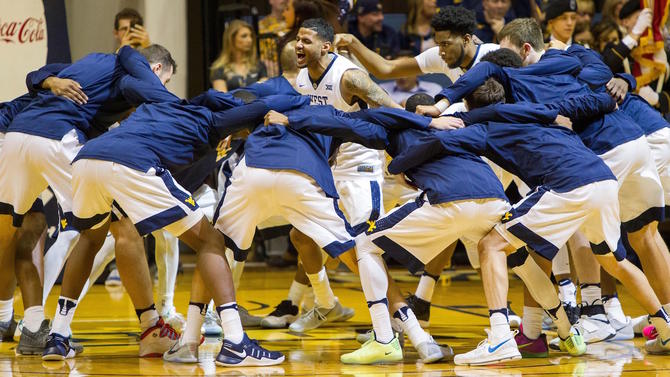
Usually, utilizing a press proves effective in one of two ways: If you full-out commit to it as an every-game thing, or if you drop it out of nowhere and stun an opponent. (See: Syracuse shocking Virginia in last season's Elite Eight.)
Though the 'Eers have some versatility in their defensive looks, they're still by far the most effective, and most reliant, pressing team in America. Only 11 teams have run a full-court press on more than 300 possessions this season. They are:
1. UNC Greensboro (407)
2. West Virginia (389)
3. Texas-Rio Grande Valley (385)
4. The Citadel (382)
5. New Mexico State (369)
6. UNC Wilmington (360)
7. Florida (357)
8. Samford (352)
9. Green Bay (336)
10. Savannah State (333)
11. Mount St. Mary's (319)
These are the teams I would categorize as "fully committed" to a full-court press as the primary pillar of their defensive scheme. West Virginia is empirically the most efficient. Opponents are scoring .56 points per possession against WVU's moving, five-man, 94-foot nightmare. Florida is second, at .70. If you want to extend it out even further, when you account for made free throws, WVU opponents score at least one point just 26.7 percent of the time when facing a press. The next closest is Florida's 31.4-percent rate.
And again, this isn't a team with even one star. Here are the five leaders in minutes: Esa Ahmad, Jevon Carter (the team's best player; could you pick him out of a lineup?), Nathan Adrian, Daxter Miles Jr. and Tarik Phillip. None of those guys are averaging more than 28.2 minutes per game. The only other ranked team that doesn't have a player averaging at least 29 minutes per game: Florida State, which is the only team deeper than WVU.
The past four seasons, at least nine players have averaged 11 minutes or more per game at WVU. Huggins has essentially recruited a hockey-player mentality to the hardwood.
If you're the kind of person who enjoys watching the beautiful get destroyed, there is no better team in America for you than West Virginia.
The devilish aspect is West Virginia's exemption to simulation. Teams cannot run practices with the speed, intensity or pressure they'll go up against when faced with Carter, Miles, Phillip and Co. It's an ersatz imitation. You can only know the real thing when the real thing is breathing down your neck. And even then, the creature adapts. In WVU's best win of the season, a shocking, convincing 66-57 road conquest against stubborn Virginia, the Mountaineers played the Cavaliers' style. A mere 14 turnovers were forced. But it was an emphatic win. Adaptability is the dominant link in a press-minded defense. Anticipate and attack. Virginia tried to change the style and West Virginia still won by nine.
All of this is even more impressive when you consider the element many have forgotten: WVU is doing this while not having the guy who was expected to be its best player. Devin Williams, rec-spec folk hero, turned into one of the best rebounders in the country last season. Then he got tempted and turned pro, leaving his senior season on the vine. Remarkably, WVU hasn't been worse off.
It has been a big year for Huggins. He hit 800 career wins in December. His force of personality has bred a sense of ruthlessness with this team that is compelling to watch and hellish to prepare for. What at first became a madcap philosophy change for Huggins then turned into an authentic counter-attack in the increasingly competitive Big 12. This program wasn't known for its press when Huggins took it over, and now it has established a unique identity and a style of play commanding enough to break through to this year's Final Four.