Eight things we learned about College Football Playoff Committee
Game control. Head-to-head. Non-conference scheduling. These factors and more have played big roles in the playoff committee's thinking.

By
Jon Solomon
•
9 min read
Back in late October, no one knew exactly what the College Football Playoff's weekly rankings would tell us. And truthfully, there are still a lot of unknowns in part because one year's "body of work" by the committee doesn't mean that's how it will operate every year. Situations and committee members change.
All that matters this year is what the committee thinks once every game is played. What got used as a justification one week may be different by the final week. That's the nature of a subjective selection process.
But along the way, the committee provided some interesting decisions and statements for six straight weeks to fill ESPN programming on Tuesday nights. There's no better way to revisit what we think we learned than through committee chairman Jeff Long's own words every Tuesday.
1. Teams can drop without losing a game
This by far has been the biggest message sent by the committee. Being undefeated is no longer the end-all, be-all. In the old BCS world, once you were ranked high, you were not going to drop without losing. In the new playoff world, all bets are off.
When one-loss Oregon jumped undefeated Florida State on Nov. 11, Long said Oregon's trio of top-25 wins, including two on the road, trumped the Seminoles' pair of home wins over top-25 teams. Florida State, which often squeaks out come-from-behind victories against unranked teams, has since dropped to No. 4 while remaining unbeaten.
There are some committee members "that really believe Florida State's ability to overcome the deficits and rally and win and keep winning is a strong statement," Long said on Dec. 2, "and there's others that look at the way those games have progressed, the fact that they've at times struggled against three unranked opponents the last three weeks."
There has been one other instance when a top-10 team dropped without losing. After No. 1 Mississippi State lost to No. 5 Alabama and No. 4 TCU struggled in a win over Kansas, the Horned Frogs fell to No. 5 the next week while Mississippi State stayed in the top 4.
2. Game control matters
On several occasions this year, Long has observed that a certain team "controlled" a game. This soon turned into a new and widely-mocked College Football Playoff term — game control. This concept isn't necessarily wrong to use, but it became awkward for the public to accept. Even some conference commissioners couldn't quite grasp game control, which in part explains why Florida State has dropped in the eyes of the committee.
Long stressed game control is not a criteria and committee members don't use the metric produced by ESPN. It's unclear how often game control is discussed and whether it's used selectively. In one instance, Long praised Alabama for controlling its game against Mississippi State but then explained that the Bulldogs remained in the top 4 in part because "you never felt they were out of it."
Long described game control this way on Nov. 18: "It might be considered somewhat subjective. The committee looks at the game, how the game was played, how close the game was played, whether there were lead changes back and forth, or whether a team was in control from the opening kickoff, or whether they gained control say in the second half and finished out the game."
3. Head to head doesn't necessarily win out
We knew going in head-to-head wouldn't always win out. But this issue is shaping up to become the most controversial aspect of the playoff's first year if No. 3 TCU and No. 6 Baylor both win and TCU remains ahead.
Baylor beat TCU 61-58 on Oct. 11. In the initial rankings on Oct. 28, TCU was No. 7 and Baylor was No. 13. "Head to head is important, but there are other factors that go into it and it's not head to head alone," Long said on Oct. 28, citing TCU's wins over Oklahoma and Oklahoma State and a "close loss" to Baylor.
Ole Miss beat Mississippi State convincingly on Nov. 29, yet the Bulldogs are No. 10 this week and the Rebels are No. 12. Ole Miss has one more loss than Mississippi State, including a 30-0 defeat to Arkansas, which lost 17-10 to Mississippi State. On the other hand, Ole Miss beat No. 1 Alabama, but Long said Mississippi State has a stronger body of work.
Long has uttered the phrase "body of work" on average nine times per post-ranking teleconference over the past month. Even if you vehemently disagree, it's time to accept that "body of work" -- however that's defined -- trumps head-to-head in the eyes of the committee.
4. Beating above-.500 teams really matters
This has been a curious theme cited by Long throughout the year. Entering this week's game against Kansas State, Baylor has beaten only two teams with a winning record. Long noted that TCU has five wins over teams with records of .500 or better, and Baylor has three.
"That's certainly discussed," Long said on Dec. 2. "That's part of their strength of schedule. It's part of their body of work, and the committee is certainly aware that they have two top-20 victories, and those are the only teams that they've beaten with winning records."
Similarly, Long said on Nov. 18 he didn't necessarily agree that Ohio State had suffered a "bad" loss earlier in the year by losing at home to Virginia Tech (6-6 final record, including a loss to woeful Wake Forest). Long has several times noted the committee looks at whether a team's win was against a sub-.500 team.
This is a dangerous measuring stick. The statistic doesn't take into account who the teams at .500 or better beat to obtain those records.
For example, which is the better of the following situations? Baylor's best win is over No. 3 TCU (two wins over teams currently ranked) but Baylor only has wins over two winning teams. On the other hand, Ohio State's best win is over No. 8 Michigan State (no wins over teams currently ranked) but Ohio State has six wins over winning teams.
Ohio State is ranked ahead of Baylor. Many of the winning teams Ohio State beat got over .500 thanks to wins within the Big Ten, which struggled out of conference.
5. Where teams used to be ranked is considered
When Mississippi State stayed in the top 4 after losing to Alabama, the Bulldogs' best argument was they had previous top-10 wins over LSU, Auburn and Texas A&M. Although those teams were starting to lose more games, Long noted that the committee took into account some of Mississippi State's wins came against teams ranked at the time.
On the one hand, one could argue it's the SEC West cannibalizing itself. On the other hand, why in the world should past rankings be a factor if those teams have shown to not be as good as they were when ranked higher?
"Well, it's just something the committee discusses," Long said on Nov. 18. "We know if a team was previously ranked 14, 15, 16, and you know what, teams played differently part of the year. A team that may have been playing very well at the beginning of the season, whether through injuries or level of competition, they're not playing as well. It's not a criteria, but we certainly discuss and know when a team was previously ranked in the Top 25."
6. Injuries do matter -- maybe
A big question this week: If Ohio State wins the Big Ten championship, what will the committee's evaluation be of the Buckeyes now that they're on their third-string quarterback? Braxton Miller and J.T. Barrett were lost to season-ending injuries.
Injuries are part of the game. Should the committee take them into consideration when evaluating teams' results and their chances moving forward?
"Certainly committee members are very interested to watch Ohio State's performance with the backup quarterback, and again, the results on the field will dictate to us how we feel about Ohio State, how they perform in the game, and then how, if we have to project forward, how they will compete," Long said on Dec. 2.
Oregon's only loss was against Arizona in October with a depleted offensive line. "We certainly discussed Oregon's performance without those players in the game and what it meant in the loss to Arizona," Long saidon Oct. 28.
7. Big 12's "One True Champion" motto could be tested
So much for "One True Champion" if TCU and Baylor both win and become co-Big 12 champions. One of the four key factors the commissioners listed for the committee to consider is conference championships. Big 12 commissioner Bob Bowlsby has said the conference won't split the tie between co-champions and pick a favorite.
That's a different tune than Bowlsby said in July at Big 12 media days. "We're always going to apply a tiebreaker to determine who our champion is, because we have to put forth a representative to one of the bowl games," Bowlsby said before the season. "So even though the records may be exactly the same, there's either a head-to-head competition with the same record or there's a tiebreaker imposed. So we always are going to get to the point of a true champion."
Does it matter to the committee?
This was Long on Nov. 11: "Well, yeah, certainly we'd take that into consideration if the Big 12 tells us who their champion is. Certainly, we'd certainly factor that in."
This was Long on Dec. 2: "Well, first we will not determine a champion for the Big 12. We will take the information that the Big 12 provides us. ... We have not had the discussions about what if there's a co-champion."
8. No clear message yet for non-conference schedules
Perhaps Baylor continues to be held back in part because it played three weak non-conference opponents. TCU beat Minnesota out of conference, a better opponent than anybody Baylor played. But as a whole, it's not entirely clear how much value the committee places on non-conference results. Should teams schedule up moving forward or take the chance they can go unbeaten and be aided by their conference schedule?
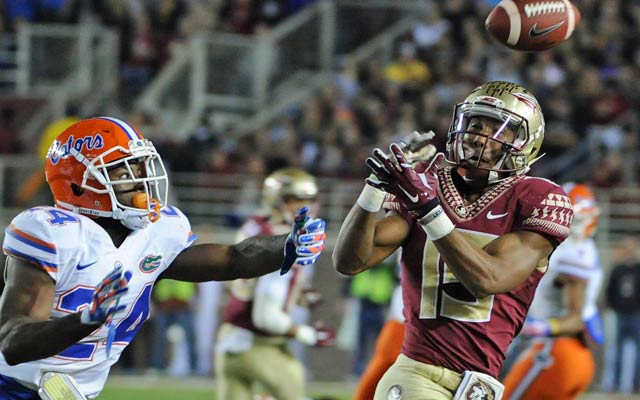
No. 1 Alabama's best non-conference win came over West Virginia (7-5). For No. 2 Oregon, it's a win over No. 8 Michigan State (10-2). No. 3 TCU's best was against Minnesota (8-4). No. 4 Florida State beat Oklahoma State (5-6), Notre Dame (7-5) and Florida (6-5) but none of them had good years. No. 5 Ohio State's best win was over Cincinnati (8-3). And No. 6 Baylor's top win was over Buffalo (5-6).
Clearly, a team's overall schedule matters if it's very poor. Ask Marshall, which was undefeated for a while and couldn't crack the top 25.
"We as a committee are not charged with sending messages to coaches and ADs about scheduling, but I think it's likely that they will see the factors that we take into account and will take a message from that," Long said on Nov. 11.
Long said on Nov. 4 that scheduling intent -- meaning an opponent turned out worse than expected -- had not been discussed by the committee. "We're really looking at the teams and how they performed against those teams and how good those teams were that they either beat or lost to."
After Mississippi State lost to Alabama, the Bulldogs continued to be in the top 4 despite a weak non-conference schedule. "We evaluate the body of work, all 12 games that these teams play, plus if they play a championship game," Long said on Nov. 18.
The body of work is almost done for the committee. The next press conference will be for real and those answers will truly matter.