WATCH: Cubs-Indians World Series Game 6 gets off to a crazy start
Game 6 of the World Series featured a home plate collision in the first inning

By
Matt Snyder
•
2 min read

CLEVELAND -- In a wild first inning of Game 6 of the World Series, the Cubs put a three-spot on Indians starter Josh Tomlin. It all started with a Kris Bryant solo home run.
A blast ... pic.twitter.com/b62CxIMlms
— MLB (@MLB) November 2, 2016
... and a bloop. pic.twitter.com/1v0jDpRJo8
— MLB (@MLB) November 2, 2016
Following that blast, Anthony Rizzo and Ben Zobrist singled. Then came the play that made the inning wild.
Addison Russell put a ball between center fielder Tyler Naquin and right fielder Lonnie Chisenhall. As both were approaching, it looked like either one might be able to make the play. Instead, there appeared to be a miscommunication and the ball dropped in. Zobrist wheeled around third and the relay throw almost got him.
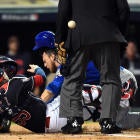
Then this happened.

Zobrist took out catcher Roberto Perez in old-school fashion.
Now, remember that MLB put in a rule to firm up when runners were allowed to run over the catcher. Many mistakenly believed they are forbidden from doing so. Heck, it seems like many players might think this, because you basically never see it anymore.
As Zobrist showed, you can. It just has to be on a so-called "bang-bang" play.
Here's Rule 7.13, which I like to call the Buster Posey Rule:
(7.13) Collisions at Home Plate
(1) A runner attempting to score may not deviate from his direct pathway to the plate in order to initiate contact with the catcher (or other player covering home plate), or otherwise initiate an avoidable collision. If, in the judgment of the umpire, a runner attempting to score initiates contact with the catcher (or other player covering home plate) in such a manner, the umpire shall declare the runner out (regardless of whether the player covering home plate maintains possession of the ball). In such circumstances, the umpire shall call the ball dead, and all other base runners shall return to the last base touched at the time of the collision. If the runner slides into the plate in an appropriate manner, he shall not be adjudged to have violated Rule 6.01(i)(Rule 7.13).
There's also a comment below that includes a passage saying that if a catcher blocks the runner's pathway to home plate, the umpire shall deem the contact unavoidable.
That's exactly what happened with Perez and Zobrist. Perez blocked the plate to catch the throw, which he's allowed to do and Zobrist ran him over, which he's allowed to do.
Quite simply: That was hard, clean baseball as it has long been intended to be played. It was great for baseball that it happened on this grand stage.