
Missouri players provide template for powerful athletes to spark change
A boycott by Missouri football players played a role in the resignation of their university's president. This may be the start of athletes realizing their voice can make a difference, both on the field and off it.

By
Dennis Dodd
•
5 min read

COLUMBIA, Mo. -- Nothing ended here Monday even after the camera crews and their television trucks left town satisfied with the elements of a sound-bitey American drama so compelling Inside Edition covered it.
Mid-America. Race. Football. A hunger strike.
Instead, when Missouri football players went back to practice, it was a continuation -- an ongoing spring awakening, if you will, of all college athletes' collective leverage. It took form here in the forced resignation of Missouri system president Tim Wolfe. Activist group #ConcernedStudent1950 had demanded it over what they said was inattention to racial issues.
In the halls of those who hold the power in college athletics, it was a stunning development. The unpaid labor force had gone beyond the oppressed student vs. free education argument. It used its standing as a group of athletes to force a university CEO out of office.
Essentially, Mizzou football was the deciding factor for Wolfe to resign ahead of hunger striker Jonathan Butler dying. It also continued the ongoing self-awareness college athletes, which began with Northwestern’s unionization movement and Oklahoma's reaction to the SAE taunts.
It just happened to reach a new level here when Missouri football joined in.
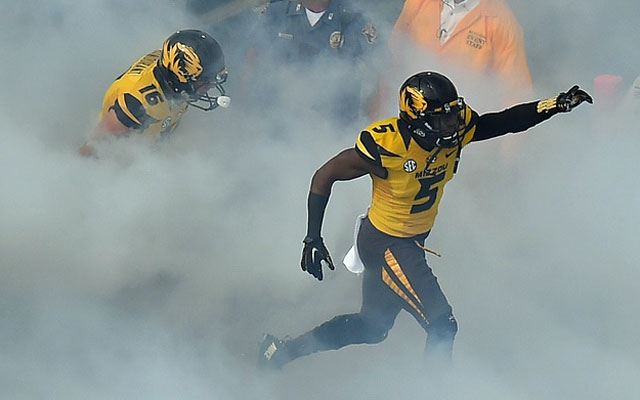
By refusing to play against BYU unless Wolfe resigned or was fired, the Missouri players became as much a part of the story as the racial strife the campus was embroiled in. In fact, they became the story.
"Let this be a testament to all of the athletes across the country that you do have power," Mizzou defensive end Charles Harris said. "It started with a few individuals on our team and look what it’s become. Look where it’s at right now. This is nationally known, and it started with just a few."
A lot of us weren't aware of the strife at Missouri until the football team made its announcement Saturday night. This started as a student protest regarding race relations. It became a national story because of the Tigers, who refused to participate in football-related activities until something substantial was done.
"The future is to let players know all around the world that they need to stand by whatever they believe in," Missouri receiver Ja'Mon Moore said. "We knew from the start change would happen."
Missouri officials tried to paint the action as a one-off.
"Primarily, a young man’s life was stake," athletic director Mack Rhoades said of Butler’s refusal to eat until Wolfe left office. "That was real for our athletes. Our student-athletes, they decided to get involved, and quite, frankly simply we supported them."
But what's next? What if players somewhere -- anywhere -- want winter conditioning at 8 a.m. instead of 6 a.m.? You don't collectively bargain with a football coach. The only wedge college players have is their bodies.
If you don’t have enough of them available, you can't play.
Extra gassers? Have the number limited in some sort of signed agreement. If not? Well, coach, you saw what happened at Missouri, right? The next flap could be something so trivial as enough frozen yogurt on the training table.
We'll let society sort out the nobility of any athlete protest in the future. The point is: it can succeed. It has succeeded. The Tigers have opened the door, or at least kept it open.
The day that began with the resignation Wolfe concluded with the resignation of chancellor R. Bowen Loftin. In between, Missouri players decided to play football again. The local power play was over. The national discussion continues.
"They're [players] not saying they want to unionize," said Berkley Hudson, a member of Missouri’s Faculty Council Committee on Race Relations. “They’re saying, ‘We want respect.' "
The Tigers' drastic actions added to an ongoing narrative -- the player as power broker. To a man, they were genuinely moved by Butler's commitment to his hunger strike.
"Jon Butler looked bad, really bad," Moore said. "When I first talked to him, he collapsed."
But as much Missouri administrators want to make this situation an outlier, it is a trail marker instead of a finish line. This situation didn't begin because of football, but it sure did end because of it.
"When the football players said they were going on strike, that got the [nation's] attention," said Stan Hudson, the Missouri Center for Health Policy associate director. And you had to admire them.
"Mizzou is very, very, very segregated," said Missouri junior Carli Rabon, who is white. "There’s a term called 'Black Mizzou.' They sit in a [separate] spot in the student section. That’s how it is."
You better believe others are watching. Athletes now have multiple templates for protest. The Northwestern unionization movement fizzled, but a point was made. This can happen. After those SAE slurs, Oklahoma players and coaches stood as one. It was absolutely the right statement to lock arms in a show of solidarity.
With so much money priming the system, athletes were bound to act out at some point. You see, it really doesn’t matter where reform comes from, as long as it is right and just.
The suits can talk about that scholarship being enough, but Missouri players took a risk. Technically, they could have lost those scholarships by withholding their services. That might have happened 50 years ago. In 2015, there would have been a riot.
"Nothing else moved Missouri faster than football players not playing this game Saturday. Nothing,” former shoe executive and athletes’ advocate Sonny Vaccaro told CBS Sports' Jon Solomon.
"Not even a guy who was starving himself. If the NCAA and their conferences do not understand what happened at Missouri today, they better stop and figure out what can happen one day when the athletes stand up for their own civil rights and don’t show up for a game. I think eventually it will happen."
In 2013, Vaccaro hinted to CBS Sports that “two specific teams" had considered delaying or not playing in the Final Four as a form of protest of the NCAA in the early 1990s.
Arizona coach Rich Rodriguez recently spoke out about late West Coast games. What Missouri showed him this week was the avenue to pursue: All it would take is for the Wildcats themselves to demand an earlier start time -- or else.
Don't think it could happen? Missouri players put Saturday’s BYU game in jeopardy. The contests themselves are now officially in play because of what happened here.
Doesn’t that matter their pursuit was noble and national spread across multiple platforms -- from civil rights to Inside Edition.
"This is not an ideal way to invoke change," Rhoades concluded. "Our problems of today are our problems of the future."
No one knows what that future holds.
Correction: The word "not" was originally omitted in a quote by Missouri athletic director Mack Rhoades. It changed and misstated the meaning of Rhoades' statement. The quote now reads: "This is not an ideal way to invoke change."
CBS Sports national college football writer Jon Solomon contributed to this story.