U.S. Open 2016: The ending always feels inevitable for Dustin Johnson
Dustin Johnson put on a show at Oakmont over his first two rounds, but we have been here before with him

By
Kyle Porter
•
5 min read

OAKMONT, Pa. -- On the short 318-yard par-4 17th hole on Friday during the second round, Dustin Johnson stood just above the sand behind the green in one of Oakmont's bunkers that seem to run taller than a couple of Rory McIlroys. Johnson was reading a birdie putt and was eye level with the ball. He wrapped his arms around the back nook of the green to steady himself.
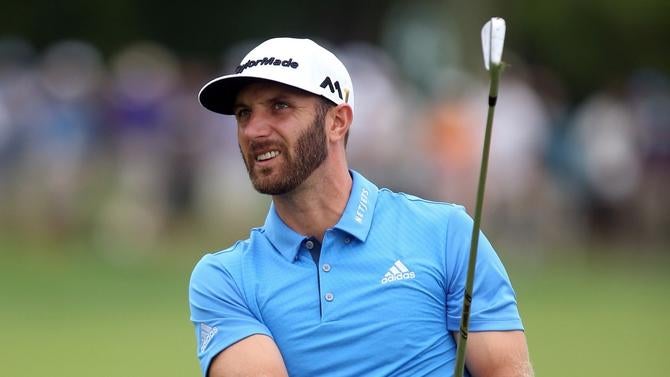
It was the exact same thing he did with the tournament on Friday. Those arms that seem to go on forever scooped this destructive, compelling event up and held on tight. Stop me if you've heard this before: Dustin Johnson took control of the U.S. Open.
He shot 67-69 in his first two rounds, both of which were played on Friday after his Round 1 was rained out on Thursday afternoon. He holds the clubhouse lead at 4 under and shares the overall lead improbably with Andrew Landry as a little over half the field hasn't finished -- or started -- playing Round 2.
Johnson's narratives feel inevitable, don't they? And that's no matter which side of the coin you land on. Whether you think he's a choking dog with no chance at ever winning a major or an outrageous talent who can't not win a major, it always feels like you can touch the ending before it happens.
Johnson played 36 holes of pretty much perfect golf on Friday. He hit 25 straight greens in regulation (a U.S. Open record) and went 27 straight holes without a bogey. He only made one bogey total in 36 holes At Oakmont. In a U.S. Open! He was the only player in the field for Round 1 that played all 18 holes bogey-free. It was the first bogey-free round at Oakmont since 1994.
It was a show he's so often given us. Johnson did it in the first round of the U.S. Open last year, too. He did it at the first two of the British Open. Both of those tournaments ended badly for him. And it usually goes poorly from here, right? Johnson's 2015-16 PGA Tour scoring average by round is not the kind of hockey stick graph you want.
- Round 1: 1st (on the PGA Tour)
- Round 2: 3rd
- Round 3: 77th
- Round 4: 57th
And yet, to watch him hit shots at this U.S. Open is to watch a golfer launch missile after missile over one of the prettiest courses in the nation. Not only do his shots look like attacks on the rest of the field, they sound like them, too. Johnson played with Hideki Matsuyama and Sergio Garcia on Friday -- not exactly the two shortest hitters -- and he clowned them off the tee. He is someone Jordan Spieth recently called "arguably the most talented player on the PGA Tour."
"U.S. Performs Successful Missile Launch" pic.twitter.com/K9yJQdyuYC
— No Laying Up (@NoLayingUp) June 17, 2016
On the 5th hole (Johnson's 14th of the day), Garcia's caddie turned to a group of us writers and said, "I've never seen someone hit it so straight and so long." I thought he was talking about the man whose bag he was on. Nope, he was talking about D.J. Garcia talked about him too afterwards.
"He played awesome," Garcia said of Johnson. "He played really, really well today. It's impressive. He drove the ball great, very far. I don't think he missed many fairways at all. He's going to be tough to beat, but I'll give it a shot."
And I don't really want to hear about the "well, he can't putt" narrative either. People think great putting cures everything. The reality is that approach shots to 15 feet for 72 straight holes cure everything. As Johnson proved for 36 straight holes on Friday, you can two- and three-putt your way to a U.S. Open championship if you hit it like he does. Johnson hit 31-of-36 greens in regulation and took 65 putts (worse than the field average). It didn't (and won't) matter. He still leads.
But this is where narratives and history go awry for me. I'm acutely aware of all of Johnson's past failures in majors, and yet, I watch him bomb drives and stick long irons on a track as pure as this one and I think, "How could he ever lose this tournament?" It's a foolish thought to entertain, I admit, but the ending always feels inevitable.
Dustin Johnson played 36 holes today with only one bogey, earning him the @Lexus Top Performance of the Day.https://t.co/rYJeZJlhfC
— U.S. Open (USGA) (@usopengolf) June 18, 2016
Friday was perfect for him, too. Johnson, of all golfers, is built to play 36 holes in a single day. Anything that can remove the long distance between his first drive of the tournament and his 280th or 281st shot of the tournament is good. So it's no surprise he flourished on this long grind of a day. He simply let his outrageous talent take over. The question will be whether he can hold steady and push the gas. He probably wishes they could have played all 72 holes on Friday. He would have won by 10.
"It was a long day today, but I felt like I played really solid all day for all 36 holes," said Johnson. "I drove it really well, hit a lot of great iron shots, felt like I rolled the putter really nicely, too. So very pleased with how it went today."
One moment on this long day at Oakmont stood out to me. In the middle of the second round, as Johnson made the turn from No. 18 to No. 1 (he started on the back nine for Round 2), he strutted in front of a bevy of Oakmont Country Club members, PGA Tour players and family sitting on the veranda just outside the Oakmont clubhouse. He walked the path from the 18th green to the first tee.
Those looking on gawked and gaped and looked as if they were peering in through the looking glass. In a lot of ways, they were. There is nobody like Dustin Johnson on the PGA Tour. Nobody who swings like him. Nobody who plays quite like him. He's a unique animal, a peerless beast, a show.
As Johnson pummeled his tee shot on the first hole and traipsed after it all arms and legs and unfathomable talent, Oakmont's thick hills rolled and rolled into the rest of Pennsylvania. A striped red and white smokestack rose in the distance as the tournament unfurled in front of him. He had no one in front of him on the hole or the leaderboard. He was all alone. The entire thing -- the tournament, the day and the week -- seemed to be within his grasp. He owned the place.
The end for Johnson always feels inevitable no matter what you believe in the beginning.