U.S. Open 2016: Weather delivers increased difficulty not needed at this major
Rickie Fowler and others struggled to find a rhythm in a wet first round, and that angst could continue into Friday

By
Kyle Porter
•
4 min read

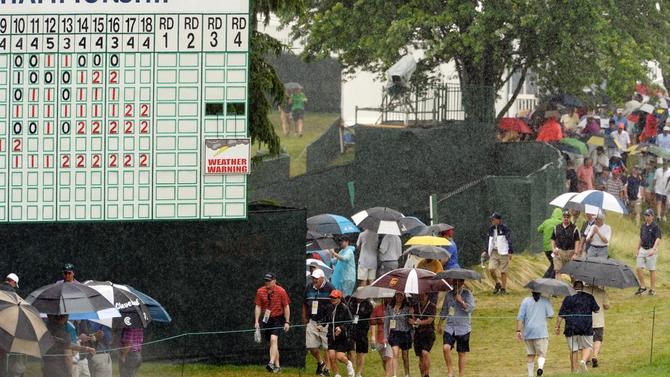
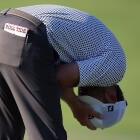
OAKMONT, Pa. - As the weather horn was pounded for the third time in the first round on Monday at the U.S. Open, Rickie Fowler looked to the British Open-like sky hovering dark and low over the 13th green and spread his arms wide. I'm not sure if he was saying, "Why us, again?" or "Where were you six hours ago when I was even par and not 6 over?" Either one was appropriate.
Fowler played with Rory McIlroy and Masters champion Danny Willett on Thursday morning-turned-afternoon as all three struggled through more stops and starts at Oakmont than a Charles Barkley golf swing. The first weather delay happened in the morning, lasted an hour, and players didn't get to warm up before being rolled back out on the hardest course in the country for some more fun.
They were less than pleased. Bernd Wiesberger vented on Facebook.
"Thanks USGA for that short notice restart without the option to warm up again after one hour of sitting around," wrote Wiesberger. "Just wondering if you gonna pull the same stuff again after this thunder has passed...!"
But the USGA stood by its decision to push players back out despite no time to loosen up their bodies.
Former USGA president Tom O'Toole says not letting players warm up after hour-plus delay "reasonable under the circumstances." #USOpen
— Brian Wacker (@brianwacker1) June 16, 2016
The second delay came shortly thereafter and lasted much longer. This time, a full range session was allowed. Golfers took advantage, and the morning wave looked to finish up its quickly unraveling first 18 holes. Only nine players finished before a third deluge came. This one was strong enough to suspend play and bump Round 1 into Friday. It kept 78 golfers from teeing off at all on Thursday.
The issue here is not so much the fact that some golfers will likely have to play 72 holes in 72 hours starting Friday, it's that those golfers who ducked in and out of the clubhouse all day on Thursday never found a rhythm to their games.
"It's a little frustrating whenever you've got to deal with this," said Kevin Streelman. "But it's the same for everybody, and you just got to try and stay mentally tough and stay patient and maintain your rest."
Except that it's not the same for everybody. The afternoon wave never had to deal with the stops and starts.
"The hard part, it's tough to get into a rhythm, obviously," said Fowler.
"The hardest part for me was getting loose," added clubhouse leader Scottie Scheffler at 1 under. "After the first one, we didn't have much time to stretch other than walking out to the hole. So that was the challenge.
Others tried to bear down and not let the rain and changing conditions affect them.
"You can't really control the weather," said Lee Westwood, who is 1 under through 13 holes. "The U.S. Open is a test of patience. This just adds to it. So try and get your head around it and make the best of it."
There are always bad and good draws at major championships. They are sometimes worth a stroke or two depending on when wind blows or rain falls. That's not a lot, but sometimes it's enough to swing trophies and legacies in one direction or another.
Oakmont has a few water hazards Thanks to all the folks in the Palmer suite let's hope tomorrow is better day pic.twitter.com/JRvr3C9WG6
— Ryan Burr (@RyanBurr) June 16, 2016
This time around, it's likely the bad draw is going out early on Thursday and late on Friday. Early Thursday-late Friday will have to have played around 10-18 holes on Thursday with constant resets and might have to bleed their Friday rounds into Saturday morning. It's difficult enough to keep the focus for five hours during a major round, much less over the course of two-and-a-half days.
The late Thursday and early Friday draw isn't exactly good, but it's certainly better. Those players, including Phil Mickelson and Jason Day, will probably play 36 straight holes on Friday afternoon. That's brutal, but at least there will be some rhythm to their rounds.
— Amanda Balionis (@Amanda_Balionis) June 16, 2016
Plus, they will likely know going in the type of course they will have to play. As Scheffler noted on Thursday afternoon, the changing weather conditions added to the difficulty.
"There's definitely some scores out there to be shot," said Scheffler. "It's tough with the adjustments that we had to make during the round. We're used to playing short to all these pins, and now we've got to worry about controlling our spin. And you've really, really got to be on the fairway to attack these pins again."
Mickelson predicted something like this on Wednesday in a very Mickelson-ian way.
"I love a quote that Stephen Hawking says: 'Intelligence is the ability to adapt to change,'" he recalled, "and that's going to be critical here at Oakmont because, as the conditions change, the tee shots are going to change."
Conditions certainly changed a lot on Thursday which was probably not as quickly as Mickelson thought would be the case and not the direction (greens slowing down, not speeding up) he considered. But such is life at an Open. Golf's ultimate grind tests so much more than your swing or your putting stroke.
It measures your ability to stay patient and to stay grounded (and not just because lightning is striking all over the place). Opens don't need an extra level of difficulty but these players got one anyway. This means the next three days will be dogged, tough golf. Players will battle fatigue, heat and long days. They will battle a wicked course and some apparently unpredictable weather.
So keep looking to the skies, Rickie. You might not find any answers, but this tournament will keep questioning how deep you need to dig.