Here are the three people critical to deciding Dodgers-Nationals NLDS Game 5
Max Scherzer will have to conquer lefties, while Dave Roberts can't Showalter his bullpen again

By
Jonah Keri
•
5 min read

Dodgers. Nationals. One game for ... well, some of the marbles.
Here are three factors to watch in the deciding Game 5 of this National League Division Series matchup.
The Nats have their ace going, while the Dodgers don't.
Advantage ... Dodgers?!
Some of the debate regarding whether or not the Dodgers should use Clayton Kershaw on short rest in Game 4 revolved around what a potential Game 5 matchup would look like. By using their ace for that game, the Dodgers would have to settle for either rookie Julio Urias in his first career playoff start, or talented but oft-injured lefty Rich Hill on short rest himself.
Hill has since been given the nod, and he'll face Nationals ace Max Scherzer on full rest in a win-or-go-home game. Given that Scherzer is one of the game's most dominant starters (and my NL Cy Young pick for 2016), the Nats would seem to have a huge edge.
Not so fast, my friends.
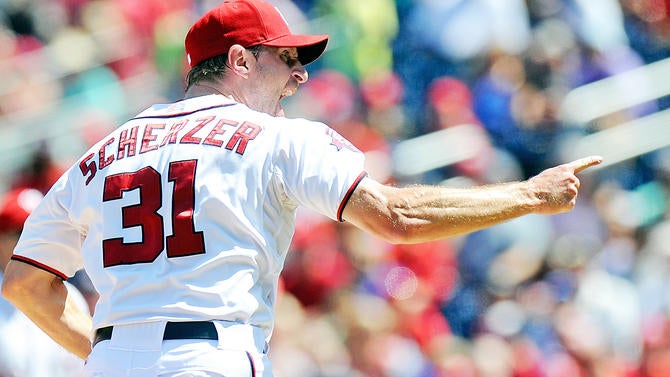
First, consider Scherzer's repertoire. A hard-throwing right-hander, more than three-quarters of Scherzer's repertoire consists of his fastball and slider, both of which are murder on right-handed hitters. The result is a huge split in his results against right-handed and left-handed hitters.
| RHH vs. Max Scherzer | LHH vs. Max Scherzer | |
| 2016 | .156/.189/.288 | .242/.315/.442 |
| 2013-15 | .193/.243/.318 | .232/.286/.378 |
In short, left-handed hitters facing Scherzer this year put up stats similar to Troy Tulowitzki's full-season line. On the flip side, right-handed hitters facing Scherzer this year hit like Diamondbacks pitcher Robbie Ray ... except a little worse than that. Even if we use the larger three-year sample from 2013-15 as our guide, we still see a pitcher who's good but beatable against lefty hitters, and a nightmare for righty hitters.
As luck would have it, the Dodgers stand poised to take advantage of that split. Among the four possible platoon splits (lefty hitters against righties or lefties, righty hitters against righties or lefties), the team fared best (by a mile) when their left-handed hitters faced right-handed pitchers this year. In those situations, Dodgers' lefty hitters batted an excellent .276/.348/.470, about the same line that Tigers second baseman and four-time All-Star Ian Kinsler produced this year.
Even those numbers don't tell the whole story, due to some of the Dodgers' in-season moves. Most notably, the Dodgers acquired outfielder Josh Reddick from the A's at the deadline, in the process nabbing a left-handed hitter who batted a terrific .322/.386/.485 vs. righties this year (and an abysmal .155/.212/.155 vs. lefties). Reddick is being strictly platooned by the Dodgers and will form part of a lefty-dominant lineup against Scherzer. When the Dodgers faced the big right-hander in Game 1, they touched him up for four runs in six innings, scoring a 4-3 victory. And at the risk of invoking the small sample size gods, this NLDS matchup has underscored how much better the Dodgers fare when right-handed pitchers take the mound.
Dodgers in NLDS Vs RHP: .259/.351/.424; 4 HR, 12 runs scored, 14% hard-hit rate
— Alex Cora (@ac13alex) October 12, 2016
Vs LHP: .152/.263/.261; 1 HR, 3 runs scored, 9% HHR.
Dave Roberts needs to be more like Terry Francona, and less like Buck Showalter.
I've already said plenty about Buck Showalter's incomprehensible decision to save dominant closer Zach Britton for a situation that never actually happened, and about Terry Francona's shrewd and aggressive use of ace reliever Andrew Miller in many spots that are more useful than traditional save situations.
Dave Roberts' Game 4 in-game decisions weren't Showalter-level bad ... but they weren't great either. In the bottom of the sixth, I wondered why Roberts had opted to have Kershaw bat, given the Dodgers could summon a pinch-hitter to potentially pad their 5-2 lead, and given that Kershaw had already delivered six quality innings on short rest, and had a history of getting gassed late in playoff games even under more favorable circumstances. Left in for the start of the seventh, Kershaw proceeded to load the bases on two singles and a walk, reaching his 110th pitch (again, on short rest) before getting pulled.
You could at least see the basic idea behind riding Kershaw: When you've got the best pitcher in the world on your team, you ride him as long as you can. Not to mention that the Dodgers' bullpen had been heavily used in the two previous games, a situation exacerbated by a rainout that made Game 4 the third game in three days for both teams.
But if Roberts wanted to follow that same train of thought, how can we explain his decision to bring in Pedro Baez to replace Kershaw and face dangerous Nats outfielder Jayson Werth with the game potentially hanging in the balance?

Baez was probably Roberts's third-best option in that spot. The second-best option was Joe Blanton, the veteran right-hander who limited right-handed batters to a line of .198/.250/.337 this year and steamrolled the league from August 1 on, save for one stray inning on the season's final day in a meaningless game (for the Dodgers) against the Giants. The best option was Kenley Jansen, who despite getting roughed up in Game 3 has established himself as one of the four or five best relievers on the planet.
Even if the Gospel of the Closer dissuaded Roberts from tapping Jansen (28 other, non-Francona managers would've probably and wrongly done the same), the combination of pushing Kershaw to the point where failure became almost inevitable, then picking Baez to try to bail the team out made for a puzzling combination of choices. The Dodgers predictably paid the price, as a Werth HBP against Baez, followed by Daniel Murphy's two-run single off lefty Luis Avilan, wiped out L.A.'s lead.
Chase Utley would save the game, and the Dodgers' season, with a go-ahead, two-out single in the eighth, thus preventing Roberts from having to answer for his curious decision-making (and winning a championship belt for himself). But if the Nats hold a subtle advantage in the deciding Game 5, it might be that Dusty Baker (Dusty Baker!) could outmanage his counterpart in the other dugout.
Bryce Harper needs to be Bryce Harper.
He pulled off a pretty strong Ted Williams impression last year, batting .330/.460/.649, the best showing by a 22-year-old hitter since the Splendid Splinter himself. Harper looked poised to duplicate that performance this year, batting .318/.434/.818 with nine homers and 24 RBI in his first 20 games.
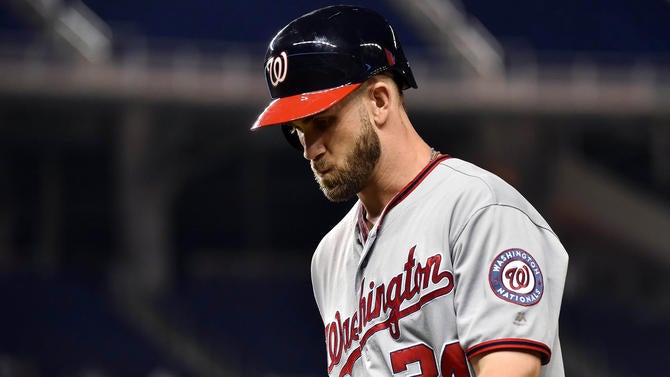
That was it for any hopes of 2016 dominance. From Game 21 to the end of the season, Harper batted a measly .232/.364/.384 -- and just .226 overall this year against left-handed pitchers. He's been even worse so far in the playoffs, batting just .214 with one extra-base hit in these first four games (albeit with an encouraging four walks). Rich Hill's illegal curveball will be a bear to handle too.
With a great batting eye even when nothing else is going right, Harper could still help his team even if he, say, goes 0 for 2 with a couple of walks. But if there was ever a time for Harper to break out of his five-and-a-half-month slump, Thursday's elimination game would be it.